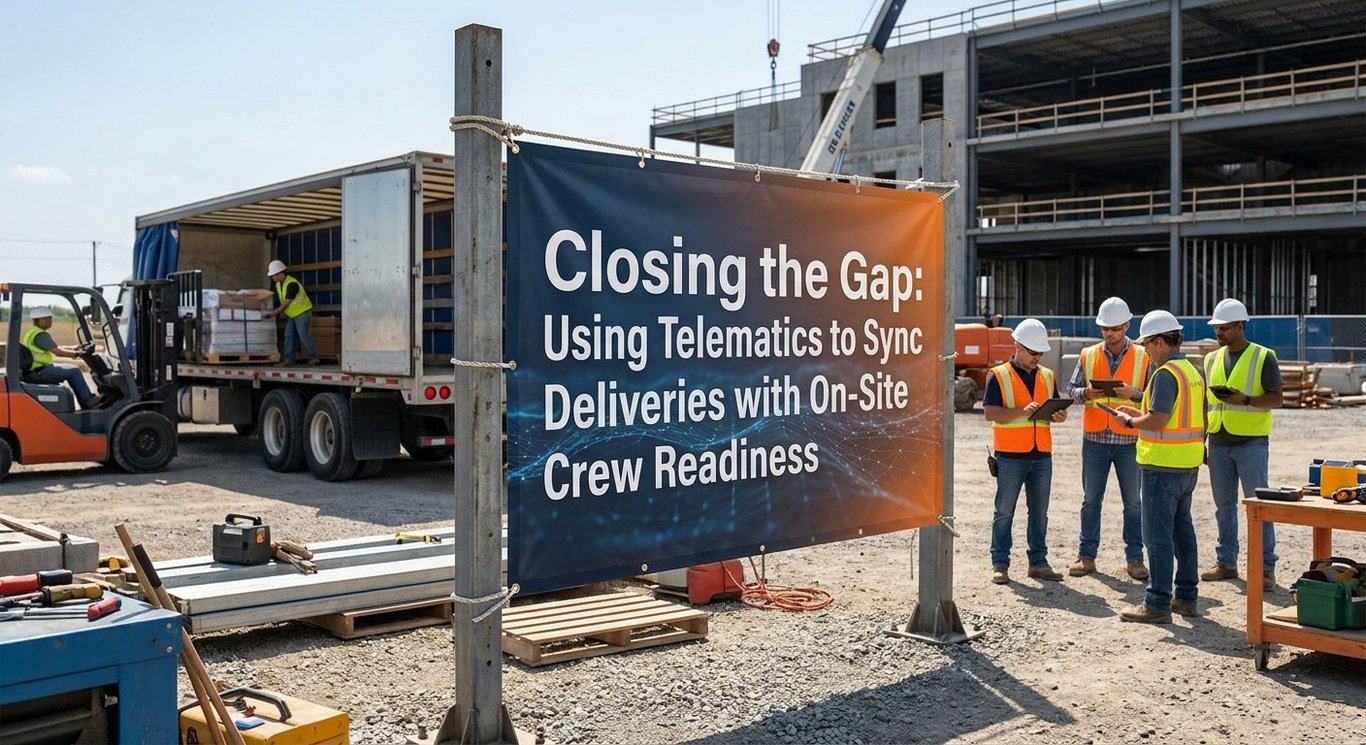

Construction projects are complex, fast-moving, and full of variables that can derail even the best-laid plans. Equipment breaks down without warning, materials go missing, deliveries arrive late, and crews end up standing around waiting for something to happen. But a new generation of connected tools – fleet telematics, materials tracking systems, and integrated project-management platforms – is giving construction teams the ability to see problems coming before they turn into expensive disasters. The predictive job site isn’t a futuristic concept anymore; it’s a practical operating model that leading contractors are already using to stay ahead of delays, cost overruns, and safety incidents. 🏗️
For decades, construction management was largely reactive. Something went wrong, and then you fixed it. As project complexity has grown and margins have tightened, that approach simply doesn’t cut it anymore. Companies are moving toward data-driven decision-making because the cost of being caught off guard is too high. In this article, we’ll walk through the full picture of what a predictive job site looks like – covering equipment health monitoring, material visibility, logistics coordination, workforce planning, safety improvements, implementation strategy, and return on investment. By the end, you’ll have a clear roadmap for making your job sites smarter and more resilient.
What Is a Predictive Job Site?
A predictive job site is a connected construction environment that continuously collects and analyzes operational data to forecast problems before they happen. Rather than waiting for an excavator to break down or a critical material delivery to fall through, the predictive job site uses real-time signals and historical patterns to anticipate equipment failures, material shortages, delivery conflicts, productivity issues, and schedule risks. Every machine, shipment, and workflow becomes a source of actionable intelligence that helps project teams make smarter decisions earlier. 📊
It’s important to understand how this differs from the approaches most companies already use. Preventive maintenance, for example, follows fixed service intervals – you change the oil every 250 hours regardless of what the engine data actually shows. Predictive management goes further by using actual operating conditions, real-time utilization data, diagnostic fault codes, and historical failure patterns to prioritize action. Instead of servicing every asset on the same schedule, you focus resources on the equipment that genuinely needs attention, and you catch problems that a calendar-based approach would miss entirely.
Why Construction Companies Need Proactive Management
The financial impact of poor visibility on a construction site is staggering. Unplanned equipment downtime can idle entire crews, push back critical path activities, and trigger expensive equipment rentals at short notice. Misplaced materials lead to duplicate orders, frustrated workers, and wasted hours searching laydown areas. Late deliveries create cascading schedule disruptions. Fuel waste from excessive idling quietly drains the budget. Safety incidents generate costs that go far beyond the immediate response. And inaccurate progress reporting means project leaders are making decisions based on outdated information – which almost always leads to bad outcomes. Each of these problems chips away at project margins, and together they can turn a profitable job into a money-losing one. 💸
A big part of what makes these problems so persistent is fragmented information. Fleet managers, superintendents, suppliers, subcontractors, and accounting teams are all working from different systems – or no systems at all – and there’s no shared view of what’s actually happening on the job site. By the time a problem reaches the right person, it’s already too late to prevent it. A unified operational view that connects the office and the field changes this dynamic completely. When everyone is working from the same data, coordination improves, decisions get made faster, and intervention happens before small issues grow into major disruptions.
How Fleet Telematics Creates Equipment Visibility
Fleet telematics is the foundation of equipment visibility on a modern construction site. At its core, a telematics system uses GPS and onboard sensors to collect a continuous stream of data from vehicles and equipment – including location, engine hours, fuel consumption, utilization rates, idle time, geofence activity, driver behavior metrics, and diagnostic trouble codes. This data is transmitted to a cloud-based platform where it can be viewed, analyzed, and acted on by project managers, fleet coordinators, and maintenance teams from anywhere. Think of it as giving every piece of equipment a voice that reports on its own health and performance in real time. 📡
One of the most powerful aspects of modern telematics is the ability to create a single operational record across an entire fleet. Whether you’re managing a fleet of delivery trucks, excavators, wheel loaders, cranes, or portable generators spread across multiple active projects, telematics pulls all of that information into one place. Instead of chasing down equipment status through phone calls and spreadsheets, managers can see the full picture at a glance. This unified view is what makes cross-project resource sharing, proactive maintenance, and accurate cost tracking actually possible at scale.
However, not all telematics solutions deliver the same level of insight. Basic asset tracking tells you where a machine is, but location alone is not enough to manage a construction fleet effectively. Advanced telematics adds layers of context – utilization patterns, maintenance history, fault code severity, fuel efficiency trends, and project-cost allocation. Without this additional data, you’re essentially just watching dots move around a map. The real value comes when you can answer questions like: Is this machine working productively or just sitting idle? Is it due for service? Is it assigned to the right project? Is it burning more fuel than it should? Those are the questions that drive better decisions.
Which Telematics Data Matters Most?
Not all telematics data is equally useful, and knowing what to focus on can save a lot of time and confusion. The highest-value data points for construction equipment include engine hours, total operating hours, idle time percentage, fuel consumption rates, active fault codes, hydraulic pressure or temperature alerts, harsh braking events, unauthorized movement notifications, and geofence entry and exit records. Each of these measurements tells a specific story about how a machine is being used and whether it’s at risk of a problem. Fault codes in particular deserve close attention – many failures give advance warning through diagnostic alerts long before they cause a breakdown. ⚠️
The real power comes from combining these measurements rather than looking at them in isolation. A machine with high idle time, elevated fuel consumption, and a recurring fault code is telling you something very different from a machine that’s running efficiently with clean diagnostics. By layering these data points together, managers can identify underused assets that should be redeployed, spot abnormal operating patterns that suggest operator issues or mechanical problems, flag equipment that’s accumulating hours faster than expected, and prioritize maintenance before failures occur. This kind of multi-dimensional analysis is what separates a truly predictive approach from simple monitoring.
Predictive Maintenance: Preventing Equipment Failures Before They Happen
Predictive maintenance takes the data collected by telematics and turns it into a forward-looking maintenance strategy. Rather than waiting for something to break or following a rigid service calendar, predictive maintenance uses live diagnostic readings, sensor data, manufacturer recommendations, historical work orders, and actual equipment utilization to identify assets that are showing signs of elevated failure risk. The goal is to intervene at exactly the right moment – early enough to prevent a breakdown, but not so early that you’re wasting parts and labor on equipment that didn’t need service yet. 🔧
“The construction industry is among the least digitized.” -McKinsey
When a telematics system flags an abnormal condition, the workflow that follows is just as important as the alert itself. A well-designed predictive maintenance process moves quickly from detection to action: the system identifies an abnormal condition, a maintenance coordinator assesses the severity, a work order is created and assigned to a technician, the required parts are sourced, downtime is scheduled at a time that minimizes project impact, and completion is verified with updated records. This workflow needs to be clearly defined and consistently followed – otherwise, alerts pile up without action and the predictive system loses credibility with the people it’s supposed to help.
The key distinction between predictive maintenance and traditional calendar-based service is prioritization. With a fixed-interval approach, every asset gets serviced on the same schedule regardless of its actual condition. With a predictive approach, you’re constantly evaluating which assets carry the greatest operational risk and focusing attention there. This means a heavily used excavator on a critical path activity gets priority over a generator that’s been running lightly and showing clean diagnostics. The result is better use of maintenance resources, fewer surprise breakdowns, and a fleet that’s always ready when the project needs it.
Building a Predictive Maintenance Program
A predictive maintenance program is only as good as the data that feeds it. Accurate asset records are the starting point – every piece of equipment needs a clean, consistent profile that includes its make, model, serial number, configuration, and operational history. From there, you need reliable maintenance histories, inspection results, diagnostic code logs, operating hour totals, parts usage records, and technician notes. Without this foundation, predictive algorithms have nothing meaningful to work with, and alerts will be unreliable or irrelevant. Getting your data house in order before you invest in advanced analytics is not optional – it’s essential. 📋
Once the data foundation is in place, the next step is establishing the operational framework that turns data into action. This means defining alert thresholds for key conditions like temperature, pressure, and fault code severity. It means setting maintenance priority tiers so that critical equipment gets faster response times. It means creating escalation procedures for high-severity alerts and establishing spare-parts policies that ensure common components are available when needed. And it means defining the key performance indicators – such as unplanned downtime rate, mean time between failures, repair cost per asset, and maintenance compliance percentage – that will tell you whether the program is actually working.
Using Materials Data to Improve Jobsite Control
Equipment is only half the story. On most construction projects, materials represent a massive portion of total project cost, and poor materials management is one of the leading causes of delays and budget overruns. Materials data can track the full lifecycle of every component – what was ordered, when it was manufactured, when it shipped, when it arrived at the gate, how it was inspected, where it was stored, when it was moved, and when it was installed. Having this information available in real time gives project teams a level of control over their supply chain that simply wasn’t possible before digital tracking systems existed. 📦
[cta-call:Call2]
The technologies that enable materials tracking have become increasingly practical and affordable. RFID tags allow individual components to be scanned automatically as they move through gates and laydown areas. Barcodes and QR codes support manual scanning with standard mobile devices. GPS-enabled logistics platforms provide real-time shipment location from the supplier’s yard to the job site gate. Supplier portals allow vendors to update delivery status directly. Drone surveys can verify inventory quantities across large laydown areas. And connected inventory systems tie all of this together into a single materials database that the whole project team can access. Each technology has its own strengths, and many projects use a combination of approaches depending on the type and value of the materials involved.
The benefits of real-time material visibility go well beyond simple tracking. When teams know exactly where materials are and what condition they’re in, they spend far less time searching laydown areas for misplaced components. Duplicate orders – a surprisingly common and expensive problem – become much rarer when the system shows that a material is already on site. Theft and damage are easier to detect and document. Storage congestion decreases because deliveries can be timed to match actual need rather than arriving all at once. And disputes with suppliers over delivery status become much easier to resolve when there’s a clear digital record of when each item arrived and how it was received. 🎯
“A 2010 US Department of Energy guide synthesising older facility evidence reported a possible 30-40% predictive-maintenance opportunity versus reactive-heavy operations and 12-18% for preventive maintenance.” -Maptrack
From Material Delivery to Installation
Thinking about materials as a lifecycle rather than a series of disconnected events is one of the most important mindset shifts in modern construction management. A well-designed material tracking workflow begins at procurement – when the order is placed and the expected delivery window is established – and continues through fabrication status updates, shipment tracking, gate arrival scanning, laydown area placement, quality inspection, internal movement, and final installation confirmation. Each step in this chain generates a data record that can be used to answer questions, resolve disputes, and plan future work with greater confidence.
The real magic happens when material status is connected directly to the construction schedule. Instead of delivering everything to the site at once and hoping it gets used in the right sequence, teams can align deliveries with specific work packages and installation windows. This reduces the amount of material sitting on a crowded site at any given time, which in turn reduces the risk of damage, theft, and disorganization. When the schedule shifts – as it inevitably does – the materials plan can shift with it, keeping deliveries synchronized with actual work progress rather than an outdated original plan.
Connecting Fleet, Materials, and Project Schedule Data
Fleet telematics and materials tracking are powerful on their own, but they produce dramatically greater value when they’re connected to the broader project ecosystem. Integrating these data streams with scheduling platforms, BIM models, ERP systems, procurement tools, timekeeping applications, maintenance management software, and project cost systems creates a unified operational picture that no single system could provide alone. This integration is what enables truly predictive management – the ability to see how a problem in one area will ripple through other parts of the project before it actually happens. 🔗
The cross-system insights that become possible with integrated data are genuinely game-changing. Imagine being able to see that a delayed material delivery will leave a crane standing idle for two days – and using that information to either expedite the delivery or redeploy the crane to another project. Or being able to check whether another active project has an available excavator that matches the specs needed for an urgent task, rather than rushing to rent one at full market rate. Or matching equipment utilization records with installed quantities to understand the true productivity of each work package. These kinds of insights are only possible when fleet, materials, schedule, and cost data are speaking the same language.
Making these integrations work reliably requires careful attention to the technical details. Shared asset identifiers – consistent naming conventions that allow the same piece of equipment or material to be recognized across multiple systems – are absolutely critical. Standardized terminology prevents confusion when data crosses system boundaries. Accurate timestamps and location data ensure that records can be properly sequenced and mapped. API integrations need to be maintained and monitored to prevent data gaps. And clear data ownership – knowing which system is the authoritative source for each type of information – prevents conflicts and duplication that erode trust in the data.
Predicting Delays, Bottlenecks, and Resource Conflicts
One of the most valuable applications of integrated project data is the ability to forecast schedule disruptions before they materialize. By combining historical project performance data with real-time signals from equipment, materials, weather services, and workforce systems, project managers can identify early warning signs of schedule slippage, equipment shortages, material delivery gaps, weather-related access constraints, and labor bottlenecks. Instead of discovering a problem on the morning it was supposed to be resolved, teams can see it coming days or weeks in advance – when there’s still time to do something about it. ⏰
The practical value of predictive alerts is that they enable scenario planning before a crisis hits. When the system flags a potential conflict, project managers can evaluate alternatives: Can the work be resequenced to avoid the bottleneck? Can the delivery window be adjusted to prevent a crew from going idle? Is there rental equipment available that could fill a gap if a critical machine goes down? Can subcontractor crews be shifted to a different activity while they wait for materials? Having the data to answer these questions in advance – rather than scrambling for answers in the middle of a disruption – is what separates proactive management from reactive firefighting.
“Upstream tracking and tracing (“upstream tracking” in brief) aims at proactively communicating production, shipment, and delivery information and updates from vendors and suppliers to project stakeholders.” -Construction Industry Institute
Dashboards and alert systems play a crucial role in making predictive data actionable, but they need to be designed thoughtfully. A system that sends dozens of notifications a day will quickly be ignored by the people it’s supposed to help. The most effective approach is exception-based alerting – surfacing only the conditions that require a specific decision or action, prioritized by their potential impact on the project. Managers should receive a short list of prioritized actions each morning, not a flood of disconnected data points. The goal is to make it easy to know what to do next, not to overwhelm people with information. 📱
Improving Productivity Through Utilization and Idle-Time Analysis
Telematics data tells a very honest story about how equipment is actually being used – and that story is often different from what project teams assume. A machine that appears busy might actually be spending 40% of its time idling. An excavator that’s supposed to be on Project A might be sitting unused on Project B. A fleet that seems appropriately sized for the workload might have significant excess capacity that’s costing money in ownership and maintenance without contributing to production. Utilization analysis cuts through assumptions and shows exactly what’s happening, which makes it a powerful tool for improving dispatching decisions, right-sizing the fleet, making smarter rental decisions, and conducting more accurate project closeouts. 📈
Idle-time reduction is one of the fastest ways to recover value from telematics data. Excessive idling wastes fuel, accelerates engine wear, and contributes to unnecessary emissions – all with zero productive output. Reducing idle time requires a combination of strategies: coaching operators on the real cost of idling, implementing automatic shutdown policies that turn off engines after a set idle period, improving equipment staging so machines don’t have to wait as long between tasks, optimizing haul routes to reduce travel time, and matching equipment size and capacity to the actual demands of each work task. Even modest improvements in idle time across a large fleet can add up to significant fuel savings and extended equipment life.
Safety, Compliance, and Security Benefits
Fleet telematics isn’t just about productivity and cost – it’s also a powerful tool for improving safety on and around the job site. Speed monitoring helps identify operators who are driving too fast for site conditions. Harsh-event detection flags sudden braking, sharp cornering, and aggressive acceleration that can indicate unsafe driving behavior. Seat-belt compliance reporting ensures that operators are protected. Geofencing alerts notify managers when equipment enters restricted areas or moves outside designated zones. And unauthorized-use alerts catch instances where equipment is being operated outside of approved hours or by unauthorized personnel. Together, these capabilities support a safety culture that goes beyond posted rules to actual behavioral accountability. 🦺
Materials data also contributes directly to job site safety in ways that are easy to overlook. Knowing exactly where hazardous materials are stored – and ensuring they’re in compliant, properly labeled locations – reduces the risk of accidental exposure. Maintaining accurate inspection records for lifting equipment, rigging, and structural components ensures that nothing goes into service without proper verification. Tracking material availability against lifting plans prevents situations where crews attempt to improvise with the wrong components. And confirming that all required materials are on site before a work package begins eliminates the rushed improvisation that so often leads to safety shortcuts.
Compliance is another area where data-driven management pays dividends. Driver hours records, maintenance documentation, equipment inspection logs, and safety event reports all need to be accurate, complete, and readily accessible for regulatory audits. Digital systems make this far easier than paper-based alternatives. However, compliance also extends to the data systems themselves. Data retention policies need to meet regulatory requirements. Worker privacy rights need to be respected, particularly around driver behavior monitoring. Cybersecurity controls need to protect sensitive operational and personnel data. And access controls need to ensure that only authorized users can view or modify records. These aren’t afterthoughts – they’re fundamental requirements for operating a responsible predictive job site. 🔒
How Predictive Analytics Supports Better Cost Control
One of the most significant financial benefits of integrated operational data is the ability to understand the true cost of work packages – not just the budgeted estimate, but the actual cost based on what equipment was used, how much fuel it consumed, what repairs were needed, how many rental units were brought in, how much material was consumed versus wasted, and how many labor hours were spent. When equipment hours, fuel records, maintenance costs, rental invoices, material quantities, and labor timesheets all flow into a connected cost system, project managers can see exactly where money is going and compare it against planned values in near real time. This visibility is what makes meaningful cost control possible, rather than discovering variances weeks later through monthly reports. 💰
“Research has shown us that materials account for approximately 50-60% of a construction project’s cost.” -Matrak
The specific cost indicators that matter most will vary by project type, but some of the most universally useful metrics include cost per operating hour for key equipment, fuel cost per production unit, repair cost by asset, material waste percentage, expedited freight charges, rental avoidance savings, and the fully loaded cost of unplanned downtime. Tracking these metrics consistently – and connecting them to specific work packages, equipment types, and project phases – allows companies to identify patterns over time. Which equipment types consistently run over budget? Which project types have the highest material waste? Which delivery suppliers generate the most expedited charges? These insights inform better estimating, better procurement decisions, and better fleet management on future projects.
Implementation Roadmap for a Predictive Job Site
The most common mistake companies make when pursuing a predictive job site is starting with technology instead of starting with a business problem. Before selecting any platform or purchasing any hardware, take the time to identify the specific pain points that are costing you the most – whether that’s unplanned equipment breakdowns on critical path activities, materials that can’t be found when crews need them, fuel costs that are running well above budget, or schedule delays that aren’t being caught until it’s too late to respond. Starting with a clear problem statement keeps the implementation focused and makes it much easier to measure success. 🎯
A phased rollout is almost always more effective than trying to transform everything at once. Begin by establishing data standards – consistent asset naming, unit definitions, and location taxonomies – that will allow different systems to communicate reliably. Then select a pilot project that’s representative of your typical work but manageable enough to learn from. Equip priority assets with telematics devices, digitize material receiving and tracking processes, integrate the core systems that need to share data, train the users who will interact with the platform daily, and evaluate results carefully before expanding. Each phase builds on the last, and the lessons learned in the pilot will make subsequent rollouts much smoother.
Measurable targets are what turn a technology initiative into a business improvement program. Before you go live, define specific, quantifiable goals: reduce unplanned downtime by a certain percentage, improve equipment utilization from its current baseline, cut idle hours by a specific amount, increase inventory accuracy to a defined level, reduce expedited deliveries by a target number per month, or improve maintenance compliance from its current rate. These targets give the implementation team something to aim for and give leadership a clear way to evaluate whether the investment is delivering value. Without defined targets, it’s very easy for a well-intentioned program to drift without producing measurable results. 📏
Selecting Telematics and Materials-Data Technology
Choosing the right technology platform is a critical decision, and the evaluation criteria go well beyond features and price. Hardware durability matters enormously on construction sites – devices need to survive dust, vibration, moisture, and extreme temperatures. Connectivity options need to match the environments where your equipment operates, including areas with limited cellular coverage. Sensor compatibility determines which types of equipment can be monitored and how deeply. Battery life affects how frequently devices need attention. Offline functionality ensures that data is captured even when connectivity drops. Mobile usability determines whether field teams will actually use the system. Integration capability dictates whether the platform can connect to your existing systems. And total cost of ownership – including hardware, software, installation, training, and ongoing support – needs to be evaluated honestly against the expected benefits. 🛠️
Beyond the feature checklist, construction companies should insist on real-world testing before committing to a platform. Does the system maintain reliable connectivity in remote locations where cellular signals are weak? Does the hardware hold up in harsh environments – extreme heat, cold, mud, and vibration? Does it work across a mixed fleet that includes equipment from multiple manufacturers? Can subcontractors use the system without requiring extensive IT support? Does it handle projects with inconsistent connectivity gracefully, or does it fall apart when the signal drops? The answers to these questions will tell you far more about whether a platform will work for your specific situation than any sales demonstration ever could.
Preparing Employees and Subcontractors for Adoption
Technology is only as useful as the people who use it, and adoption is often the hardest part of any digital transformation. Effective training needs to be tailored to each role – operators need to understand what the system monitors and why it matters for their daily work; superintendents need to know how to interpret utilization and alert data; mechanics need to understand how to respond to maintenance flags; warehouse teams need to master the material scanning workflows; procurement staff need to see how delivery tracking connects to their ordering decisions; project managers need to understand how to use dashboards for schedule and cost decisions; and executives need to understand how to read summary metrics and make investment decisions based on them. Generic training rarely sticks – role-specific training that connects directly to the decisions each person makes every day is what drives lasting adoption. 👷
“E&C firms are turning to digital control towers that provide real-time visibility from supplier to site.” -PwC
Adoption concerns are real and need to be addressed honestly rather than dismissed. Workers may worry that telematics is primarily a surveillance tool rather than a productivity aid. Operators may feel that behavior monitoring is unfair or invasive. Field teams may resist additional scanning tasks if they feel the data never leads to any visible improvement. Alert fatigue can set in quickly if the system generates too many notifications that don’t require action. And people across the organization may fear that data will be used to assign blame without context rather than to improve processes. Addressing these concerns requires clear communication about how data will and won’t be used, visible follow-through on the improvements the data enables, and a consistent message that the goal is better outcomes for the whole team – not just more management oversight.
Data Governance, Accuracy, and Cybersecurity
Even the most sophisticated predictive analytics platform is useless if the underlying data is inaccurate or inconsistent. Inaccurate asset names make it impossible to match equipment records across systems. Missing work orders create gaps in maintenance history that undermine predictive models. Duplicate material records lead to incorrect inventory counts and bad ordering decisions. Incorrect location data sends people to the wrong place. Inconsistent units – hours versus minutes, gallons versus liters, tons versus pounds – create calculation errors that compound over time. These data quality problems are mundane and unglamorous, but they are absolutely the most common reason that predictive systems fail to deliver on their promise. 🗂️
Good data governance means putting people and processes in place to keep data accurate, consistent, and trustworthy over time. This starts with assigning clear data ownership – specific individuals who are responsible for the accuracy of specific data types. It includes regular validation of sensor readings to catch hardware malfunctions before they corrupt the data record. It requires standardized naming conventions that are documented, communicated, and enforced. It involves periodic audits of records to catch and correct errors before they propagate. And it means defining retention rules – how long different types of data are kept, where they’re stored, and who can access them – that balance operational needs with privacy and compliance requirements.
Cybersecurity is a growing concern for construction companies as more operational data moves to cloud platforms and connected devices. Role-based access controls ensure that users can only see and modify the data they need for their specific responsibilities. Multifactor authentication protects accounts from unauthorized access even if passwords are compromised. Secure API integrations between systems prevent data from being intercepted or manipulated in transit. Device management policies ensure that telematics hardware is properly configured and updated. Vendor security assessments verify that technology partners are protecting your data with appropriate controls. Regular backups protect against data loss. And documented incident-response procedures ensure that if something does go wrong, the team knows exactly how to respond. 🔐
Measuring the Return on Investment
You can’t measure improvement without a baseline, and establishing that baseline before implementation begins is one of the most important steps in the entire process. Before going live with any new system, document your current performance across the metrics you’re trying to improve. How many unplanned downtime hours does your fleet experience per month? How much do emergency repairs cost on average? What is your current fuel consumption per operating hour? What percentage of equipment time is spent idling? How long does it take crews to locate materials when they’re needed? How large is your typical inventory variance at project closeout? How often do you pay expedited freight charges? How frequently do you incur rental costs for equipment you didn’t plan to need? These baseline numbers are the foundation against which you’ll measure every improvement the system delivers. 📊
Once the system is live and operational, calculating the return on investment requires connecting avoided costs and productivity gains to specific operational changes. Avoided equipment failures translate directly into avoided downtime costs and emergency repair expenses. Reduced fuel consumption from idle-time reduction shows up in the fuel budget. Improved asset utilization reduces the need for rentals and allows the fleet to be right-sized over time. Fewer expedited material shipments cut freight costs. Reduced theft and loss improve inventory accuracy and reduce replacement spending. Improved labor productivity – from having the right equipment and materials available when needed – shows up in reduced labor cost per installed unit. And more accurate project forecasting reduces the cost of schedule overruns and the management time spent dealing with surprises. When these benefits are aggregated and compared against the cost of the technology, the ROI case for a predictive job site is typically very strong.
Common Challenges and How to Overcome Them
Despite the clear benefits, implementing a predictive job site is not without its challenges. Disconnected legacy systems that don’t share data are one of the most common barriers – many construction companies have separate platforms for fleet management, maintenance, ERP, scheduling, and procurement that were never designed to work together. Incomplete or unreliable data undermines predictive models before they can deliver value. Limited connectivity in remote or underground locations creates gaps in real-time monitoring. Legacy equipment without built-in telematics capability requires retrofit solutions. Inconsistent participation from subcontractors creates blind spots in the operational picture. Unclear ownership of data and processes leads to accountability gaps. Upfront technology costs can be difficult to justify without a proven ROI. And resistance to process change – which is really resistance to the discomfort of doing things differently – is present on almost every implementation. 😤
Fortunately, practical responses exist for each of these challenges. Starting with a focused pilot project limits the scope and risk while generating the proof of value needed to build organizational support. Retrofit telematics devices extend monitoring capability to older equipment that lacks built-in connectivity. Offline workflows ensure that data is captured even when connectivity is unreliable, syncing automatically when a connection is restored. API integrations can bridge legacy systems without requiring full replacement. Simplified field forms and mobile scanning workflows reduce the burden on field teams. And tying alerts directly to clear responsibilities – so that every notification has an obvious owner – prevents the diffusion of accountability that often causes alerts to be ignored.
One of the most important lessons from successful predictive job site implementations is that data volume does not equal insight. Companies sometimes assume that collecting more data automatically leads to better decisions, but the opposite is often true – too much data creates noise that obscures the signals that actually matter. The most effective approach is to start with a small number of high-value decisions that the data needs to support, design the system around those specific decisions, and expand only after the initial workflow is producing measurable results. Adding complexity before the foundation is solid almost always leads to frustration, low adoption, and wasted investment. 🎯
Future Trends in Predictive Construction Management
The predictive job site of today is impressive, but the trajectory of technology suggests that what’s coming next will be even more transformative. Artificial intelligence and machine learning are already beginning to improve the accuracy of failure predictions and schedule forecasts by identifying patterns in large datasets that human analysts would never spot. Computer vision systems can monitor site activity through cameras and flag safety hazards, productivity issues, and quality problems in real time. Digital twins – virtual replicas of physical assets and project sites – allow teams to simulate scenarios and test decisions before implementing them in the real world. Autonomous equipment is moving from research projects to commercial deployment on certain site types. Connected wearables monitor worker health and location. Drone-based progress verification is replacing manual quantity surveys. And increasingly automated procurement and maintenance workflows are reducing the administrative burden on project teams. 🚀
Looking further ahead, the future predictive job site will operate as a fully integrated intelligence system that combines operational data from equipment, materials, and workforce with project plans, weather forecasts, production rate models, supplier performance histories, financial data, and the accumulated performance records of hundreds of previous projects. This system will not just flag problems – it will recommend specific actions, ranked by expected impact, with enough context for project leaders to make confident decisions quickly. The shift from data collection to decision support to autonomous recommendation is already underway, and the construction companies that invest in building the data foundation today will be best positioned to take advantage of these emerging capabilities as they mature.
FAQ: The Predictive Job Site
What is a predictive job site?
A predictive job site is a connected construction operation that uses real-time and historical data to anticipate equipment failures, material shortages, safety risks, productivity issues, and schedule disruptions before they affect project delivery. By continuously analyzing data from telematics systems, materials tracking platforms, and project management tools, teams on a predictive job site can act on early warning signals rather than reacting to problems after they’ve already caused damage to the schedule, budget, or workforce. 🏗️
How does telematics help construction companies?
Telematics provides construction companies with real-time visibility into asset location, utilization rates, engine hours, fuel consumption, idle time, driver behavior, and diagnostic fault conditions. This information allows fleet managers and project teams to improve equipment dispatching decisions, schedule maintenance before failures occur, reduce fuel waste, detect unauthorized equipment use, improve operator safety, and allocate equipment costs accurately to specific projects. The result is a fleet that’s better utilized, better maintained, and significantly less likely to cause unplanned disruptions. 📡
Can telematics predict equipment failure?
Yes – telematics can identify abnormal operating patterns, elevated temperatures, unusual fuel consumption, and diagnostic fault codes that indicate a higher-than-normal risk of equipment failure. When these signals are combined with maintenance history and manufacturer recommendations, maintenance teams can often intervene before a breakdown occurs. That said, predictive accuracy is not perfect and depends on several factors: the quality and coverage of the sensors, the completeness of the maintenance history, the type and age of the equipment, the operating context, and how quickly and consistently the maintenance team responds to alerts. Telematics dramatically reduces the frequency of surprise failures, but it doesn’t eliminate them entirely. ⚙️
How does materials tracking reduce construction delays?
RFID tags, barcodes, QR codes, and connected logistics systems give project teams a real-time view of where every material is in its lifecycle – whether it’s been ordered, is in fabrication, is in transit, has arrived at the gate, has been inspected, is in storage, or has been installed. This visibility helps crews locate components quickly when they’re needed, identify missing or delayed items before they become critical, coordinate deliveries to match actual work sequences, and prevent the all-too-common scenario where a crew shows up ready to work and has to stop because a required material isn’t available. The result is fewer idle crews, fewer schedule disruptions, and a much more organized job site. 📦
How should a construction company begin using predictive jobsite data?
The best starting point is to select one specific, high-value problem – such as unplanned equipment downtime or excessive time spent searching for materials – and pilot a focused solution on a single representative project. Before going live, establish clear baseline metrics so you can measure improvement objectively. Standardize the data definitions and naming conventions that the system will rely on. Train the users who will interact with the platform on the specific decisions the data will support. Measure results carefully after a defined pilot period. And only expand the program to additional projects and use cases after you’ve confirmed that the initial workflow is producing real, measurable value. Starting small and proving value quickly is almost always more effective than attempting a large-scale transformation all at once. 🚀
Conclusion
The predictive job site represents a fundamental shift in how construction projects are managed – from reacting to problems after they’ve already caused damage to anticipating them early enough to prevent that damage from occurring. Fleet telematics improves equipment visibility by providing continuous data on location, utilization, condition, and maintenance needs. Predictive maintenance reduces surprise failures by identifying risk before it becomes breakdown. Materials data strengthens supply-chain control by tracking every component from procurement through installation. Integrated systems improve scheduling by connecting equipment, materials, and project plans into a unified operational picture. And exception-based analytics help project teams act on the right information at the right time, without being overwhelmed by data. Together, these capabilities create a construction operation that is more efficient, more reliable, safer, and more profitable. 🏆
The opportunity to build a predictive job site is available right now – and the best way to start is simpler than most people think. Identify one costly source of downtime or delay in your current operations. Establish a clear, measurable baseline for that specific problem. Connect the relevant data sources – whether that’s telematics on your critical equipment, digital tracking for your most important materials, or better integration between your scheduling and fleet systems. Launch a focused pilot on a representative project, measure the results rigorously, and use those results to build the business case for expanding the program. The construction companies that start building this capability today will have a significant competitive advantage as the industry continues to move toward data-driven management – and the ones that wait will find themselves playing catch-up in an increasingly connected world. Start your predictive job site journey today. 🎯