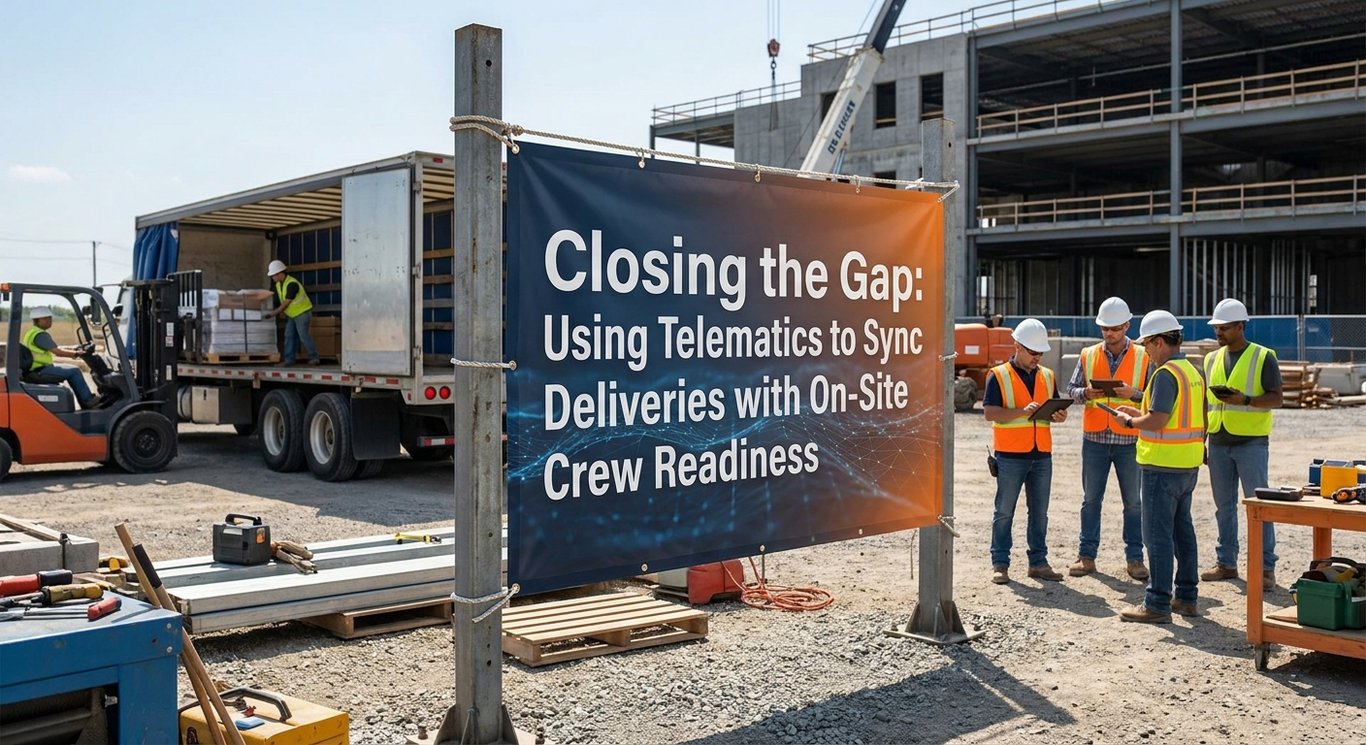
Construction and field-service operations run on coordination – and when that coordination breaks down, everyone pays for it. Materials arrive before the crew is ready. Trucks sit idling at a gate while a forklift operator finishes a task on the other side of the site. A delivery window gets missed because traffic added forty minutes to a route nobody was monitoring. These situations aren’t rare; they’re the daily reality for project managers, dispatchers, and site supervisors juggling dozens of moving parts at once. The gap between a vehicle leaving a depot and a jobsite being genuinely prepared to receive it is where time, money, and productivity quietly disappear. Telematics addresses this problem directly by connecting location data, vehicle status, route progress, equipment utilization, and operational communication into a single, shared view – one that gives every stakeholder the information they need to act before delays become disruptions.
Beyond just tracking where trucks are, telematics creates a feedback loop between the vehicle moving toward a site and the people and equipment waiting at it. When dispatchers can see live estimated arrival times, and crew supervisors receive automatic alerts when a delivery is twenty minutes out, the entire operation becomes more responsive. Waiting time drops. Congestion at site entrances decreases. Avoidable downtime – the kind caused by a crane crew standing around because the steel hasn’t arrived yet – becomes something you can actually prevent rather than just apologize for later.
The central premise of this article is straightforward: a delivery is only truly successful when the right materials arrive at the right place, at the right time, with the right crew and equipment ready to receive or use them. Arrival alone is not the finish line. What happens in the window between a truck pulling up and productive work beginning is where the real operational performance lives – and that’s exactly what telematics, when used well, helps organizations control.
What “Closing the Gap” Means in Construction and Field-Service Logistics
There’s a meaningful difference between dispatching a vehicle and having a jobsite ready for it. In theory, these two things should happen in sync. In practice, they rarely do. A delivery might be scheduled for 9:00 AM, but the crew assigned to unload it is still finishing a pour on the other side of the site. The access road might be blocked by equipment that was repositioned overnight. A change in work priorities might mean the area where materials were supposed to be staged is now occupied. None of these problems are necessarily anyone’s fault – they’re the natural result of complex, fast-moving operations where conditions change faster than communication can keep up. The gap isn’t just a scheduling problem; it’s an information problem.
Common causes of this gap include incomplete site preparation, shifting work sequences, traffic delays that aren’t communicated back to the site, unavailable equipment operators, restricted access points that weren’t flagged in advance, and lifting equipment that’s been reassigned to another task. Each of these factors can independently cause a delivery to arrive at a site that simply isn’t ready for it. And when multiple factors stack up – which they often do – the result is significant idle time, frustrated workers, and a delivery that technically happened but didn’t actually move the project forward.
It’s worth distinguishing between delivery arrival time and delivery readiness time, because they measure two very different things. Arrival time tells you when the truck showed up. Readiness time tells you when the site was actually prepared to receive it productively. Measuring both gives organizations a far more accurate picture of operational performance than tracking arrival alone. A site that consistently shows on-time arrivals but has an average 45-minute lag before unloading begins has a readiness problem – and without that second data point, the problem stays invisible.
What Is Telematics and How Does It Support Delivery Coordination?
Telematics is the combination of vehicle or equipment data, GPS positioning, onboard sensors, wireless communications, and software dashboards working together to give organizations real-time visibility into their mobile assets. At its core, a telematics system collects data from devices installed in vehicles and equipment – tracking location, speed, heading, and movement patterns via GPS. But it goes well beyond basic tracking. Onboard sensors monitor engine status, fuel consumption, battery voltage, temperature, and component health. Driver behavior data captures events like harsh braking, rapid acceleration, and excessive idling. All of this information is transmitted wirelessly to a central platform where it can be viewed, analyzed, and acted on.
The software side of telematics is where raw data becomes operational intelligence. Dashboards display fleet-wide activity in real time, showing where every vehicle and piece of equipment is, what it’s doing, and how it’s performing. Alerts can be configured to notify specific users when predefined conditions occur – a vehicle entering a geofenced area, a driver exceeding a speed threshold, a vehicle stopped unexpectedly, or a maintenance fault code triggering. Reporting tools aggregate historical data to identify patterns, compare performance across routes or drivers, and support planning decisions. Together, these capabilities turn a scattered collection of vehicles and equipment into a manageable, visible operation.
Perhaps the most practical shift telematics enables is moving from reactive communication to proactive coordination. Instead of a dispatcher calling a driver to ask where they are, or a site supervisor texting to find out when materials will arrive, everyone with appropriate access sees the same live operational picture. Project managers, dispatchers, drivers, and site supervisors can monitor vehicles, assets, deliveries, routes, and jobsite activity from a shared platform – reducing the back-and-forth that slows decisions and causes information to get lost between phone calls, spreadsheets, and paper records.
Why Delivery Timing and Crew Readiness Must Be Managed Together
Early deliveries might seem like a good problem to have, but they create real operational headaches. When a truck arrives before the site is ready, it often has nowhere to go. Access roads get blocked. Other vehicles can’t move freely. Materials end up staged in the wrong location because the intended area isn’t cleared yet. And the driver – who has a schedule to keep – is burning time and fuel sitting idle while someone scrambles to figure out where things should go. In congested urban construction sites or busy logistics yards, an early delivery can cascade into delays for every vehicle that arrives after it. 🚛
Late deliveries create a different but equally costly problem. When materials arrive after the crew expected them, workers who were scheduled to begin a specific task are left with nothing productive to do. Cranes, loaders, and specialized crews – all of which come with real hourly costs – sit idle. If the delay pushes past a shift boundary, overtime costs kick in. In some cases, a late delivery forces a work-sequence change that ripples through the entire project schedule. The point isn’t that punctuality is everything; it’s that timing mismatches between delivery and readiness have consequences that extend well beyond the moment of arrival.
Effective delivery coordination requires synchronizing a set of interdependent operational elements: the delivery vehicle’s arrival, gate or site access, availability of the unloading zone, crew assignment and availability, lifting or handling equipment, material inspection procedures, and the next scheduled work activity that depends on those materials. When even one of these elements is out of sync, the others are affected. Managing delivery timing and crew readiness as a single, connected workflow – rather than two separate responsibilities – is what allows organizations to actually close the gap. 🔗
Building a Shared Readiness Model for Every Delivery
Before a vehicle is ever dispatched, “ready” should mean something specific and verifiable. A shared readiness model defines what conditions must be confirmed on both ends of a delivery before it begins. On the site side, this includes an accessible entry point, confirmed and current delivery instructions, a prepared storage or placement area, crew members who are assigned, available, and briefed, and any required equipment positioned and operational. On the vehicle side, it includes a confirmed load, a verified route, and a driver who has everything needed to complete the delivery without improvising on arrival. Readiness isn’t a feeling – it’s a checklist that both sides of the delivery can confirm before the clock starts running.
“GPS tracking and telematics give you a live view of where every vehicle is, how it is being driven and how it is performing.” -Geotab
Vehicle and Driver Readiness
Vehicle readiness covers more than just knowing where a truck is. Before dispatch, the system should confirm the vehicle’s current location and estimated departure time, its maintenance status and whether any outstanding faults exist, fuel level relative to the route distance, the assigned driver and their familiarity with the delivery location, load details including weight, dimensions, and any special handling requirements, and any access restrictions at the destination that the driver needs to know about. Route compliance – meaning the driver is following the planned route – can be monitored in real time once the vehicle is moving, with deviations flagged automatically for dispatcher review.
Jobsite and Crew Readiness
On the jobsite side, readiness involves confirming crew availability and their current work-stage status, verifying that site access is clear and that any gate or security requirements are handled, assessing unloading capacity based on what equipment is available and positioned, checking weather or ground conditions that might affect safe unloading, and confirming that the receiving team has received the most current delivery instructions. It sounds like a lot of coordination – and it is – but when these confirmations are built into a standard workflow rather than left to informal communication, they happen consistently instead of only when someone thinks to ask.
Material and Equipment Readiness
Material type, quantity, and handling method all affect what equipment needs to be available at the time of delivery. Bulk materials handled by a conveyor have different requirements than palletized goods moved by forklift, or structural steel lifted by crane. A shared readiness model should link each delivery’s material specifications to the equipment required to handle it, confirm that equipment’s operating status and current location, and flag any conflicts with other scheduled tasks. When a crane is booked for a delivery at 10:00 AM but is still committed to a task that’s running long, the system should surface that conflict early enough to adjust – not after the delivery truck is already at the gate. ⚙️
Using Real-Time Location Data to Improve Estimated Arrival Times
A static estimated arrival time calculated at dispatch is almost immediately out of date. Traffic conditions change. Road closures appear. A driver stops for fuel. A construction zone slows progress on a key stretch of highway. Real-time GPS location data, combined with live traffic feeds, route-progress monitoring, geofencing, and historical travel-time data for similar routes, allows estimated arrival times to be updated continuously as conditions evolve. This turns an ETA from a fixed appointment into an active operational signal – one that the dispatch team and site crew can both rely on to make informed decisions in real time.
[cta-call:Call2]
Historical travel data adds another layer of accuracy. If a particular route consistently runs ten minutes longer than mapping software predicts between 7:30 and 9:00 AM due to school traffic, that pattern can be built into future estimates. Over time, telematics systems accumulate enough route-specific data to produce ETAs that are meaningfully more accurate than generic navigation estimates – which matters when the difference between a crew being ready and a crew standing idle is fifteen minutes. Treating arrival estimates as living data rather than fixed commitments is a mindset shift that makes the whole system more useful. 📍
When a vehicle is running ahead of schedule, behind schedule, rerouted, or stopped unexpectedly, dispatchers need to know – and so does the site. Telematics platforms can be configured to send automated notifications to crew supervisors when a vehicle crosses specific distance or time thresholds. A “vehicle is 20 minutes out” alert gives the site enough time to clear the access route, position handling equipment, and have the receiving crew in place. A “vehicle has been stopped for 15 minutes” alert prompts a dispatcher to check in and find out whether there’s a breakdown, an accident, or simply a longer-than-expected fuel stop. These proactive notifications replace the reactive phone calls that currently eat up dispatcher and supervisor time.
Geofencing: Connecting Delivery Milestones to Jobsite Actions
Geofencing is the use of virtual geographic boundaries – defined by GPS coordinates – to trigger automated events when a vehicle or asset enters, exits, or remains within a specified area. In delivery coordination, geofences can be created around depots, supplier yards, staging areas, restricted access points, and jobsites. When a vehicle crosses one of these boundaries, the system records the event automatically, capturing the time, vehicle identity, and location. This creates a reliable, timestamped record of delivery milestones that doesn’t depend on a driver remembering to check in or a dispatcher catching the movement on a map. 🗺️
“By bringing together near real-time data, intelligent routing and GPS visibility, modern fleet management platforms give fleets the tools to reduce wasted miles, improve dispatch efficiency and reduce fleet fuel costs without adding complexity to daily operations.” -Verizon Connect
Geofences can be layered to capture the full delivery journey. A departure geofence at the depot records when the vehicle left. A staging-area geofence records when it passed through a key waypoint. A jobsite geofence records arrival and, importantly, dwell time – how long the vehicle stayed on site before departing. Dwell time is particularly valuable data because it reveals how long the unloading process actually took, which can then be compared against the planned window to identify inefficiencies or site-access problems that consistently extend turnaround time.
Beyond recording events, geofence alerts can trigger practical actions that prepare the site for arrival. When a vehicle crosses the “approaching” geofence – say, two kilometers from the site – an automated notification can go to the receiving crew supervisor, prompting them to clear the access route and position the forklift. When the vehicle crosses the site-entry geofence, a gate attendant can be notified to open access. If the vehicle stops unexpectedly within a restricted area or lingers past its expected departure time, an escalation alert can notify a dispatcher to investigate. These automations reduce the communication burden on everyone involved while making the process more consistent and reliable.
Coordinating Crews, Vehicles, and Heavy Equipment in One Workflow
A delivery truck arriving at a construction site doesn’t complete a delivery on its own. It needs something on the other end: a crew to receive it, and often a machine to move what it’s carrying. Whether that’s a forklift for palletized materials, a crane for structural steel, an excavator for spoil removal, or a telehandler for materials being placed at height, the equipment required to complete the delivery is just as critical as the vehicle making it. Delivery coordination that focuses only on the truck and ignores the receiving equipment is solving half the problem. A telematics-enabled workflow connects the delivery vehicle with the crew and equipment needed at the destination, treating them as a single coordinated unit rather than separate operational threads. 🏗️
This kind of multi-asset coordination becomes more complex on larger sites where multiple deliveries, multiple crews, and multiple pieces of equipment are all operating simultaneously. A crane might be scheduled to support three different deliveries across a morning – and if the first one runs long, everything after it shifts. When equipment location and utilization data is visible in the same platform as delivery tracking, supervisors can see these conflicts forming before they become problems. If the crane is still active on a previous task when the next delivery truck is twenty minutes out, there’s time to communicate a delay, adjust the delivery window, or identify whether another piece of equipment can substitute.
Equipment location and utilization data can reveal exactly whether the machine needed for a delivery is available, actively operating on another task, sitting idle in a different part of the site, or undergoing maintenance. Without this visibility, a site supervisor has to physically locate the equipment or make phone calls – neither of which is fast or reliable. With it, the answer is available on a dashboard in seconds, and the decision about whether to proceed, delay, or reroute can be made with real information rather than guesswork.
Designing a Telematics-Enabled Dispatch and Readiness Workflow
A well-designed telematics workflow begins long before a vehicle leaves the depot. It starts with a confirmed delivery request that contains everything needed to plan and execute the delivery successfully: the exact jobsite location and access instructions, the material type and quantity, the delivery window, unloading requirements, the assigned receiving crew, required equipment, and any safety or compliance considerations. When this information is captured in a standardized format at the point of request, every downstream step – dispatch, routing, site preparation, unloading, and completion recording – has a clear foundation to work from.
Step 1: Create the Delivery Record
Before dispatch, a complete delivery record should be created in the system with fields that are standardized across the organization. This means the same information is captured the same way every time, regardless of who creates the record. Standardization matters because it eliminates the ambiguity that causes problems downstream – when a driver arrives at a site and the delivery record says “rear entrance” but doesn’t specify which rear entrance on a multi-building complex, that’s a gap that standardized location fields and access-instruction requirements would have prevented. A complete record gives project managers, dispatchers, drivers, suppliers, and site supervisors a shared reference point that everyone can trust.
“When materials tracking links to delivery schedules and site readiness, crews aren’t standing around waiting for supplies that haven’t arrived.” -Nektar
Step 2: Confirm Site Readiness
Before the vehicle leaves the depot, a readiness checkpoint should be completed for the destination site. This confirmation covers access (is the entry point clear and appropriate for the vehicle type?), storage or placement area (is it prepared and available?), personnel (are the receiving crew members assigned and on site?), equipment (is the required handling machine available, fueled, and positioned?), safety controls (are any required permits or safety briefings in place?), and work sequencing (is the site at the right stage to receive and use these materials?). This checkpoint doesn’t need to be a lengthy process – a structured digital form completed by the site supervisor takes minutes and prevents hours of wasted time.
Step 3: Monitor En Route Progress
Once the vehicle is moving, the telematics platform provides live location, continuously updated estimated arrival time, and alerts for any route deviations, unexpected stops, or significant delays. Dispatchers monitoring multiple deliveries simultaneously can see at a glance which vehicles are on track and which need attention. Automated notifications handle routine updates – like a vehicle passing a key waypoint – so dispatchers can focus their attention on exceptions rather than manually tracking every vehicle on a map. Traffic-related delays are flagged as they develop, giving the team time to notify the site and adjust labor or equipment assignments accordingly.
Step 4: Trigger Arrival Preparation
When the vehicle crosses a proximity geofence – typically set at a distance that gives the site enough lead time to prepare – automated alerts go to the receiving crew supervisor and any other relevant personnel. These alerts prompt specific actions: clear the access route, move any obstructing vehicles or equipment, position the forklift or crane at the unloading zone, verify that the delivery paperwork matches what’s expected, and have the receiving crew in place. By the time the truck arrives, the site should be ready to begin unloading immediately – not starting the preparation process. This is where the gap between arrival time and productive use of materials gets meaningfully compressed. ✅
Step 5: Confirm Completion and Capture Exceptions
After the delivery is complete, the system should capture a set of completion data points: confirmed arrival time, unloading start time, unloading completion time, vehicle departure time, and total dwell time. Any exceptions – rejected or damaged materials, access problems, equipment unavailability, crew delays, or safety incidents – should be recorded with enough detail to support later analysis. This completion data is what transforms individual delivery events into organizational learning. Over time, patterns in exceptions reveal systemic problems that can be addressed through process changes, supplier conversations, route adjustments, or crew scheduling improvements.
Reducing Waiting Time, Idle Time, and Failed Delivery Attempts
One of the most valuable things telematics data does over time is reveal patterns that aren’t visible in individual delivery events. A single instance of a truck waiting forty-five minutes at a gate might look like a one-off problem. But when the data shows that deliveries to a particular site consistently have long dwell times on Tuesday mornings, or that a specific supplier’s drivers routinely arrive thirty minutes early, or that a certain route produces late arrivals two or three times per week – those patterns point to structural problems that can actually be fixed. Telematics turns anecdotal frustration into documented evidence. 📊
Excessive dwell time, premature arrivals, repeated site-access problems, and unproductive idling all have costs that accumulate quietly in the background of daily operations. Failed delivery attempts – where a vehicle arrives but can’t complete the delivery due to site unreadiness, access issues, or crew absence – are particularly expensive because they consume the full cost of the delivery without producing any value. Identifying these recurring failure modes through telematics data gives organizations a specific, actionable target for improvement rather than a vague mandate to “do better.”
Historical delivery data supports smarter planning across the board. When organizations can see which delivery windows consistently result in on-time, efficient completions versus which ones generate delays, they can adjust scheduling to favor the windows that work. Route analysis might reveal that a particular road is reliably slow in the afternoon, suggesting that deliveries to sites along that corridor should be scheduled for morning. Supplier-specific data might show that one supplier’s drivers consistently need more time to unload than the delivery window allows, prompting a conversation about loading practices or vehicle configuration. All of this improvement is grounded in real operational data rather than assumptions.
“A key technique enabled by this data is delivery slotting-assigning specific time windows for deliveries based on real-time site conditions and crew readiness.” -SAP
Using Predictive Maintenance to Protect Delivery Reliability
A delivery schedule is only as reliable as the vehicles executing it. When a truck breaks down en route to a jobsite, the consequences extend well beyond the vehicle itself – the crew waiting at the destination has nowhere to direct their time, the equipment staged for unloading sits idle, and the work sequence that depended on those materials gets disrupted. Telematics addresses this risk through predictive maintenance: using vehicle diagnostic data, fault codes, engine hours, service interval tracking, and component health indicators to identify maintenance needs before they become breakdowns. When a sensor flags an emerging issue with a vehicle’s braking system or transmission, that’s information that can trigger a service appointment during planned downtime rather than an emergency repair on the side of a highway. 🔧
Predictive maintenance isn’t just about keeping vehicles running – it’s about keeping delivery commitments intact. Organizations that track service intervals through telematics can plan maintenance around delivery schedules rather than having maintenance interrupt them. Vehicles approaching service thresholds can be rotated out of high-priority routes in advance, with replacement assets assigned before the gap in coverage occurs. This kind of proactive planning is only possible when the data is available and visible, which is exactly what telematics provides.
The connection between vehicle uptime and crew readiness is direct and often underappreciated. When a delivery vehicle becomes unexpectedly unavailable – whether due to a breakdown, a failed inspection, or an unplanned repair – the impact lands immediately on the jobsite. The telematics system can help dispatchers respond faster by identifying which alternative vehicles are available, their current location and load status, and which routes could get a replacement to the site with the least delay. Simultaneously, an automated notification to the site supervisor gives the crew time to adjust labor assignments and reschedule equipment rather than waiting in place while the situation is sorted out.
Improving Safety and Compliance Through Telematics
Safety in delivery and field-service operations isn’t just about what happens at the jobsite – it starts with how vehicles are driven on the way there. Telematics monitors driver behavior continuously, capturing events like speeding, harsh braking, rapid acceleration, and sharp cornering. Seat-belt compliance can be tracked through sensor data. Excessive idling – which affects both fuel consumption and emissions – is flagged automatically. Unauthorized vehicle use outside of approved hours or geographic areas is recorded, creating accountability that discourages misuse. Where driver hours regulations apply, telematics can support compliance by tracking on-duty time and flagging potential violations before they occur. 🛡️
Geofenced restricted areas add another layer of safety management. Construction sites often have zones where vehicle access is prohibited during certain operations – near crane lift areas, active excavations, or pedestrian corridors. Geofencing can enforce these restrictions digitally, alerting dispatchers when a vehicle enters a restricted zone and creating a record of the event. Route deviation alerts can flag when a driver leaves the approved path, which might indicate an attempt to take an unauthorized shortcut through a restricted area or a navigation error that needs correction.
Beyond individual driver behavior, telematics supports safer jobsites at a systemic level. When site supervisors know exactly when delivery vehicles are approaching, they can coordinate pedestrian and equipment movement to clear the access path before the truck arrives – reducing the risk of unexpected vehicle-pedestrian interactions. Documented incident records from telematics data support post-event analysis and can inform safety briefings, policy updates, and training programs. Over time, the combination of behavioral monitoring, geofencing, and incident documentation creates a measurable improvement in safety culture that goes beyond compliance checkboxes.
Integrating Telematics with Dispatch, Scheduling, and Project Systems
Telematics is most powerful when it’s not operating in isolation. When telematics data flows into and out of the other systems an organization relies on, the operational benefits multiply. Integration with dispatch software means delivery records created in the dispatch platform automatically populate vehicle assignments, routes, and delivery windows in the telematics system – eliminating duplicate data entry and reducing the risk of information getting out of sync. Integration with fleet maintenance platforms means service alerts generated by telematics data can automatically create work orders in the maintenance system. Integration with construction scheduling tools means delivery completion data can update project progress records without manual intervention. 🔄
“Route optimization uses GPS and real-time traffic data to reduce mileage, avoid delays and lower fuel usage.” -Geotab
Connecting telematics with inventory systems, electronic proof-of-delivery tools, and workforce-management platforms creates a continuous data loop that supports decision-making at every level of the operation. When a delivery is completed and confirmed through an electronic proof-of-delivery signature, that confirmation can update inventory records, trigger an invoice, and mark a project milestone – all without anyone manually entering data into multiple systems. The cumulative time savings from eliminating these manual steps across dozens or hundreds of deliveries per week is significant, and the reduction in data-entry errors is equally valuable.
The full data flow in an integrated telematics ecosystem looks something like this: a project schedule identifies a material need and creates a delivery requirement, dispatch assigns a vehicle and driver and generates a delivery record, telematics monitors the vehicle’s progress and updates the ETA in real time, the jobsite confirms readiness through a digital checklist, arrival and completion events are recorded automatically via geofencing, and completion data flows back into project records to update progress and trigger downstream actions. Each step informs the next, and the whole cycle is visible to the people who need to act on it.
Before committing to an integration strategy, organizations should address a set of practical interoperability questions. Does the telematics platform offer application programming interfaces (APIs) that allow data to flow to and from other systems? Who owns the data generated by the telematics devices – the fleet operator, the software vendor, or the client? Are the devices compatible with the vehicles and equipment in the fleet, including older assets that may not support modern connectivity standards? How does the system behave when cellular connectivity is unavailable – does it store data locally and sync when connection is restored? What user-permission structures are available to control who can see what? And critically – can subcontractors or third-party carriers be given limited access to relevant delivery information without exposing sensitive operational or financial data? These questions should be answered before implementation, not after.
Key Metrics for Measuring Delivery and Crew Synchronization
Implementing telematics without establishing baseline metrics is like installing a speedometer without knowing what speed limit you’re trying to meet. Before going live, organizations should document their current performance across the key areas telematics will affect – delivery timing, crew wait time, vehicle utilization, fuel consumption, and maintenance frequency. With a baseline in place, post-implementation results can be compared meaningfully, and improvements can be attributed to specific changes rather than general operational drift. Performance should be tracked not just at an aggregate level but broken down by project, route, supplier, crew, vehicle, and site – because the same system can produce very different results in different operational contexts.
Delivery Performance Metrics
Core delivery performance metrics include on-time arrival rate (the percentage of deliveries that arrive within the agreed window), estimated-arrival accuracy (how closely the system’s ETAs match actual arrival times), delivery-window compliance (whether deliveries are scheduled within windows that the site can actually support), completed deliveries per vehicle per day (a measure of fleet productivity), failed delivery attempts (deliveries that couldn’t be completed due to site, access, or crew issues), and average route deviation (how often vehicles depart from planned routes and by how much). Together, these metrics paint a detailed picture of how well the delivery side of the operation is performing.
Jobsite Readiness Metrics
Jobsite readiness metrics focus on what happens after the vehicle arrives. Crew wait time measures how long workers assigned to a delivery are waiting before productive work begins. Vehicle dwell time measures how long the delivery vehicle is on site, which should ideally match the planned unloading window. Equipment readiness rate tracks how often the required handling equipment is available and operational at the time of delivery. Unloading start delay captures the gap between vehicle arrival and the beginning of unloading. Unloading duration tracks how long the actual unloading process takes versus the estimate. Site-access incidents record how often access problems delay or prevent unloading. And time between arrival and productive use of materials captures the full cost of readiness gaps in a single, meaningful number. ⏱️
Fleet and Cost Metrics
Fleet and cost metrics connect operational performance to financial outcomes. Fuel consumption per delivery or per route identifies inefficiencies in routing, idling, or vehicle selection. Idle hours – time when a vehicle’s engine is running but the vehicle isn’t moving – represent direct fuel waste and can often be reduced significantly through driver coaching supported by telematics data. Unplanned maintenance events (versus planned, scheduled service) indicate how well predictive maintenance is working. Vehicle utilization measures how much of each vehicle’s available capacity and time is being used productively. Overtime costs tied to delivery delays or extended unloading windows reveal the crew-cost impact of operational inefficiencies. Empty miles – distance traveled without a load – represent a direct opportunity for route optimization. Cost per delivery and avoided downtime round out the financial picture by quantifying both the direct cost of each delivery and the savings generated by preventing disruptions.
Privacy, Data Governance, and Change Management
Telematics generates a significant amount of data about people – specifically, about where drivers are, how they’re driving, and when they’re working. Organizations have a responsibility to handle this data carefully and transparently. Clear policies should define what data is collected, how long it’s retained, who has access to it, and how it can and cannot be used. Role-based access controls ensure that a site supervisor sees delivery arrival data relevant to their site without having access to driver behavior records that are only appropriate for fleet managers or HR. Cybersecurity measures protect the platform from unauthorized access, and data-accuracy protocols ensure that the information being acted on is reliable. Where labor agreements or privacy regulations apply – and in many jurisdictions, they do – compliance requirements should be understood and built into the data-governance framework before the system goes live. ⚖️
Technology implementation is ultimately a people challenge as much as a technical one. Drivers, crew supervisors, subcontractors, and project managers all need to understand what the telematics system does, why it’s being used, and how the data it generates will affect them. Clear, honest communication about data use – including explicit statements about what the data will not be used for – builds the trust that makes adoption successful. Pilot programs that start with a small group of willing participants allow the organization to work out process kinks before a full rollout. Feedback sessions give frontline users a voice in how the system is configured and used, which both improves the system and increases buy-in. Training should be practical and role-specific rather than generic, so each user understands exactly what they need to do and why it matters.
Common Implementation Challenges and How to Address Them
Real-world telematics implementation rarely goes as smoothly as a product demo suggests. Poor cellular connectivity in remote or underground locations can create gaps in location data. Inaccurate jobsite addresses – especially on large multi-access sites or new developments that haven’t been fully mapped – can cause geofences to trigger at the wrong location or not at all. Incomplete delivery records, created when the intake process isn’t enforced consistently, undermine the entire workflow. Incompatible systems that don’t share data cleanly create manual workarounds that defeat the purpose of automation. Inconsistent driver adoption – where some drivers engage with the system and others ignore it – produces patchy data that’s difficult to act on. Sensor failures generate false alerts or data gaps that erode confidence in the system. And data overload, where too many alerts are configured without clear ownership, leads to alert fatigue where important notifications get ignored along with the unimportant ones.
The most common reason telematics implementations underperform is that organizations try to do too much at once. Starting with a focused, well-defined use case – such as reducing delivery wait time at the three highest-volume sites in the fleet – allows the team to learn the system, refine the workflow, and demonstrate measurable results before expanding scope. Once the core use case is working well and the team is confident in the data, it becomes much easier to extend the system to predictive maintenance monitoring, driver safety analytics, equipment utilization tracking, and broader asset management. A phased approach also makes change management more manageable, because each phase involves a smaller group of people making a smaller set of changes. 🎯
How to Build a Business Case for Telematics
Building a credible business case for telematics starts with understanding the full cost of implementation. Hardware costs include the telematics devices themselves, installation labor, and any mounting or wiring requirements specific to the vehicle or equipment type. Software costs include subscription fees, which are typically charged per asset per month and vary based on the feature set included. Integration costs cover the technical work required to connect the telematics platform with existing dispatch, maintenance, scheduling, or ERP systems. Training costs cover the time required to onboard drivers, dispatchers, supervisors, and administrators. Ongoing support costs include any vendor support contracts, internal IT resources required to maintain the system, and the cost of managing data quality over time.
On the benefit side, the categories are broad and the magnitudes can be significant. Fewer failed delivery attempts mean fewer repeat trips and less wasted driver time. Lower idle time translates directly to fuel savings. Improved vehicle utilization means more deliveries completed per asset, potentially deferring the need for fleet expansion. Reduced fuel consumption lowers both direct costs and emissions. Better maintenance planning reduces unplanned breakdowns and the expensive emergency repairs that come with them. Fewer delays improve crew productivity and reduce overtime. Stronger communication with clients and project partners builds trust and can support contract retention. Improved crew productivity – the direct result of closing the gap between delivery arrival and productive work – may be the largest single benefit, because labor is typically the biggest cost in construction and field-service operations. 💡
The most credible return-on-investment calculations are grounded in an organization’s own baseline data rather than industry-wide averages. Before implementation, measure the metrics that telematics is expected to improve – crew wait time, vehicle dwell time, failed delivery rate, fuel consumption, idle hours, and unplanned maintenance frequency. After a defined pilot period, compare results against that baseline. This approach produces a business case that reflects actual operational conditions rather than best-case scenarios, and it gives leadership the confidence to expand the program based on demonstrated results rather than projections. A well-structured pilot with clear success criteria is worth more than any vendor-provided ROI calculator.
FAQ: Closing the Gap Between Deliveries and On-Site Crew Readiness
What is telematics in delivery and construction operations?
Telematics in delivery and construction operations is a technology framework that combines GPS location tracking, vehicle and equipment data, onboard sensors, and wireless communications to provide real-time visibility into the movement, status, and utilization of mobile assets. It captures information about where vehicles and equipment are, how they’re being used, what condition they’re in, and how they’re moving through the operation – and makes that information available through software dashboards and automated alerts to the people who need it to make decisions.
How does telematics help synchronize deliveries with crew readiness?
Telematics enables synchronization by providing live location data and continuously updated estimated arrival times that can be matched against crew schedules, site-access availability, unloading zone readiness, and equipment positioning. When a delivery vehicle’s ETA is visible in real time, site supervisors can time crew assignments and equipment preparation to match actual arrival rather than a planned window that may no longer be accurate. Automated proximity alerts give the site advance notice to complete preparation before the truck arrives, reducing the gap between arrival and productive unloading.
Can telematics reduce delivery delays and crew idle time?
Yes – telematics can expose the root causes of delivery delays and crew idle time by capturing data on dwell time, arrival accuracy, site-access incidents, equipment availability, and route performance. With this information, organizations can make targeted improvements to delivery windows, routing, crew scheduling, and site preparation processes. That said, the degree of improvement depends heavily on how consistently the workflow is adopted by dispatchers, drivers, and site teams, and on the quality and completeness of the data being captured. Telematics provides the visibility; the improvement comes from acting on what it reveals.
What information should a jobsite provide before a delivery is dispatched?
Before a delivery is dispatched, the jobsite should provide the exact delivery location including specific access point instructions, the delivery window that works with the site’s work sequence, the material type, quantity, and any special handling requirements, the unloading method and required equipment, the storage or placement area where materials should go, the name and contact information of the receiving crew member or supervisor, any safety requirements or permit conditions, and confirmation that the site will be ready at the agreed time. The more complete and accurate this information is at the point of request, the fewer problems arise during execution.
How should companies measure whether telematics is working?
Companies should measure telematics effectiveness by tracking a defined set of metrics against a pre-implementation baseline. Key indicators include on-time arrival rate, crew wait time, vehicle dwell time, equipment readiness rate at time of delivery, failed delivery attempts, idle hours, fuel consumption, unplanned maintenance events, and cost per completed delivery. Reviewing these metrics regularly – broken down by site, route, vehicle, and crew – reveals where the system is delivering value and where workflow or configuration adjustments are needed. Improvement should be measured over a meaningful time period, not just in the first few weeks after go-live.
Conclusion: Turning Delivery Visibility into Jobsite Readiness
Telematics delivers its greatest value not when it simply shows where a truck is, but when that location data is connected to the people, equipment, access conditions, and work sequence waiting at the destination. Visibility is the starting point, not the finish line. The organizations that get the most from telematics are the ones that take the alerts, ETAs, and data the system produces and translate them into defined readiness actions – a crew supervisor notified, a forklift repositioned, a gate opened, a delivery window adjusted. Without that translation from data to action, even the most sophisticated telematics platform is just an expensive tracking system. 🚀
The key takeaways from this discussion are clear and practical: define what “ready” means on both sides of every delivery, connect vehicle tracking with crew schedules and equipment availability, use live arrival data as an active operational signal rather than a static estimate, automate milestone notifications so preparation happens without manual prompting, measure crew wait time and vehicle dwell time alongside traditional delivery metrics, protect driver and location data with clear governance policies, and treat every delivery cycle as an opportunity to improve the next one. If your organization is still managing the delivery-to-crew handoff through phone calls, text messages, and gut instinct, there’s a real and measurable gap waiting to be closed. Start with a focused telematics pilot at your highest-volume site, measure what changes, and let the data guide the next step. The gap between arrival and productive work is costing you more than you think – and it’s more fixable than it might feel right now.
Ready to take the first step? Evaluate your current delivery workflow, identify where wait time and idle time are costing you the most, and explore telematics solutions designed for construction and field-service operations. A focused pilot with clear metrics is the fastest path to results you can build on – and the clearest way to demonstrate value to the people who need to see it before they’ll commit to something bigger.