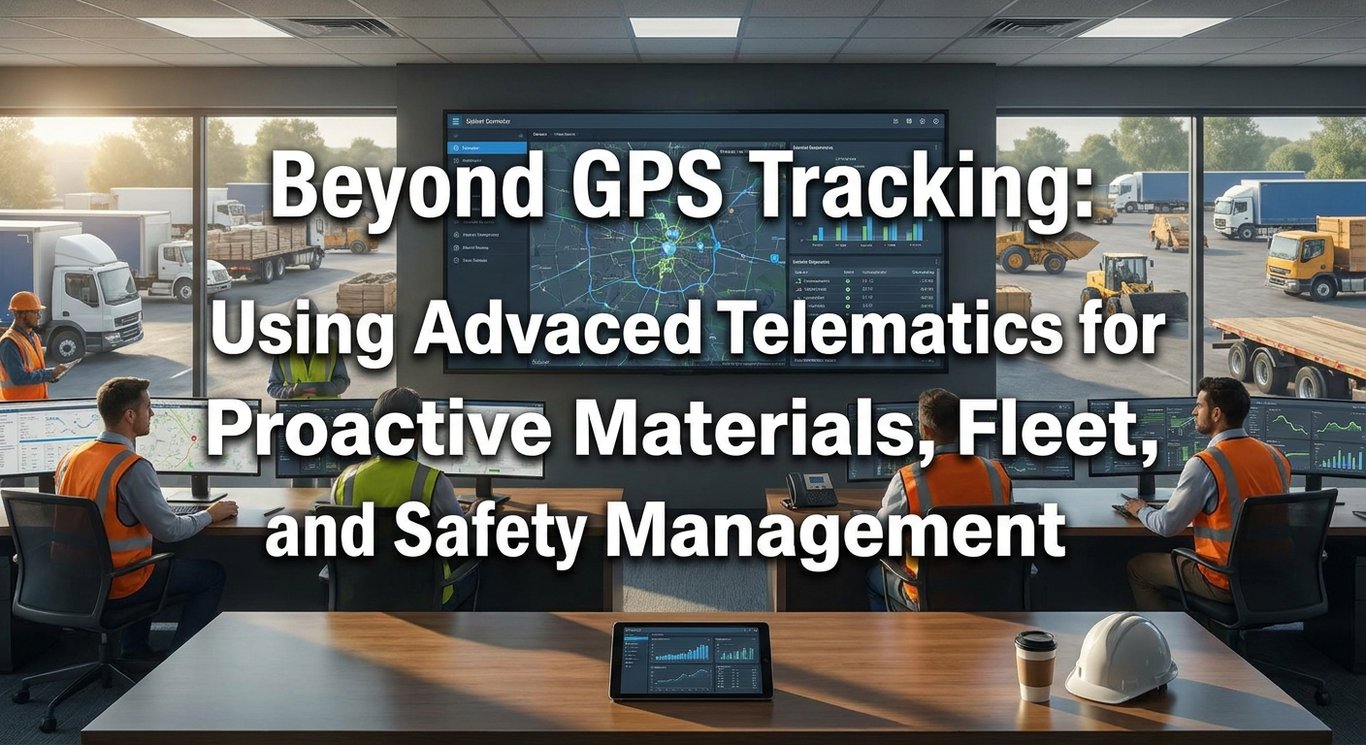
Every construction or field operations project lives and dies by two things: getting the right materials to the right place at the right time, and keeping vehicles moving productively. When those two elements fall out of sync, the consequences pile up fast – idle crews, spoiled concrete, duplicate deliveries, and budget overruns that nobody planned for. The connection between vehicle movement and material availability is tighter than most project managers realize, and when that connection breaks down, jobsite productivity takes a serious hit. Integrating fleet telematics with materials management directly addresses this problem by giving teams the visibility they need to coordinate deliveries, reduce unnecessary trips, and keep projects on schedule.
The financial stakes are real. Unnecessary trips burn fuel and driver hours. Delivery delays force crews to stand around waiting for materials that should have arrived an hour ago. Poor inventory coordination leads to overordering, spoilage, and damage – all of which eat into project profitability. 📦 When telematics data and materials management systems work together, companies can dramatically cut down on these losses. The result is fewer surprises, smarter logistics, and a much healthier bottom line across every project.
The central argument of this article is straightforward: fleet telematics provides real-time location, vehicle health, driver behavior, and equipment utilization data, while materials management determines what must arrive, where it must go, and when it is needed. These two disciplines are not competing priorities – they are two halves of the same operational equation. When they share data and work from a common picture, waste shrinks, delays drop, and projects run closer to plan.
Why Fleet Telematics and Materials Management Must Work Together
In most organizations, fleet operations and material workflows are managed through completely separate systems with separate teams. Dispatchers track trucks and drivers. Warehouse teams manage stock levels and outbound orders. Procurement staff handle supplier relationships and purchase orders. Project managers focus on schedules and site requirements. Each group has its own tools, its own dashboards, and its own priorities. The problem is that when a delivery runs late, nobody in the chain has a complete picture of why – or what to do about it. That communication gap is where waste and delays are born. 🚚
These disconnected systems create a frustrating game of phone tag when things go wrong. A dispatcher might know a truck is stuck in traffic, but the warehouse team has already staged materials that are now sitting unprotected. A project manager might be waiting on a critical delivery with no way to check its status without calling three different people. Procurement staff may not know a supplier shipment was refused at the gate until hours later. These information gaps are not just inconvenient – they translate directly into rework, overtime, and wasted materials that could have been avoided with better coordination.
Integrated data changes that dynamic completely. When telematics feeds into the same operational environment as inventory records, delivery schedules, and jobsite requirements, every stakeholder works from a shared view of what is happening. Dispatchers can see which materials are loaded and where each vehicle is headed. Warehouse managers can confirm that the right goods left the yard. Project supervisors can track incoming deliveries and prepare their crews accordingly. That shared visibility is the foundation of efficient, waste-free logistics. 🗺️
How Material Waste and Delivery Delays Affect Project Performance
Material waste on construction and field projects comes from more sources than most teams track carefully. Overordering is one of the most common culprits – when quantities are estimated loosely, excess materials often end up sitting on-site until they degrade, get damaged, or simply disappear. Inaccurate quantities mean some materials arrive short while others pile up unused. Poor storage conditions expose materials to weather, moisture, and temperature extremes. Duplicate deliveries happen when communication breaks down between procurement and the field. And materials arriving out of sequence – say, finishing supplies showing up before rough-in work is complete – can block work areas and create storage nightmares.
Beyond the obvious waste of materials themselves, there is the hidden cost of handling those materials multiple times. When goods arrive at the wrong time or in the wrong place, crews have to move them, re-stage them, or return them to storage. That burns labor hours that should be going toward productive work. Damaged goods require disposal, which adds cost and often triggers emergency reorders at premium prices. Unused materials that cannot be returned become write-offs. Taken together, these sources of waste represent a significant percentage of total project costs – and most of them are preventable with better logistics coordination.
The downstream effects of poor material management ripple through an entire project schedule. Rework caused by damaged or incorrect materials creates schedule overruns. Disposal expenses for spoiled goods add unplanned costs. Equipment that sits idle waiting for materials burns fuel and accumulates unnecessary wear. Crews forced into overtime to recover lost time drive up labor costs. And when suppliers repeatedly deal with rejected deliveries, returns, or disputes over quantities, relationships deteriorate – which can affect pricing, priority, and reliability on future projects. 😤
Time-sensitive materials add another layer of complexity that demands precise routing and arrival coordination. Ready-mix concrete has a working window of roughly 90 minutes after batching. Asphalt must be placed within a narrow temperature range. Temperature-sensitive adhesives, coatings, and sealants can fail if stored improperly even for a few hours. Perishable jobsite supplies like food-grade materials or biological products have strict shelf lives. For these materials, a delivery that is even slightly late or routed to the wrong site can mean a complete loss – not just a delay. That level of precision is simply not achievable without real-time logistics visibility.
What Fleet Telematics Adds to Materials Management
Fleet telematics brings a powerful set of capabilities to the materials logistics challenge. GPS tracking gives dispatchers and project managers a live view of every vehicle’s position, updated in near real time. Geofencing allows teams to define virtual boundaries around supplier yards, warehouses, staging areas, and jobsites – and receive automatic alerts when vehicles enter or exit those zones. Route history lets managers review exactly where a vehicle traveled, how long it spent at each stop, and whether it followed the planned path. Estimated arrival times, calculated from current position and traffic conditions, give receiving teams the advance notice they need to prepare. 📡
Beyond location, telematics captures vehicle diagnostics that directly affect delivery reliability. Engine fault codes, tire pressure data, battery health, fuel consumption, and service interval tracking all feed into a picture of vehicle readiness. Idle-time reporting shows how long engines run without productive movement – a major source of fuel waste and unnecessary wear. Driver behavior data, including hard braking, rapid acceleration, and speeding, helps managers identify risky habits that can damage sensitive cargo or increase accident risk. Equipment utilization data shows whether assets like cranes, forklifts, or refrigerated trailers are being used efficiently or sitting idle when they should be working.
Together, these capabilities answer the operational questions that materials management teams ask every day. Where is the delivery right now? Is it on schedule to arrive before the crew needs those materials? Did the truck actually reach the correct jobsite, or did it drop the load at the wrong address? Is a vehicle sitting at the loading dock for two hours when it should have been back on the road an hour ago? Telematics turns those questions from phone calls and guesswork into data-driven answers available to anyone with access to the platform. 🔍
Using Real-Time Visibility to Prevent Delivery Delays
Real-time visibility gives dispatch teams the ability to act before a delay becomes a crisis. When a vehicle falls behind schedule due to traffic, a road closure, or a longer-than-expected loading time, dispatchers can see the problem developing and respond immediately. They can reroute the driver, contact the jobsite to adjust crew assignments, or arrange for a backup delivery if the situation is critical. Without that visibility, the first sign of trouble is often a frustrated project supervisor calling to ask where their materials are – by which point it may be too late to prevent idle crews or missed milestones.
“Asset tracking is nearly as common a starting point, cited by 74% of fleets, followed by increasing operational efficiency at 45%.” -SambaSafety
Proactive communication is one of the most underrated benefits of real-time tracking. When a jobsite team knows 45 minutes in advance that a delivery is running late, they can reassign crews to other tasks, adjust equipment schedules, and avoid paying workers to stand around waiting. That kind of early warning is only possible when dispatch teams are actively monitoring delivery progress and have a direct line to site supervisors. Telematics makes that communication loop fast, accurate, and automatic rather than dependent on drivers remembering to call in. 📞
Geofencing takes real-time visibility a step further by automating arrival and departure records at every key location in the supply chain. When a truck enters a supplier yard, a geofence alert logs the time automatically. When it departs, another alert records how long it spent there. The same happens at warehouses, staging areas, and jobsites. This automated record-keeping eliminates manual check-in processes, reduces errors, and creates an accurate timeline of every delivery without requiring anyone to make a phone call or fill out a form. Dwell-time data is especially useful for identifying bottlenecks at loading docks or receiving areas.
Accurate arrival information also helps supervisors make smarter decisions about resources at the receiving end. When a site supervisor knows a flatbed is 20 minutes out with structural steel, they can position the crane operator and rigging crew to be ready the moment the truck arrives. When a delivery is running two hours late, that same supervisor can release the crane to another task rather than keeping it tied up waiting. These small adjustments add up to significant savings in equipment time, labor costs, and project schedule performance. 🏗️
Optimizing Routes, Loads, and Delivery Sequences
Route optimization in a materials logistics context is more complex than simply finding the shortest path between two points. Dispatchers must account for vehicle weight limits on certain roads, bridge clearances, time-of-day restrictions near urban jobsites, delivery windows set by project schedules, and the physical access constraints of specific sites. A route that looks efficient on a map might require a truck to back down a narrow alley, cross a weight-restricted bridge, or arrive during a window when the site gate is closed. Telematics data, combined with route optimization software, helps dispatchers plan routes that actually work in the field rather than just on paper.
[cta-call:Call2]
Load planning is equally important. Sending a partially loaded truck across town when a full load could have been consolidated wastes fuel, driver time, and vehicle capacity. Telematics data on vehicle utilization and route history helps managers identify patterns of underloaded vehicles and opportunities to combine compatible deliveries. When materials for two nearby jobsites can be loaded on the same truck in the right sequence, both sites get served in a single trip rather than two. That kind of consolidation is difficult to achieve without data showing exactly what each vehicle is carrying, where it is going, and how long each stop takes.
Dispatchers who use telematics data to consolidate deliveries can also eliminate a surprising number of empty miles – trips where vehicles travel without any productive load. By reviewing route history and delivery records, managers can identify patterns where trucks regularly return empty from supplier runs that could have been combined with outbound deliveries. Reducing empty miles lowers fuel costs, reduces driver hours, and extends vehicle life – all without adding any new resources to the operation. 🛣️
Practical examples make this concrete. Consider a company managing three active jobsites within a 15-mile radius. Site A needs lumber in the morning and hardware in the afternoon. Site B needs concrete forms by noon. Site C has an urgent need for replacement bolts after a delivery error. Without telematics and route optimization, these might be handled as four separate trips by two or three different vehicles. With integrated data, a dispatcher can sequence a single vehicle to pick up lumber and hardware together, deliver lumber to Site A, drop forms at Site B on the way, swing by the supplier for the replacement bolts, deliver them to Site C, and return the hardware to Site A – all in a single efficient loop. 📋
“Material delays throw schedules off track, leading to costly rework and labor waste.” -Nektar
Reducing Idle Time, Unproductive Trips, and Fuel Waste
Idle time is one of the most persistent and expensive problems in fleet operations, and it is almost invisible without telematics. A truck sitting at a loading dock with its engine running for 45 minutes is burning fuel, accumulating engine hours, and contributing to emissions – but without data, that time is invisible to managers reviewing daily logs. Telematics idle-time reporting surfaces these patterns clearly, showing exactly which vehicles are idling, for how long, and where. Once managers can see the data, they can address the root causes: long wait times at supplier docks, drivers keeping engines running for climate control, or vehicles left running during extended breaks.
Beyond idling, telematics helps identify repeated routes that serve no productive purpose, long dwell times that suggest loading or unloading inefficiencies, unauthorized vehicle use outside of working hours, and vehicle movement that does not correspond to any scheduled material activity. Each of these patterns represents a cost that is difficult to see without data but easy to address once it is visible. A driver making a personal stop on a delivery route adds miles and time. A vehicle sitting at a warehouse for three hours when a 30-minute pickup was scheduled points to a process problem that is costing the project real money. 💸
The connection between lower idle time and operational savings is direct and measurable. Every hour of unnecessary idling burns roughly a gallon of fuel, adds engine wear, and contributes to emissions that may be subject to environmental reporting. Reducing idle time across a fleet of 20 vehicles by even 30 minutes per day can save thousands of dollars in fuel annually, extend engine life meaningfully, and reduce maintenance frequency. Lower emissions also support sustainability goals and can be relevant to environmental compliance reporting on regulated projects.
One of the more nuanced benefits of telematics in this area is the ability to distinguish legitimate waiting from avoidable delays. A driver waiting at a jobsite because the receiving crew is short-staffed is a different problem from a driver sitting at a truck stop for an hour with no clear reason. By comparing telematics records – showing vehicle position, engine status, and time – with loading logs, inventory receipts, and delivery confirmations, managers can identify exactly where time is being lost and whether the cause is on the fleet side, the warehouse side, or the jobsite side. That distinction is critical for fixing the right problem. 🔧
Preventing Spoilage, Damage, and Misplaced Materials
Delayed or poorly coordinated deliveries expose materials to risks that can make them unusable before they ever reach the project. A load of drywall left on a flatbed overnight in rainy weather can be a total loss by morning. Adhesives and sealants stored in a truck cab during a summer heat wave may fail to perform correctly even if they look fine. Concrete additives, paints, and coatings all have temperature and humidity sensitivities that are easy to violate when deliveries are delayed and materials sit in transit longer than planned. Poor coordination between dispatch and the jobsite can also mean materials are dropped in an unsecured area, where they are vulnerable to theft, impact damage from equipment, or contamination from nearby work.
Impact damage during transport is another significant source of loss. Aggressive driving – hard braking, sharp cornering, rapid acceleration – can shift loads, break seals on containers, crack tiles or panels, and damage fragile equipment. Telematics driver behavior data captures these events in real time, allowing managers to identify drivers who regularly handle vehicles in ways that put cargo at risk. When that data is connected to damage reports and insurance claims, the correlation between driving behavior and material loss becomes clear and actionable. 📊
Location records, delivery timestamps, and geofence data create a chain-of-custody trail that supports accountability at every stage of the delivery process. If a load of materials is reported missing or damaged, telematics records can show exactly when the vehicle departed the supplier, what route it took, when it arrived at the jobsite, and how long it stayed. That documentation is invaluable for resolving disputes with suppliers, supporting insurance claims, and identifying where in the process the loss occurred. Without it, these situations often turn into unresolvable finger-pointing between parties who each claim the problem was someone else’s responsibility.
“When a vehicle breaks down because of a missed maintenance window, deliveries get delayed – and time-sensitive materials like concrete or asphalt can be rendered unusable, resulting in direct material waste and costly rework.” -Nektar
Confirming that materials actually reached the correct destination is more important than it might sound. In operations managing multiple jobsites, staging areas, and storage zones, misdirected deliveries are more common than most managers realize. A driver who confuses two similarly named sites can drop an entire load at the wrong location, triggering a scramble to recover the materials, a delay at the intended site, and potentially a second delivery charge. Geofence records tied to specific project codes make it straightforward to confirm that a vehicle entered the correct site boundary at the expected time – providing proof of correct delivery without requiring anyone to be physically present to sign off. ✅
Integrating Telematics With Inventory and Materials Systems
The real power of fleet telematics in materials management comes not from the telematics platform alone but from its integration with the other systems that run the business. Enterprise resource planning systems hold purchase orders, project budgets, and financial records. Warehouse management systems track stock levels, picking orders, and outbound shipments. Inventory platforms manage material quantities, locations, and reorder points. Procurement systems handle supplier relationships, pricing, and order status. When telematics data flows into these systems – or when all of them share a common data layer – the result is an operational picture that none of them could provide on their own.
Dispatch and accounting systems also benefit significantly from telematics integration. Dispatch platforms can use live vehicle location to assign the nearest available vehicle to an urgent pickup, calculate realistic delivery windows, and update project managers automatically when deliveries are confirmed. Accounting systems can use delivery timestamps and mileage records to validate invoices, allocate fuel costs to specific projects, and flag discrepancies between billed and actual delivery activity. Project management platforms can update task status automatically when key material deliveries are confirmed, reducing the manual effort of tracking delivery milestones. 💻
The shared data points that make these integrations valuable include purchase order numbers that link a vehicle trip to a specific procurement event, stock levels that trigger dispatch decisions, material identifiers that confirm the correct goods were loaded, vehicle and driver assignments that create accountability, delivery windows that define acceptable arrival times, jobsite codes that verify correct destinations, proof-of-delivery records that close the loop on each transaction, and return records that track materials coming back from the field. Each of these data points becomes more useful when it is visible across systems rather than locked in a single platform.
Integration methods range from simple to sophisticated depending on the systems involved. Application programming interfaces allow telematics platforms to push and pull data from inventory, ERP, and dispatch systems in near real time. Cloud dashboards can aggregate data from multiple sources into a single operational view without requiring deep system integration. Mobile applications give drivers, warehouse staff, and site supervisors access to relevant data from anywhere. Barcode scanning and radio-frequency identification tags allow physical materials to be tracked alongside vehicle location data, creating a complete picture of where goods are at every stage. Automated status updates triggered by geofence events can close delivery records, update inventory counts, and notify project teams without any manual input. 📱
Building a Reliable Delivery and Materials Data Workflow
A reliable delivery and materials data workflow starts long before a truck leaves the yard. It begins with a material request from the project team, which triggers a purchase order in the procurement system. The supplier confirms availability and schedules a pickup or delivery. The warehouse team prepares the order, confirms quantities, and assigns a vehicle and driver. Dispatch creates a route plan with a delivery window tied to the project schedule. At every stage, data flows between systems so that each team member has the information they need without having to ask for it separately.
From the moment the vehicle departs, telematics takes over as the primary source of real-time status information. The system tracks the vehicle’s position, compares it against the planned route, and updates the estimated arrival time continuously. When the vehicle enters the supplier yard geofence, the system logs the arrival time and starts a dwell-time clock. When it departs, the departure is recorded automatically. The same process repeats at the jobsite, where the arrival triggers an alert to the receiving team and the departure closes the delivery record. After unloading, inventory records are updated to reflect the received materials, and the purchase order is marked as fulfilled. 🔄
“Before a machine ever breaks down, construction fleets have already lost 30-40% of their equipment’s productive time to idling – and the cost goes up when you account for fuel waste or the ripple event of project delays.” -Nektar
Automated alerts are essential to making this workflow reliable rather than just theoretical. Alerts should be configured for late departures from the warehouse, route deviations that suggest a driver is off course, extended dwell times that indicate a loading or unloading problem, missed geofences that suggest a delivery went to the wrong location, unplanned stops that could indicate a breakdown or unauthorized activity, vehicle fault codes that threaten delivery completion, and delivery-window risks when a vehicle is unlikely to arrive on time. Each alert should go to the right person with enough context to act, not just a notification that something happened.
Clear ownership of exceptions is what separates a functional alert system from an ignored one. Every type of alert should have a defined owner – the person responsible for investigating and resolving the issue. A late departure alert might go to the warehouse manager. A route deviation might go to the dispatcher. A missed geofence might go to the project supervisor and procurement team simultaneously. A vehicle breakdown alert should trigger a response from both the fleet maintenance team and the dispatch team. When everyone knows their role in the exception-handling process, problems get resolved faster and with less confusion. 👥
Using Predictive Maintenance to Protect Material Schedules
Vehicle breakdowns are one of the most disruptive events in a materials logistics operation. A truck that fails en route with a full load of time-sensitive materials can trigger a cascade of problems: the materials may be lost, the crew waiting at the jobsite goes idle, a replacement vehicle must be sourced urgently, and the project schedule takes a hit that may require overtime to recover. Predictive maintenance – using telematics diagnostics to identify potential failures before they happen – is one of the most effective ways to protect delivery reliability. By monitoring engine health, fluid levels, component wear, and service intervals continuously, maintenance teams can schedule repairs during planned downtime rather than reacting to roadside failures.
The financial case for predictive maintenance is compelling. A planned service visit costs a fraction of an emergency roadside repair, a towing bill, and the labor cost of a crew waiting on delayed materials. When telematics data shows a vehicle developing a pattern of engine fault codes, elevated coolant temperatures, or unusual fuel consumption, that is a signal to pull the vehicle for inspection before it fails in the field. Over time, this approach extends vehicle life, reduces repair costs, and improves the overall reliability of the fleet as a delivery asset. 🔩
The range of failure modes that telematics can detect includes engine fault codes that indicate developing mechanical problems, tire pressure anomalies that increase blowout risk, battery voltage issues that can strand a vehicle, missed service intervals for oil changes and filter replacements, hydraulic system irregularities in lift-equipped vehicles, refrigeration unit performance in temperature-controlled trucks, and brake system wear indicators. Each of these failure modes has a different consequence for material delivery reliability, but all of them are easier and cheaper to address before they cause a breakdown than after.
Connecting maintenance records with delivery planning is a practical step that many fleets overlook. When a vehicle is scheduled for service, it should be automatically flagged as unavailable for high-priority or time-critical material runs during that window. Dispatchers should have visibility into upcoming maintenance schedules when assigning vehicles to deliveries, so that a truck due for a brake service tomorrow is not assigned to a long-haul run with perishable materials today. This coordination between maintenance planning and dispatch scheduling prevents the frustrating scenario where a vehicle is pulled from service mid-route because a service appointment was forgotten. 🗓️
Measuring the Financial and Operational Return
Before implementing any new system, it is essential to establish a clear baseline of current performance. That means capturing metrics like total fuel consumption by vehicle and route, cost per delivery including driver time and fuel, on-time arrival rate by project and supplier, empty miles as a percentage of total miles driven, idle hours per vehicle per week, material waste and spoilage costs by project, rework expenses caused by delivery problems, overtime hours attributable to delivery delays, and vehicle downtime frequency and duration. Without this baseline, it is impossible to demonstrate the value of the integration after implementation – and it is harder to identify which specific improvements are driving the results.
“Companies that successfully connect their fleet, materials, and safety data typically see improved equipment productivity, reduced idle time, lower fuel consumption, fewer material delivery delays, better maintenance planning, and stronger regulatory compliance.” -Nektar
Once the system is running, the same metrics can be tracked and compared against the baseline to quantify savings. Organizations that implement integrated telematics and materials management typically see measurable improvements across multiple categories simultaneously. Fuel savings from route optimization and idle reduction are often the most immediately visible. Reduced overtime from better delivery coordination shows up in labor cost reports. Lower spoilage and damage rates reduce material write-offs. Fewer emergency purchases – the expensive last-minute orders that happen when a delivery fails – drop procurement costs. Each of these savings categories can be calculated and compared against implementation costs to produce a clear return on investment figure. 💰
Calculating the full ROI requires accounting for both direct cost savings and avoided costs. Direct savings include lower fuel bills, reduced maintenance expenses, and fewer overtime hours. Avoided costs include emergency deliveries that did not happen, rework that was prevented, spoilage that was avoided, and insurance claims that were not filed. Together, these can add up to a return that significantly exceeds the cost of the telematics and integration investment, often within the first year of operation.
It is also worth measuring operational improvements that do not translate directly into dollar amounts but affect long-term business performance. Schedule reliability – the percentage of projects delivered on time – is a metric that affects client satisfaction and repeat business. Supplier performance scores improve when delivery data makes it easier to hold suppliers accountable for their commitments. Workforce utilization improves when crews spend more time on productive work and less time waiting. Safety records improve when driver behavior data is used to coach risky habits. Customer satisfaction scores reflect the downstream effect of all these improvements on the people who ultimately pay for the work. 🌟
Key Performance Indicators for Integrated Fleet and Materials Operations
Choosing the right KPIs is critical to making integrated telematics and materials management data actionable rather than just interesting. The most useful metrics for this type of integration include on-time-in-full delivery rate, which measures whether the right materials arrived at the right place at the right time in the right quantity. Average delivery delay captures how far off schedule deliveries typically run and helps identify systemic problems. Material damage rate tracks the percentage of deliveries that result in reported damage, which can be correlated with driver behavior data and route conditions. Material waste percentage measures the share of ordered materials that are not productively used, which is a direct indicator of procurement and delivery coordination quality.
Cost per delivery is a composite metric that captures fuel, driver time, vehicle depreciation, and overhead for each delivery event, making it useful for comparing routes, vehicle types, and supplier relationships. Fuel cost per mile isolates the efficiency of vehicle operation independent of delivery volume. Idle percentage shows what share of engine-on time is spent without productive movement. Empty-mile percentage highlights how often vehicles travel without cargo. Vehicle utilization measures how effectively the fleet’s capacity is being used relative to its availability. Unplanned downtime tracks how often vehicles are pulled from service unexpectedly, which directly affects delivery reliability. 📈
Segmenting these KPIs by project, supplier, route, vehicle type, material category, driver, and delivery window is what transforms aggregate data into actionable insight. A high overall damage rate might look like a fleet-wide problem, but when segmented by driver, it might reveal that two specific drivers account for the majority of incidents. A high average delivery delay might seem like a traffic problem, but when segmented by route, it might point to a single supplier yard with consistently slow loading times. This kind of drill-down analysis is what allows managers to fix specific root causes rather than applying broad solutions to poorly understood problems.
Dashboards that combine real-time alerts with weekly and monthly trend analysis give operations teams the best of both worlds. Real-time alerts enable immediate response to developing problems. Trend analysis reveals patterns that are invisible in daily data but become clear over time. Relying only on raw location data – without summarizing it into meaningful metrics and trends – is one of the most common mistakes organizations make after implementing telematics. The data is only as valuable as the decisions it informs, and those decisions require context, comparison, and pattern recognition that only structured reporting can provide. 📊
Implementation Challenges and How to Overcome Them
Implementing integrated telematics and materials management is not without its challenges, and being realistic about them upfront makes the process go much more smoothly. Inconsistent data is one of the most common obstacles – when inventory records are inaccurate, delivery schedules are not updated in real time, or material identifiers vary between systems, the integration produces unreliable outputs that erode trust in the data. Disconnected software platforms that lack APIs or data export capabilities can make integration technically difficult or expensive. Poor inventory labeling makes it hard to match physical materials with digital records. Limited connectivity at remote jobsites can interrupt real-time data transmission. Device installation across a mixed fleet of owned and leased vehicles requires coordination and planning. Inadequate reporting processes mean that even good data does not get used effectively.
Each of these challenges has practical solutions. Data quality issues can be addressed through a data audit before integration, standardization of material codes and location identifiers, and clear data entry protocols for warehouse and field staff. Software disconnects can often be bridged through middleware platforms or cloud-based integration tools that do not require deep customization of existing systems. Connectivity gaps at remote sites can be addressed through cellular signal boosters, satellite-based telematics devices, or store-and-forward data transmission that uploads when connectivity is restored. The key is to identify these obstacles before implementation rather than discovering them after the system is live. 🛠️
Employee concerns about monitoring are a legitimate implementation challenge that deserves direct and transparent handling. Drivers and field staff may worry that telematics data will be used to discipline them unfairly, invade their privacy, or create unrealistic performance expectations. These concerns are best addressed through clear written policies that explain exactly what data is collected, who can access it, how it will and will not be used in performance reviews, and what privacy protections apply during non-working hours. When employees understand that the system is designed to improve operations rather than to catch them doing something wrong, adoption tends to be much smoother.
Starting with a focused pilot program is the most reliable way to manage implementation risk. Rather than rolling out the full integration across the entire fleet, all warehouses, and every jobsite simultaneously, choose a manageable scope: one region, one vehicle type, one warehouse, a handful of selected suppliers, and two or three jobsites. Run the pilot for 60 to 90 days, measure results carefully, collect feedback from users at every level, and refine the configuration before expanding. A successful pilot builds internal confidence in the system, surfaces practical issues in a controlled environment, and creates a group of experienced users who can support the broader rollout. 🚀
Best Practices for Adoption and Continuous Improvement
Successful adoption of integrated telematics and materials management requires more than good technology – it requires organizational commitment at every level. Executive sponsorship is essential because cross-functional integration touches multiple departments, each with its own priorities and workflows. Without a senior leader who can resolve conflicts between dispatch, warehouse, procurement, and project management teams, integration efforts often stall at department boundaries. Cross-functional process mapping – where representatives from each affected team document how their current workflows interact and where the gaps are – is one of the most valuable exercises an organization can do before implementation. It surfaces assumptions, identifies handoff points, and creates shared understanding of how the integrated system should work.
Staff training must go beyond how to use the software. It should cover why the integration matters, how each person’s data inputs affect everyone else’s outputs, and what to do when something does not look right. Standardized material codes across all systems eliminate the confusion that arises when the same item has different identifiers in the inventory system, the ERP, and the dispatch platform. Accurate site information – correct addresses, access instructions, contact names, and delivery window times – is surprisingly often the weak link that causes deliveries to go wrong even when everything else is working. Clear escalation procedures give every team member a defined path to follow when an exception arises that they cannot resolve on their own. 📚
Alert fatigue is a real risk in any monitoring system. When telematics platforms are configured to send alerts for every minor deviation, users quickly learn to ignore them – which means they also miss the important ones. Regularly reviewing alert configurations to eliminate low-value notifications and sharpen the focus on exceptions that actually affect cost, safety, material condition, or schedule performance keeps the system useful over time. A good rule of thumb is that every alert should require a specific action from a specific person. If an alert does not meet that standard, it should be reclassified as a report item rather than a real-time notification. 🔔
Monthly improvement meetings that use data to drive decisions are one of the most effective practices for maintaining momentum after the initial implementation excitement fades. These meetings should review KPI trends, identify recurring problems, and assign specific actions to address root causes. Route configurations that consistently produce late arrivals should be redesigned. Delivery windows that are routinely missed should be renegotiated with suppliers or project teams. Maintenance schedules that are repeatedly disrupting deliveries should be restructured. Inventory policies that lead to overordering or stockouts should be adjusted based on actual consumption data. Over time, these data-driven refinements compound into significant operational improvements that would not be visible without the integrated system. 📅
FAQ: Curbing Waste and Delays With Fleet Telematics and Materials Management
What is fleet telematics, and how does it support materials management?
Fleet telematics is technology that collects and communicates data from vehicles and equipment, including GPS location, engine diagnostics, driver behavior, fuel consumption, idle time, and route history, and transmits that data to a central platform in near real time. In the context of materials management, this information improves delivery coordination by showing where every vehicle is and when it will arrive, enhances inventory visibility by confirming when and where materials were delivered, and supports jobsite planning by giving project teams accurate, up-to-date delivery status without relying on phone calls or manual check-ins. 📡
Can telematics reduce construction material waste?
Telematics does not manage every source of material waste on its own – it cannot prevent overordering driven by poor quantity takeoffs or damage caused by improper storage practices at the jobsite. However, it can significantly reduce waste that originates in logistics failures, including materials spoiled because a delivery was delayed and left exposed to weather, goods damaged by aggressive driving, incorrect site arrivals that result in materials being dropped in the wrong location, unnecessary trips that increase handling and damage risk, and vehicle breakdowns that leave time-sensitive materials stranded in transit. When integrated with inventory and procurement systems, telematics data also helps identify patterns of overordering and duplicate deliveries that contribute to waste. ♻️
How does telematics help prevent delivery delays?
Telematics helps prevent delivery delays through a combination of live vehicle tracking that shows exactly where every truck is at any moment, estimated arrival times calculated from current position and traffic conditions, geofencing that automatically records arrivals and departures at key locations, route optimization that helps drivers avoid congestion and road restrictions, driver communication tools that allow dispatchers to redirect vehicles in real time, breakdown alerts that trigger immediate response when a vehicle develops a mechanical problem, and proactive notification systems that alert project teams when a delivery is at risk of missing its window so they can adjust crew and equipment schedules before the delay causes idle time. ⏱️
What systems should be integrated with fleet telematics?
The most valuable integration targets for fleet telematics in a materials management context include inventory management systems that track stock levels and material locations, warehouse management systems that handle picking and outbound shipping, procurement platforms that manage purchase orders and supplier relationships, enterprise resource planning systems that connect financial and operational data, dispatch platforms that assign vehicles and routes, accounting systems that allocate costs and validate invoices, project management platforms that track milestones and task status, maintenance management systems that schedule and record vehicle service, barcode and RFID systems that link physical materials to digital records, and proof-of-delivery platforms that confirm receipt and close delivery records. 🔗
How can a company measure the ROI of integrating telematics with materials management?
Measuring ROI starts with establishing a pre-implementation baseline for key metrics including fuel consumption, cost per delivery, on-time arrival rate, material waste and spoilage costs, rework expenses, overtime hours, and vehicle downtime frequency. After implementation, the same metrics are tracked and compared against the baseline, with savings calculated across categories like reduced fuel use from route optimization and idle reduction, lower material write-offs from fewer spoilage and damage events, decreased overtime from better delivery coordination, avoided emergency purchase premiums, and lower maintenance costs from predictive maintenance. Implementation costs, including hardware, software, integration development, and training, are compared against total savings to produce an ROI figure, while operational improvements like schedule reliability and supplier performance are tracked separately as indicators of long-term business value. 💡
Conclusion: Turning Fleet and Materials Data Into Action
The key takeaways from this discussion are worth restating clearly. Material waste and project delays are not random – they most often originate in disconnected logistics processes where fleet operations and materials management teams are working from different information with different tools. Telematics supplies the real-time operational visibility that closes that gap, giving every stakeholder an accurate picture of where vehicles are, where materials are, and whether deliveries are on track. When that visibility is integrated with inventory, procurement, dispatch, and project management systems, teams can coordinate deliveries before problems develop rather than reacting to crises after they happen. 🏆
The organizations that get the strongest results from this type of integration are not necessarily the ones with the most sophisticated technology – they are the ones that combine technology with standardized workflows, accurate and consistent data, thorough employee training, proactive predictive maintenance, disciplined route optimization, and measurable KPIs that drive continuous improvement. Technology alone does not reduce waste or prevent delays. It is the combination of good data, well-designed processes, and empowered people who know how to use that data that produces lasting operational improvement. Every component of the system reinforces the others, and the result is a logistics operation that is genuinely more reliable, more efficient, and more profitable over time.
If you are ready to take action, start by honestly evaluating your current operation. How many deliveries arrive late each week? How many idle hours does your fleet accumulate? What did material waste and spoilage cost your projects last year? How often do unplanned trips disrupt your schedule? If you do not know the answers to those questions, that is itself a sign that better data visibility is overdue. Consider launching a focused pilot program – choose a small fleet, one warehouse, a few key suppliers, and a handful of active jobsites, and start measuring what is actually happening in your delivery operation. The data you collect will make the case for broader integration far more powerfully than any industry statistic, and it will give you the baseline you need to prove the value of curbing waste and delays by integrating fleet telematics with materials management. 🚀