The construction industry is in the middle of a digital transformation, and at the center of it is a concept that’s changing how project teams see, manage, and control their work: the construction digital twin. A digital twin is a continuously updated digital representation of a physical project, site, asset, or process – one that pulls together data from BIM models, IoT sensors, fleet telematics, materials tracking systems, and safety platforms to give teams a real-time view of what’s actually happening on the ground. Unlike a static snapshot or a weekly report, a digital twin reflects conditions as they change, helping teams move from reactive firefighting to proactive decision-making. This article is focused on practical implementation – not technology hype – so if you’re looking for a grounded, actionable guide to building a construction digital twin that actually works, you’re in the right place. 🏗️
The business problems that drive interest in digital twins are very real. Equipment sits idle while crews wait for materials. Deliveries arrive late because nobody flagged a scheduling conflict in time. Safety incidents happen in zones where equipment and workers crossed paths without warning. Project data lives in five different systems that don’t talk to each other, so managers are always working with incomplete information. These aren’t small inconveniences – they’re the kind of chronic inefficiencies that erode margins, damage reputations, and put people at risk. A well-implemented construction digital twin addresses all of these challenges by connecting the right data to the right people at the right time.
What Is a Construction Digital Twin?
A construction digital twin is a dynamic digital representation of a physical project, site, asset, or process that is continuously updated with real-world data. Think of it as a living model – one that doesn’t just show you what was designed or planned, but what is actually happening right now. It can represent an entire construction site, a specific asset like a crane or concrete pump, a material flow, or even a safety zone. The key word is “dynamic.” The twin evolves as the physical world evolves, capturing changes in real time and making that information available to the people who need it most.
It’s important to understand what a digital twin is not, because there’s a lot of confusion in the market. A static BIM model is not a digital twin – it’s a starting point. A 3D visualization of a building is not a digital twin. A project dashboard that shows you last week’s data is not a digital twin. And basic GPS tracking of equipment is definitely not a digital twin. What sets a true digital twin apart is the combination of live data feeds, two-way feedback loops, advanced analytics, and lifecycle continuity. The twin doesn’t just reflect the current state – it can simulate future states, flag deviations from the plan, and support decisions across the full project lifecycle from design through handover and beyond.
Building a construction digital twin requires several technologies working together. BIM provides the geometric and information model of the project. IoT sensors and telematics devices supply real-time operational data. GIS adds spatial context – where things are in relation to the broader environment. Cloud platforms store, process, and distribute the data at scale. Artificial intelligence and machine learning help interpret patterns, predict outcomes, and generate actionable insights. Computer vision, fed by cameras and drones, can detect what’s happening on site without requiring manual input. And the digital twin dashboard ties it all together, giving users a single interface where they can see, analyze, and act on integrated project information. 🖥️
Why Integrate Fleet Telematics, Materials, and Safety Data?
When fleet management, procurement, logistics, scheduling, and safety systems all operate in separate silos, project teams end up making decisions with incomplete information. The dispatcher doesn’t know that the excavator is already running at full capacity on the other side of the site. The site manager doesn’t know that a concrete delivery is arriving two hours early because the logistics system isn’t connected to the schedule. The safety officer doesn’t know that a crane is swinging over a zone where workers are active because there’s no real-time equipment tracking linked to the hazard register. These blind spots aren’t just frustrating – they’re expensive and dangerous.
Integration changes this picture entirely. When equipment location and utilization data is connected to material delivery schedules, work zone assignments, project timelines, and hazard controls, project teams can see the full picture. A supervisor can see that a delivery truck is 20 minutes out and that the unloading zone is currently occupied by a concrete mixer – and can redirect traffic before a conflict occurs. A planner can see that an excavator has been idle for three hours and reassign it to a more productive task. A safety manager can see that a worker’s wearable has placed them inside a restricted zone and trigger an immediate alert. This kind of connected intelligence is what makes the digital twin genuinely useful rather than just technically impressive.
The business outcomes of this kind of integration are significant and measurable. Companies that successfully connect their fleet, materials, and safety data typically see improved equipment productivity, reduced idle time, lower fuel consumption, fewer material delivery delays, better maintenance planning, and stronger regulatory compliance. More importantly, they shift from reactive management – responding to problems after they happen – to proactive risk management, where issues are identified and addressed before they escalate. That shift alone can have a dramatic impact on project performance, cost control, and worker safety. 📊
The Core Architecture of a Construction Digital Twin
Every construction digital twin starts with the physical layer – the real-world assets, people, and processes that the twin is designed to represent. This includes all the machinery and vehicles operating on site, the workers performing tasks, the raw materials and prefabricated components moving through the supply chain, the structures being built, the site zones designated for different activities, and the temporary works like scaffolding, shoring, and formwork that support construction operations. Understanding this physical layer in detail is the foundation of any successful digital twin implementation, because you can only model and monitor what you’ve clearly defined.
Above the physical layer sits the data-collection layer – the sensors, devices, and systems that capture real-world information and feed it into the twin. GPS units and telematics devices track the location and performance of vehicles and equipment. RFID tags and QR codes identify materials, components, and assets as they move through the site. Wearable sensors monitor worker location, fatigue, and exposure to environmental hazards. Environmental sensors measure temperature, humidity, noise, dust, and vibration. Fixed and mobile cameras, combined with computer vision software, observe site activity continuously. Drones capture aerial imagery and progress data. And onboard equipment diagnostics provide engine health, fuel consumption, and fault code information. Together, these data sources create a continuous stream of real-world information that keeps the twin current and accurate.
The integration layer is where all of this data comes together. APIs connect disparate systems, allowing them to share information in real time. Common data environments (CDEs) serve as central repositories where BIM models, documents, and project data are stored and managed. GIS platforms add geospatial context. Enterprise resource planning (ERP) systems provide financial, procurement, and resource data. Fleet management software contributes operational equipment data. Procurement tools track material orders and supplier performance. Safety platforms manage permits, inspections, hazard registers, and incident records. Getting these systems to communicate reliably and consistently is one of the most technically demanding aspects of building a digital twin – but it’s also what makes the twin genuinely powerful.
Finally, the visualization and intelligence layer is what users actually interact with. This is where 4D and 5D BIM models display construction progress linked to time and cost. Dashboards present key metrics in a format that supports quick decision-making. Automated alerts notify the right people when conditions deviate from plan. Predictive analytics forecast equipment failures, material shortfalls, or schedule slippages before they occur. Simulations allow teams to test different scenarios – what happens if a key piece of equipment goes down, or if a material delivery is delayed by two days? Digital work instructions guide field crews through complex tasks. And automated reporting reduces the administrative burden on project managers and site supervisors. 🧠
“Digital twins give us a living, breathing model of assets – bridges, buildings, and utility systems – that we can inspect, analyze, and improve using advanced surveying and sensing tools, all while minimizing field exposure and safety risks.” -American Society of Civil Engineers
Connecting Fleet Telematics to the Digital Twin
Not all telematics data is equally valuable in a digital twin context, so it’s worth being specific about what matters most. The highest-value data points include real-time equipment location, cumulative engine hours, fuel consumption rates, utilization percentages (how much of the available time is the machine actually working), travel speed and route data, harsh braking and acceleration events, active fault codes and diagnostic alerts, operating temperatures, current maintenance status, and geofence activity – whether equipment has entered or exited defined site zones. These data points, when combined and analyzed in context, give project teams a detailed and actionable picture of how their fleet is performing.
GPS and geofencing capabilities are particularly powerful when connected to the digital twin. By mapping equipment locations against the site model in real time, project teams can see exactly where every asset is operating at any given moment. Geofences can be drawn around sensitive areas – active excavations, material storage zones, pedestrian routes, or restricted access areas – and automatic alerts can be triggered when equipment enters or exits these boundaries. This supports site logistics planning, helps prevent unauthorized equipment movement, and provides a digital record of where assets have been and when. For large, complex sites with dozens of machines operating simultaneously, this kind of spatial awareness is genuinely transformative. 📍
Beyond location, telematics data can drive significant improvements in how equipment is managed day to day. Dispatchers can use real-time utilization data to make smarter decisions about which machines to deploy and where. Maintenance teams can shift from time-based service intervals to condition-based maintenance, servicing equipment when diagnostics indicate it’s needed rather than on a fixed calendar. Fuel managers can identify inefficient operating patterns – excessive idling, for example – and take corrective action. And project managers can use historical utilization data to benchmark productivity, identify underperforming assets, and make better decisions about equipment procurement and rental.
Of course, connecting fleet telematics to a digital twin isn’t without its challenges. Data quality is a persistent issue – inconsistent asset identifiers across different systems can make it difficult to match telematics records to the right BIM objects or work packages. Poor cellular or satellite connectivity on remote sites can create gaps in the data stream. Equipment from multiple manufacturers often uses incompatible telematics platforms, requiring middleware or API translation layers. Sensor calibration drift can introduce inaccuracies over time. And there are legitimate privacy concerns around monitoring operator behavior, which need to be addressed through clear policies, worker consultation, and transparent data use agreements. None of these challenges are insurmountable, but they do require careful planning and ongoing management. 🔧
Managing Materials Through a Digital Twin
One of the most compelling use cases for a construction digital twin is end-to-end materials management – tracking every component and material from the moment it’s ordered through fabrication, transport, delivery, site storage, installation, inspection, and final handover. This kind of full lifecycle visibility has historically been very difficult to achieve in construction, where materials pass through multiple hands, travel long distances, and often arrive on site with minimal information attached to them. A digital twin changes this by creating a continuous data thread that follows each material or component through every stage of its journey.
[cta-call:Call2]
The technology toolkit for materials tracking includes RFID tags embedded in or attached to components, QR codes and barcodes that can be scanned at key checkpoints, GPS-enabled delivery vehicles that report location in real time, supplier data feeds that push order status and dispatch notifications, weighbridge records that confirm delivery quantities, specialized concrete tracking systems that monitor mix design, transit time, and pour conditions, and automated receiving workflows that update inventory records as deliveries are confirmed. Each of these tools contributes a piece of the materials visibility puzzle, and together they create a data-rich picture of where every material is and what condition it’s in. 📦
“The data and the bi-directional connection provide timely insights to improve a built asset’s design, construction, handover, operation, maintenance, renewal, and end-of-life processes.” -Royal Institution of Chartered Surveyors
The real power comes when material status is linked directly to BIM model elements. When a precast concrete panel is scanned at the factory gate, its status in the BIM model updates from “fabricating” to “dispatched.” When it arrives on site and is scanned again, the model updates to “delivered.” When it’s lifted into position and installed, the model updates to “installed,” triggering an inspection workflow and updating the project schedule. This connection between physical materials and their digital counterparts means that project teams can see at a glance which components are on track, which are delayed, and which are ready for installation – all within the context of the broader project model and schedule.
The practical benefits of real-time materials visibility are substantial. Stockouts – situations where a critical material isn’t available when it’s needed – can be anticipated and prevented through early warning alerts. Duplicate orders placed by different site teams who don’t know what’s already been received can be eliminated. Material waste can be reduced by matching quantities more precisely to actual installation needs. Theft and damage can be detected more quickly through inventory discrepancy alerts. Storage congestion can be managed by optimizing delivery sequencing. And schedule disruptions caused by late or missing materials can be identified early enough to allow corrective action before they cascade into major delays. 🚛
Using the Digital Twin for Construction Safety Management
Construction safety management involves juggling a huge number of moving parts simultaneously – hazard registers that need to be kept current, method statements that must be followed, permits to work that need to be issued and closed out, inspections that must be completed on schedule, worker locations that need to be monitored, equipment movements that need to be coordinated, and site conditions that change hour by hour. A digital twin can connect all of these elements into a single, coherent safety picture, giving safety professionals the situational awareness they need to intervene early and effectively.
High-risk activities deserve particular attention in any digital twin safety strategy. Excavation work, where ground conditions can change rapidly and the risk of collapse is real, benefits from continuous monitoring of soil movement and groundwater levels. Demolition operations require careful coordination between equipment, workers, and structural stability assessments. Lifting operations need precise spatial awareness to prevent collisions and dropped loads. Work at height demands fall prevention monitoring and rescue planning. Confined space entry requires atmospheric monitoring and communication systems. Traffic management on busy sites requires real-time visibility of vehicle and pedestrian movements. And temporary works – scaffolding, shoring, falsework – need regular inspection and load monitoring. The digital twin can support safety management across all of these activities by providing current, accurate information to the people responsible for managing the risks. ⚠️
The sensor technologies that make safety monitoring possible include wearable devices that track worker location and detect falls or unusual movement patterns, geofences that define restricted zones and trigger alerts when they’re breached, computer vision systems that can identify unsafe behaviors or proximity events from camera feeds, environmental sensors that monitor air quality, noise levels, and temperature, and 4D BIM models that show where hazardous activities are planned and when, allowing safety teams to pre-position controls and resources. Together, these tools can identify unsafe proximity between workers and equipment, detect unauthorized access to restricted areas, monitor changing hazard conditions in real time, and generate alerts that reach the right people quickly enough to make a difference.
It’s absolutely critical to be clear about what technology can and cannot do in a safety context. Alerts, sensors, and dashboards are tools that support qualified safety professionals – they do not replace them. A geofence alert is only useful if someone acts on it. A computer vision flag is only meaningful if it’s reviewed by someone who understands the site context. Worker training, toolbox talks, competent supervision, and established safety procedures remain the foundation of any effective safety management system. The digital twin enhances these foundations by providing better information – but the human judgment, experience, and accountability that make safety management work cannot be automated. 👷
“During construction, digital twins optimize logistics, track progress, and reduce risk across large-scale projects.” -Bentley Systems
4D BIM, Scheduling, and Production Control
One of the most powerful features of a construction digital twin is the ability to connect the project model directly to the construction schedule, creating what’s known as 4D BIM. In a 4D model, every BIM element – a wall, a column, a pipe run, a structural connection – is linked to one or more schedule activities, along with the crews, equipment, materials, safety controls, and planned dates associated with those activities. This means that the digital twin doesn’t just show you what the project looks like; it shows you what the project should look like at any given point in time, and what resources should be in place to make that happen.
The real value of 4D BIM in a digital twin context comes from comparing planned progress to actual progress in real time. Site observations, telematics data, drone imagery, laser scanning, and field updates from supervisors all feed into the twin, creating an as-built record that can be overlaid on the planned model. When the two diverge – when a structure that should be 80% complete is only 60% complete, or when equipment that should be on the north side of the site is sitting idle on the south side – the twin flags the deviation and gives project managers the information they need to respond. This kind of real-time progress monitoring transforms schedule management from a weekly reporting exercise into a continuous control process. 📅
Beyond monitoring, the digital twin supports proactive planning and problem-solving. Scenario planning tools allow teams to model the impact of different decisions – what happens to the schedule if a tower crane goes down for three days, or if a concrete pour is delayed by weather? Logistics simulations can optimize delivery routes, storage layouts, and equipment positioning. Clash detection identifies conflicts between planned activities before they occur on site. Look-ahead planning processes, supported by real-time constraint tracking, help teams identify and resolve blockers before they impact production. And when production does deviate from the baseline, the twin provides the data needed to understand why and what to do about it.
Data Standards, Interoperability, and Governance
A digital twin is only as good as the data that feeds it, and data quality starts with consistent standards. Every asset needs a unique, consistent identifier that can be recognized across all connected systems. Materials need standardized codes that match between procurement, logistics, inventory, and BIM. Location references need to use a common coordinate system and zone naming convention. Timestamps need to be synchronized so that events from different systems can be correctly sequenced. And responsibility assignments – who owns which data, who is authorized to update it, who is accountable for its accuracy – need to be clearly defined and documented. Without these foundations, the twin becomes a source of confusion rather than clarity.
Interoperability between systems is one of the biggest technical challenges in digital twin implementation. BIM platforms, GIS systems, fleet management software, ERP systems, project management tools, procurement platforms, maintenance management systems, and safety platforms all need to exchange data reliably and accurately. Open standards like IFC, IDS, and COBie help with BIM interoperability. Industry-standard APIs and middleware platforms can bridge gaps between proprietary systems. But achieving true, seamless interoperability across a complex technology stack requires careful architecture design, thorough testing, and ongoing maintenance. It’s not a one-time task – it’s an ongoing commitment. 🔗
Data governance is equally important and often underestimated. Questions about data ownership – who has the right to access, use, and share project data – need to be answered clearly in contracts and data-sharing agreements. Access permissions need to be configured carefully to ensure that sensitive information is available to those who need it and protected from those who don’t. Cybersecurity measures need to protect the twin from unauthorized access and data breaches. Privacy requirements, particularly around worker location and behavior monitoring, need to be addressed in compliance with applicable regulations. Data retention policies need to specify how long different types of data are kept and when they are deleted. And audit trails need to record who accessed or modified data and when.
“These twins enable real-time tracking of construction materials, optimise procurement, and reduce waste generation by up to 30%.” -Taylor & Francis Online
Even with the best standards and governance frameworks in place, data quality problems will occur. Sensors malfunction. Manual entries contain errors. System integrations drop records. Models get updated without the changes being propagated to connected systems. To manage these inevitable issues, organizations need clear data validation rules that flag suspicious or out-of-range values, synchronization procedures that ensure all systems reflect the latest information, master data management processes that maintain a single authoritative source for key reference data, and documented procedures for identifying, reporting, and correcting inaccurate or incomplete information. The goal isn’t perfection – it’s a system that catches problems quickly and fixes them before they cause decisions to go wrong. 🛡️
How to Build a Construction Digital Twin: A Practical Road Map
The most common mistake organizations make when starting a digital twin initiative is beginning with technology rather than with a problem. Before you buy a platform, install sensors, or commission a BIM model update, you need to identify a specific, measurable business problem that the twin is going to solve. Is your equipment underutilized? Are material delivery delays consistently disrupting your schedule? Do you have poor visibility into progress on large or complex sites? Are you experiencing recurring safety incidents in specific types of work? Starting with a clear problem statement keeps the initiative focused and makes it much easier to demonstrate value – which is essential for securing continued investment and organizational support.
Once you’ve defined the problem, the next step is to define the minimum viable twin – the smallest version of the digital twin that can meaningfully address that problem. This means selecting the specific project or project area you’ll focus on, identifying the priority assets and data sources that are most relevant to the problem, defining who the users are and what decisions they need to make, and establishing the measurable outcomes you’re aiming for. Resist the temptation to boil the ocean. A focused, well-defined minimum viable twin that delivers real value on a small scale is far more valuable than an ambitious, sprawling initiative that never quite gets off the ground. 🎯
Before you connect any live data feeds, you need a reliable information baseline. This means validating your BIM data to ensure it accurately reflects the current design intent and site conditions. It means building or updating your asset register to include all the equipment and systems you plan to monitor. It means mapping your site layout, including work zones, access routes, storage areas, and safety exclusion zones. It means aligning your work breakdown structure with your BIM model elements so that schedule data can be correctly linked to model objects. And it means documenting your material records and safety zones in a format that can be integrated with the twin. This baseline work is unglamorous but essential – without it, the twin will be built on shaky foundations.
With a solid baseline in place, you’re ready to run a controlled pilot. Choose one project area, one class of equipment, one material stream, or one high-risk activity, and implement the digital twin for that specific scope. Run the pilot long enough to generate meaningful data – at least a few weeks, ideally a few months. Measure the outcomes against your baseline metrics. Gather feedback from users. Identify what’s working and what isn’t. Fix the problems you find before you try to scale. A well-run pilot not only generates valuable learning – it also builds organizational confidence in the approach and creates champions who can help drive broader adoption. 🧪
Scaling the digital twin across the organization is the final – and often the longest – phase of the road map. Scaling requires more than just deploying the same technology on more projects. It requires developing standardized workflows that work across different project types and teams. It requires training programs that bring new users up to speed quickly. It requires integration improvements that reduce friction and improve data quality. It requires governance reviews that ensure standards are being maintained as the system grows. And it requires continuous measurement – tracking KPIs, reviewing outcomes, and making adjustments to keep the twin aligned with evolving business needs. Done well, scaling transforms a successful pilot into an organizational capability that delivers competitive advantage on every project.
“On-site workers can get real-time tracking and alerts about the site, including hazardous area notifications and emergency situation response instructions.” -Institution of Engineering and Technology
Key Performance Indicators for Measuring Results
Measuring the performance of your fleet through the digital twin requires a clear set of KPIs that reflect both operational efficiency and cost effectiveness. The most important fleet metrics include equipment utilization rate (the percentage of available hours that equipment is actually working), idle hours (time when the engine is running but the machine isn’t productive), fuel consumption per operating hour, instances of unauthorized equipment movement detected through geofencing, maintenance compliance rate (the percentage of scheduled services completed on time), unplanned downtime hours, and total cost per operating hour. Tracking these metrics consistently over time allows you to identify trends, benchmark performance, and quantify the impact of improvements driven by the digital twin. 📈
Materials management performance can be measured through a complementary set of KPIs. On-time delivery rate tracks how often materials arrive when they’re needed. Inventory accuracy measures how closely physical stock levels match system records. Material waste percentage captures how much material is lost to damage, over-ordering, or poor handling. The number of damaged items received or identified during storage reflects supply chain and handling quality. Stockout frequency measures how often critical materials aren’t available when needed. Traceability coverage shows what percentage of materials can be tracked through the full lifecycle. Installation readiness rate tracks how often materials are confirmed available before installation activities are scheduled to begin. And procurement variance measures the difference between planned and actual material costs.
Safety and overall project performance KPIs complete the picture. Near-miss reporting rate is an important leading indicator – more near misses reported often means a stronger safety culture, not a worse one. Hazard closeout time measures how quickly identified hazards are addressed and closed. Restricted-zone violation frequency tracks how often geofence breaches occur. Inspection completion rate measures whether safety inspections are being conducted as planned. Schedule reliability – the percentage of planned activities completed on time – is a key indicator of production control effectiveness. Rework rate captures the cost of work that has to be redone due to errors or quality failures. Overall site productivity, measured as output per crew hour or per machine hour, reflects the combined impact of all digital twin improvements. And recordable incident rate remains the ultimate lagging indicator of safety performance. 🏆
Common Implementation Challenges and How to Solve Them
Most construction organizations don’t start with a clean slate – they have legacy systems, inconsistent data, and complex technology environments that create real implementation challenges. Fragmented systems that don’t share a common data model make integration difficult and expensive. Inconsistent data – asset IDs that don’t match between systems, material codes that vary between procurement and site teams, timestamps that aren’t synchronized – undermines data quality. Limited connectivity on remote or underground sites creates gaps in the data stream. BIM models that don’t accurately reflect as-built conditions give the twin a flawed foundation. And equipment from multiple manufacturers with incompatible telematics platforms requires middleware solutions or vendor negotiations. The key to overcoming these challenges is to address them systematically, starting with the highest-priority data sources and working outward from there. 🔨
Technology is rarely the biggest barrier to digital twin adoption – people are. Operators who are worried about being monitored may resist wearing sensors or accepting new workflows. Supervisors who are comfortable with existing processes may be skeptical of dashboards that seem to second-guess their judgment. Safety teams may be concerned that technology is being used to replace rather than support their expertise. Suppliers and subcontractors may be reluctant to share data or adopt new tracking requirements. The most effective way to manage this resistance is to involve all of these groups in the design process from the beginning. When operators help design the workflows they’ll use, when supervisors help define the alerts they’ll receive, and when subcontractors help shape the data-sharing requirements, adoption becomes much smoother and the resulting system is much better suited to real-world use.
There’s a real risk in digital twin implementations of creating more noise than signal. When every sensor generates an alert and every dashboard shows 50 metrics, users quickly learn to ignore everything. Alert fatigue is a genuine problem that can undermine the safety and operational value of the twin. Poor dashboard design – too much information, unclear visualizations, slow loading times – frustrates users and drives them back to familiar manual processes. Unreliable sensors that generate false positives erode trust in the system. And collecting data that doesn’t support any real decision is a waste of resources and attention. The solution is ruthless prioritization: identify the decisions that matter most, design alerts and dashboards around those specific decisions, and continuously review and refine based on user feedback. 🎯
Finally, the financial and organizational investment required for a full-scale digital twin can be daunting – but it doesn’t have to be made all at once. A phased investment approach, starting with high-value use cases and expanding as results are demonstrated, makes the initiative more manageable and more defensible. Choosing platforms with open APIs and standard integrations reduces the risk of vendor lock-in and makes it easier to connect new systems as needs evolve. Establishing clear data ownership and governance from the start prevents the kind of organizational confusion that derails many technology initiatives. Investing in training and change management alongside technology deployment ensures that users can actually use the tools they’re given. And defining measurable use cases with clear success criteria makes it possible to demonstrate ROI and maintain organizational commitment over the long term.
Real-World Applications and Use Cases
Imagine a large infrastructure project where dozens of trucks, excavators, and concrete pumps are operating across a sprawling site. By connecting fleet telematics to a digital twin, the project team can see the real-time location of every vehicle overlaid on the site model, synchronized with the day’s delivery schedule and the planned locations of active work zones. When a batch of ready-mix concrete trucks is dispatched from the plant, the twin automatically checks whether the designated pour area is accessible and whether the concrete pump is in position. If a conflict is detected – say, a delivery truck is heading to a zone that’s currently blocked by a grading operation – the dispatcher receives an alert and can redirect the truck before it arrives. Traffic routes are optimized dynamically, storage areas are managed based on current inventory levels, and the entire site logistics operation runs more smoothly as a result. 🚧
In a precast construction project, tracking individual concrete panels from the manufacturing plant to their final installed position is a complex logistical challenge. With a digital twin, each panel is tagged with an RFID chip at the factory and assigned a unique identifier that links it to the corresponding BIM element. As the panel moves through fabrication, quality inspection, dispatch, transport, site receiving, temporary storage, and final installation, each event is recorded and the BIM model is updated automatically. The project team can see at any moment which panels have been installed, which are on site awaiting installation, which are in transit, and which are still being fabricated. When a panel is lifted into position and the installation is confirmed, the BIM element changes status, the schedule activity is updated, and an inspection workflow is automatically triggered. This end-to-end traceability dramatically reduces the coordination effort required and virtually eliminates the “where is that panel?” conversations that used to consume hours of supervisor time every week.
On a busy urban construction site where workers and heavy equipment share tight spaces, the risk of unsafe proximity is a constant concern. By connecting worker wearables and equipment telematics to the digital twin, the safety team can monitor in real time whether any worker is within the exclusion zone of an active crane, whether a pedestrian is in the path of a reversing vehicle, or whether someone has entered a restricted area without the required permit. When an unsafe condition is detected, an alert is sent simultaneously to the worker’s wearable device, the equipment operator’s cab display, and the site safety officer’s dashboard. The alert includes the location, the nature of the hazard, and the identities of the people involved, allowing the safety officer to respond immediately and effectively. Over time, the pattern of alerts can be analyzed to identify chronic hotspots and redesign site layouts or workflows to eliminate the underlying risks. ⚠️
Predictive maintenance is another area where the digital twin delivers compelling real-world value. By continuously monitoring engine diagnostics, operating temperatures, fuel consumption patterns, and utilization history for a fleet of excavators, the maintenance team can identify early warning signs of impending failures – a gradual increase in hydraulic fluid temperature, for example, or a subtle change in fuel consumption that indicates injector wear. Rather than waiting for the machine to break down on a critical day, the team can schedule maintenance during a planned production break, order the required parts in advance, and complete the service with minimal disruption to the project schedule. The digital twin also maintains a complete maintenance history for each asset, which supports warranty claims, informs future procurement decisions, and provides documentation for regulatory compliance. 🔧
The Future of Construction Digital Twins
The capabilities of construction digital twins are expanding rapidly, driven by advances in artificial intelligence, machine learning, computer vision, robotics, and edge computing. AI models trained on large datasets of construction project data are becoming capable of predicting schedule overruns, equipment failures, and safety incidents with increasing accuracy. Computer vision systems are getting better at automatically detecting progress, identifying unsafe behaviors, and quantifying material quantities from camera feeds. Autonomous equipment – self-driving haul trucks, robotic bricklayers, autonomous inspection drones – will generate rich streams of operational data that feed directly into the twin. Extended reality tools, including augmented and virtual reality headsets, will allow workers to interact with the twin directly in the field, overlaying digital information on the physical environment in real time. And edge computing will bring more processing power closer to the data source, reducing latency and enabling real-time decisions even in areas with limited connectivity. 🤖
Looking further ahead, the digital twin doesn’t have to end when construction is complete. The same connected model that supported construction delivery can be handed over to the building owner or facility manager as the foundation for ongoing operations and maintenance. Equipment maintenance histories, material specifications, as-built drawings, inspection records, and performance data can all be preserved in the twin and made available to the teams responsible for managing the asset over its operational life. This kind of lifecycle continuity – from design through construction into operations – represents one of the most exciting long-term opportunities in the digital twin space, enabling truly data-driven facility management, energy optimization, and asset performance monitoring throughout the building’s life.
As digital twin adoption expands, the industry will need to grapple seriously with some important challenges. Trustworthy data is the foundation of every benefit the twin can deliver – but ensuring data quality, accuracy, and completeness at scale is genuinely difficult. Responsible automation requires careful thinking about where human judgment is essential and where algorithms can be trusted to act. Human oversight of AI-generated recommendations needs to be built into workflows, not bolted on as an afterthought. Cybersecurity risks grow as more systems are connected and more sensitive data is stored and transmitted. Privacy protections for workers need to keep pace with monitoring capabilities. And industry-wide interoperability – the ability for digital twins from different projects, organizations, and platforms to share data seamlessly – will require sustained collaboration on open standards and data governance frameworks. The technology is advancing fast; the governance and culture need to keep up. 🌐
Frequently Asked Questions
What is a construction digital twin?
A construction digital twin is a data-connected digital representation of a construction project, site, asset, or process that continuously reflects real-world conditions. Unlike a static model or a periodic report, the digital twin is updated in real time through connected sensors, telematics devices, field inputs, and system integrations. It supports analysis, monitoring, and decision-making across the full project lifecycle – from design and planning through construction delivery and into operations – giving project teams a single, coherent view of what’s happening and what’s likely to happen next.
How is a digital twin different from BIM?
BIM – Building Information Modeling – is primarily a tool for organizing model geometry and project information in a structured, shareable format. It’s incredibly valuable for design coordination, documentation, and information management, but on its own it’s largely static. A digital twin adds a layer of continuously updated operational, sensor, location, performance, and contextual data on top of the BIM foundation. Where BIM tells you what was designed and planned, the digital twin tells you what is actually happening right now – and what’s likely to happen next. The two are complementary: BIM provides the model, and the digital twin brings it to life with real-world data.
How does fleet telematics support a construction digital twin?
Fleet telematics supplies a continuous stream of operational data from construction vehicles and equipment – including real-time location, engine hours, fuel consumption, utilization rates, driving behavior, diagnostic fault codes, and maintenance status. When this data is connected to the digital twin, it can be linked to project schedules, work zone assignments, BIM model elements, and safety controls. This allows project teams to see not just where equipment is, but whether it’s being used productively, whether it needs maintenance, whether it’s operating in an authorized zone, and whether its location creates any safety concerns. The result is a much richer and more actionable picture of fleet performance than telematics alone can provide.
Can a digital twin improve construction safety?
Yes – connected data can significantly improve safety management on construction sites. By linking worker location data from wearables, equipment position data from telematics, and hazard zone definitions from the safety management system, the digital twin can identify when a worker is in unsafe proximity to moving equipment, detect unauthorized access to restricted areas, monitor environmental conditions that may create health hazards, and generate timely alerts that reach the right people quickly enough to prevent incidents. That said, it’s essential to be clear that technology supports safety management – it does not replace it. Competent safety professionals, thorough worker training, effective supervision, and well-designed procedures remain the foundation of any construction safety system. The digital twin enhances these foundations by providing better, faster information. 👷
What is needed to implement a construction digital twin?
A successful construction digital twin implementation requires several key ingredients working together. You need a clearly defined business case – a specific problem you’re trying to solve and measurable outcomes you’re aiming for. You need reliable, validated asset and BIM data as your information baseline. You need connected sensors, telematics devices, and other data collection systems that supply real-time information. You need integration capabilities – APIs, middleware, or platform connectors – that allow your different systems to share data. You need robust cybersecurity measures to protect sensitive project and operational data. You need a governance framework that defines data ownership, access permissions, and quality standards. You need a user training program that ensures the people using the twin can get value from it. And you need measurable performance indicators that allow you to track progress and demonstrate return on investment.
Conclusion
The construction digital twin is most valuable when it truly connects the full ecosystem of a project – people, equipment, materials, schedules, models, and safety information – into a coherent, continuously updated picture that supports better decisions at every level. Fleet telematics provides the operational visibility that transforms equipment management from guesswork into data-driven planning. Materials tracking creates supply chain control that reduces delays, waste, and disruption. Integrated safety data supports earlier intervention, giving safety professionals the situational awareness they need to act before incidents occur rather than after. And 4D BIM ties it all together, linking the physical progress of construction to the planned schedule and enabling the kind of proactive production control that consistently delivers projects on time and on budget. 🏆
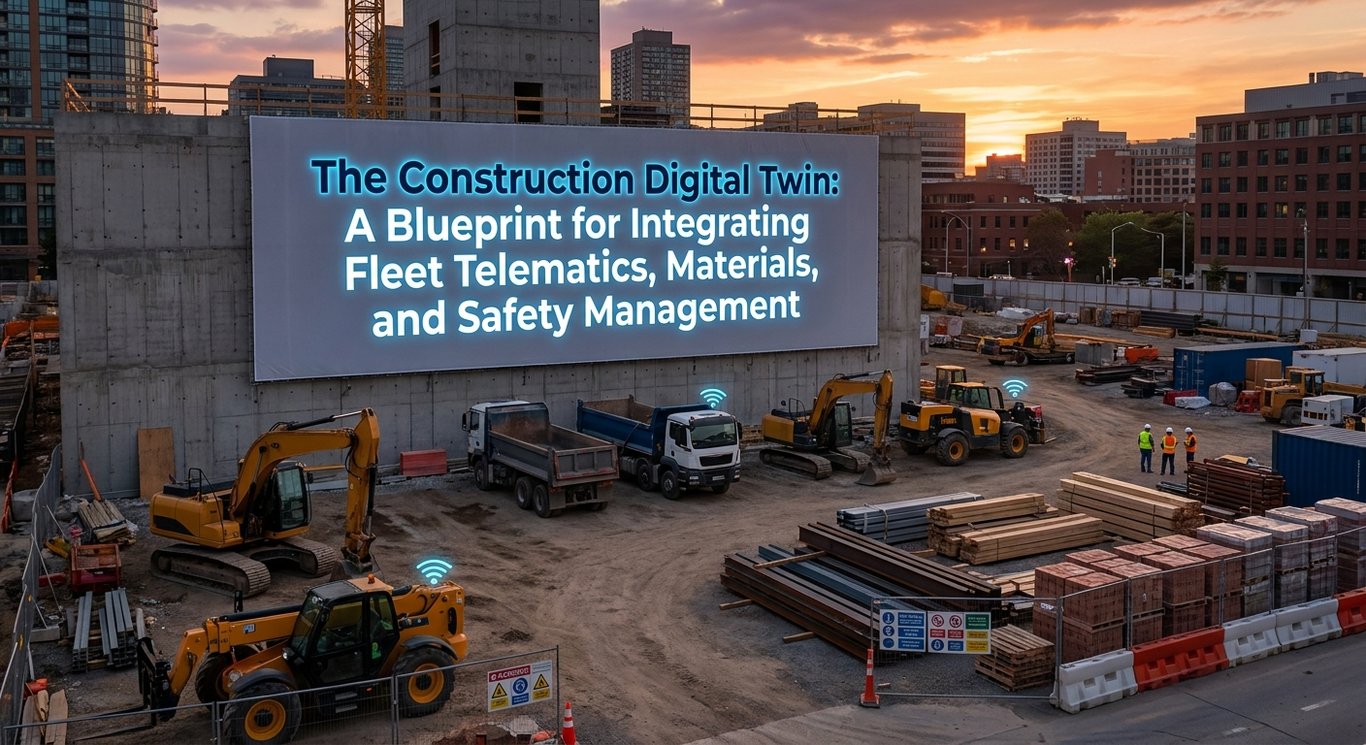
If you’re a contractor, owner, or project leader who’s been thinking about where to start, the answer is simpler than you might think: pick one problem, define one measurable outcome, and build the minimum viable twin that addresses it. Don’t wait for the perfect platform, the perfect dataset, or the perfect organizational conditions – they don’t exist. Start with what you have, learn as you go, and build from there. Assess your current systems honestly – where are the gaps, where is the data fragmented, where are the decisions being made with incomplete information? Use those gaps to define your integration priorities and create a phased implementation plan. The vision of The Construction Digital Twin: A Blueprint for Integrating Fleet Telematics, Materials, and Safety Management isn’t achieved in a single project or a single year – it’s built incrementally, use case by use case, with every step generating the data, the confidence, and the organizational capability to take the next one. The construction industry has everything to gain from making this journey. The question is simply where you choose to begin. 🚀