The construction industry is changing fast, and the jobsite of today looks nothing like it did a decade ago. 🏗️ The concept of a connected jobsite has moved from a futuristic idea to a strategic priority for contractors who want to stay competitive. At its core, a connected jobsite means bringing together fleet, materials, and safety management into one unified system – powered by telematics, the Internet of Things (IoT), and cloud-based platforms. Instead of managing these areas in separate silos, contractors can now see everything in one place, from where their excavators are running to whether a delivery of rebar just arrived on time. That kind of visibility changes how decisions get made on the ground.
The benefits of this integration are real and measurable. When fleet, materials, and safety data all talk to each other, contractors experience higher productivity, fewer incidents, better equipment utilization, and stronger regulatory compliance. This guide is designed to walk you through every major aspect of building and running a connected jobsite – from core definitions and key technologies to implementation roadmaps, ROI measurement, and answers to the most common questions contractors ask. Whether you’re just starting to explore telematics or looking to scale an existing program, this article has something for you. Let’s dig in. 🚜
What Is a Connected Jobsite? Core Concepts and Definitions
A connected jobsite is, in practical terms, a construction site where technology ties everything together in real time. It uses telematics, GPS tracking, sensors, and software platforms to connect fleets, materials tracking, and safety systems so that managers have a live picture of what’s happening across the entire operation. In a traditional jobsite management approach, a fleet manager might use one spreadsheet, a safety officer another system, and a materials coordinator a completely separate process – none of which communicate with each other. A connected jobsite breaks down those walls and creates a shared data environment where information flows freely and quickly.
The ecosystem of a connected jobsite typically includes several key components working together. Fleet telematics devices are installed on vehicles and heavy equipment to report location, engine data, and usage patterns. Asset and materials tracking systems monitor where supplies are on site and how they’re being consumed. Wearables and smart safety systems keep tabs on worker locations and behaviors in hazardous zones. All of this data flows into centralized dashboards that give project managers and safety leaders a single, unified view. Think of it like a control tower for your jobsite – everything is visible, and everything is connected. ✅
Key Technologies Behind the Connected Jobsite
The technologies that make a connected jobsite possible are more accessible than ever. Telematics devices installed on equipment capture data on location, engine hours, fuel consumption, fault codes, and operator behavior. GPS systems provide precise positioning for vehicles, machines, and even materials in transit. On-equipment sensors go even deeper – monitoring things like hydraulic pressure, payload weight, and temperature. Cameras add a visual layer, capturing driver behavior and site conditions in real time. All of this raw data is transmitted via cellular or satellite networks to cloud-based platforms where it’s processed, stored, and made available through web and mobile dashboards. The architecture doesn’t have to be complicated – what matters is that the data gets captured reliably and ends up somewhere useful.
What really ties a connected jobsite together is the ability of different systems to share data with each other through APIs and software integrations. A telematics platform might push fleet data into a project management tool, which then connects to a safety dashboard and a materials tracking system. The result is a “single pane of glass” – one interface where a project manager or safety leader can see fleet status, material deliveries, and worker safety alerts without jumping between five different apps. That kind of unified visibility is what transforms data from a collection of numbers into something that actually drives better decisions on the jobsite. 💡
Why Integrating Fleet, Materials, and Safety Matters for Contractors
Contractors today are operating under more pressure than ever before. Margins are tight, skilled labor is hard to find, regulations keep getting more complex, and many companies are running multiple projects across different locations simultaneously. These business realities make it nearly impossible to manage fleet, materials, and safety effectively when each function operates in its own bubble. Real-time visibility isn’t a luxury anymore – it’s a necessity. When a superintendent can’t tell where their equipment is or whether a critical material delivery is on schedule, the ripple effects on productivity and cost can be significant.
Integration solves this by making the right information available to the right people at the right time. When fleet data connects to project schedules, equipment downtime doesn’t catch anyone off guard – maintenance can be planned proactively instead of reactively. When materials tracking links to delivery schedules and site readiness, crews aren’t standing around waiting for supplies that haven’t arrived. And when safety data feeds into the same platform as fleet and operational data, safety leaders can spot patterns and intervene before incidents happen rather than just documenting them afterward. For superintendents and project managers, this kind of connected intelligence is what makes the difference between a project that runs smoothly and one that spirals into delays and cost overruns. 📊
Productivity, Cost Savings, and Risk Reduction
One of the most compelling arguments for a connected jobsite is the direct impact on productivity and cost. When fleet telematics reveals that a piece of equipment is sitting idle for three hours a day, that’s a concrete opportunity to reduce waste. When GPS tracking shows that haul trucks are taking inefficient routes, dispatchers can correct that in real time. When materials tracking systems alert site managers that concrete is about to run short, they can place orders before a pour gets delayed. These aren’t hypothetical scenarios – they’re the kinds of insights that connected systems generate every single day, and they add up to real savings in fuel, labor, and materials costs over the life of a project.
Beyond productivity, the risk reduction benefits of a connected jobsite are just as compelling. When fleet and safety data are auditable and actionable, contractors are better positioned to demonstrate compliance during regulatory inspections. Fewer accidents mean lower workers’ compensation claims and reduced insurance premiums over time. And when near-misses and incident precursors are logged automatically, safety teams can identify and address hazards before they escalate into something serious. The financial case for integration isn’t just about efficiency – it’s about protecting the business from the kinds of costly incidents that can derail a project or damage a company’s reputation. 🛡️
Connected Fleet Management: From Tracking to Total Control
Fleet management in construction has come a long way from clipboards and phone calls. Today, GPS tracking and telematics systems give fleet managers a comprehensive view of every vehicle and piece of heavy equipment in their operation. They can see where each machine is located, how many hours it’s been running, how much fuel it’s consuming, whether it’s sitting idle, and what fault codes the engine control module is throwing. For a company running dozens or hundreds of assets across multiple sites, that level of visibility is transformational. It means less time chasing down equipment and more time making smart decisions about how to deploy it.
“Before a machine ever breaks down, construction fleets have already lost 30-40% of their equipment’s productive time to idling – and the cost goes up when you account for fuel waste or the ripple event of project delays.” -Geotab
The real power of connected fleet management comes when that data is integrated with broader jobsite activity. When fleet telematics feeds into scheduling and dispatch systems, managers can make sure the right equipment is at the right place at the right time – and not burning fuel sitting idle somewhere else. Remote diagnostics mean that when a machine throws a fault code, a maintenance alert goes out automatically, and a technician can be dispatched before a minor issue becomes a major breakdown. Automated maintenance scheduling based on actual engine hours rather than calendar intervals helps extend equipment life and reduce unplanned downtime. In short, connected fleet management shifts the entire operation from reactive to proactive. 🔧
Safety-Focused Fleet Telematics
Fleet telematics isn’t just about knowing where your equipment is – it’s also one of the most powerful tools available for improving safety on and off the jobsite. Modern telematics systems can monitor a wide range of driver and operator behaviors, including speeding, harsh braking, sharp cornering, distracted driving, and unauthorized use of vehicles outside of approved hours or geofenced areas. When a driver exceeds a speed threshold or enters a restricted zone, automated alerts can be sent to supervisors immediately. More importantly, these systems support structured coaching workflows – so instead of just issuing warnings, managers can have data-driven conversations with operators about specific behaviors and track improvement over time.
The results of adopting safety-focused fleet telematics speak for themselves. Many construction organizations report meaningful reductions in safety incidents and measurable improvements in operator behavior after deploying telematics programs. These aren’t just anecdotal wins – they reflect a genuine shift in how safety is managed when fleet data becomes part of the safety toolkit. When fleet and safety systems share the same data environment, the line between “fleet management” and “safety management” starts to blur in the best possible way. 🚦
Materials Management in a Connected Jobsite
The scope of a connected jobsite extends well beyond machines and vehicles – it reaches into the supply chain and across every corner of the site where materials are stored, moved, or consumed. Telematics and asset tracking technologies can monitor loads in transit, track fuel deliveries, manage consumables inventory, and even pinpoint where specific materials are located within different zones of a large site. When a haul truck picks up a load of aggregate, a connected system can record the time, location, payload weight, and destination – creating a digital trail that connects supply chain activity to site production in real time.
[cta-call:Call2]
Materials management pain points are familiar to anyone who has run a construction project. Stockouts that halt production, over-ordering that ties up cash and creates storage headaches, lost materials that nobody can account for, and misallocated loads that end up in the wrong part of the site – these are costly and frustrating problems. Connected systems address these issues directly. Geofencing can trigger alerts when materials leave designated areas. Payload monitoring systems ensure that trucks are carrying the right amounts. Real-time inventory dashboards give project managers the information they need to adjust orders and allocations before small problems become big delays. 📦
Linking Materials Flows with Fleet and Production Plans
The true value of connected materials management emerges when it’s integrated with fleet operations and production schedules. When haul trucks, loaders, and cranes are tracked alongside material inventories and project timelines, it becomes possible to synchronize the movement of materials with the actual pace of construction. If a concrete pour is scheduled for Tuesday morning, the system can ensure that the right number of mixer trucks is dispatched, that the batch plant is notified, and that the receiving area on site is clear – all based on real-time data rather than guesswork and phone calls. That kind of coordination is what separates projects that finish on time from those that don’t.
Specific use cases like payload monitoring and cycle tracking take materials management even further. By measuring payload weights on haul trucks and tracking how many cycles per hour are completed between loading and dump zones, project managers can calculate production rates in real time and compare them against targets. If a shift is falling behind, adjustments can be made immediately rather than discovered in a daily report the next morning. These materials metrics tie directly to progress tracking, giving everyone from the field superintendent to the project owner a clear, data-backed picture of how the job is advancing. 📈
“Telematics can help track risky worker behavior, identify coaching opportunities, maintain OSHA (Occupational Safety and Health Administration) compliance and offer rich safety data reports.” -Geotab
Safety Management and Worker Protection in the Connected Jobsite
Worker safety is where the stakes of a connected jobsite are highest – because the consequences of getting it wrong aren’t measured in dollars, they’re measured in lives. Connected safety solutions bring together wearables, smart cameras, geofencing, and telematics to create a comprehensive picture of worker locations, behaviors, and exposure to hazards across the site. For example, geofenced exclusion zones around operating heavy equipment can trigger immediate alerts if a worker enters a danger area. Wearables can monitor fatigue indicators or detect falls. Smart cameras can identify workers who aren’t wearing required PPE and flag the situation for a supervisor in real time. These tools don’t replace human judgment – they amplify it. 👷
The ability to act on near real-time safety data changes the entire dynamic of how safety is managed on a jobsite. Instead of waiting for an incident to happen and then investigating what went wrong, safety teams can use live data to identify high-risk areas, spot patterns in unsafe behaviors, and intervene before something serious occurs. If a particular zone of the site is generating repeated proximity alerts between workers and equipment, that’s a signal to review the traffic management plan. If a specific operator is consistently triggering speed alerts, that’s a coaching opportunity. Connected safety systems turn the safety function from a documentation exercise into an active, data-driven discipline that continuously improves outcomes.
From Reactive Reporting to Proactive Safety Analytics
When safety data is integrated with fleet and materials information, something powerful happens – patterns start to emerge that would be invisible if each system operated independently. Maybe incidents involving a specific type of equipment tend to cluster around certain times of day or particular site zones. Maybe near-misses spike during periods of heavy materials delivery traffic. These kinds of insights are only visible when multiple data streams are analyzed together. Integrated safety analytics give safety leaders the ability to predict and prevent incidents rather than simply respond to them, shifting the entire safety culture from reactive to genuinely proactive.
The compliance and documentation benefits of connected safety systems are equally significant. Automated logs of equipment inspections, operator certifications, safety briefings, and incident precursors create a detailed, timestamped record that can be invaluable during regulatory audits or insurance reviews. Instead of scrambling to pull together paperwork after an incident, contractors who run connected jobsites have that documentation ready and organized at all times. That kind of readiness not only supports compliance – it demonstrates a level of professionalism and due diligence that can make a real difference in how regulators and insurers view a company. 📋
Designing an Integrated Platform: Data, Dashboards, and Workflows
Building a connected jobsite isn’t just about installing hardware – it’s about designing a platform that makes data useful for the people who need it. A well-designed integrated platform provides single-pane dashboards that bring fleet status, materials tracking, and safety alerts into one view. It supports configurable alerts so that the right people get notified about the right events without being overwhelmed by noise. Role-based access ensures that a field supervisor sees what’s relevant to their crew, while an executive dashboard shows high-level KPIs across all projects. Mobile views are essential – superintendents and safety managers aren’t sitting at desks, and they need to access real-time data from their phones or tablets on the go.
A thoughtful data strategy is just as important as the technology itself. Contractors need to choose solutions that are built for the specific demands of construction – not generic enterprise software that doesn’t understand the difference between a wheel loader and a delivery truck. Supporting mixed fleets from multiple equipment brands is a must, since most contractors don’t operate a single-brand fleet. Setting clear KPIs from the start – things like equipment utilization rates, safety incident frequency, cycle times, and material waste percentages – gives the platform configuration a purpose and makes it much easier to demonstrate value over time. Data without goals is just noise. 🎯
Choosing and Integrating Tools Across the Jobsite Tech Stack
Selecting the right telematics and jobsite management vendors requires looking beyond feature lists and price points. Interoperability is critical – can the platform connect with your existing ERP system, project management software, or BIM tools? Does it support open APIs that allow data to flow between systems without expensive custom development? Does it handle mixed fleets and multiple equipment brands, or does it only work well with one manufacturer’s machines? These questions matter a lot in practice, because a platform that can’t connect to the rest of your tech stack will just create a new silo instead of eliminating old ones. The goal is integration, not addition.
“The first requirement is a single operating view where equipment data lives together instead of in silos.” -Clue
The practical steps of integration deserve careful attention. Start by mapping the data fields that need to flow between systems – what information does your fleet platform need to share with your safety dashboard, and in what format? Test data quality early, because garbage in means garbage out. Run a pilot with a subset of assets before committing to a full rollout, so you can identify technical issues and workflow gaps before they affect the whole operation. And invest seriously in training – the best platform in the world won’t deliver value if the people who need to use it don’t know how or don’t trust it. Adoption is the final frontier of any technology initiative. 🤝
Steps to Implementing a Connected Jobsite Strategy
Implementing a connected jobsite strategy doesn’t have to be overwhelming, but it does require a clear plan. The most effective approach is phased: start by assessing your current systems and identifying your biggest pain points – whether that’s equipment downtime, materials delays, or safety incidents. From there, define specific goals for what you want to achieve and select a pilot project that gives you enough complexity to learn from without risking a major project. Choose your hardware and software based on the integration criteria discussed earlier, and set measurable success metrics before you flip the switch. Starting small and learning quickly is far better than trying to boil the ocean on day one. 🗺️
Change management is often the hardest part of implementing new technology – and it’s the part that gets the least attention. Building buy-in across operations, safety, and IT teams requires communicating the “why” clearly and honestly. Crews need to understand that connected systems are there to make their work safer and easier, not to spy on them or generate reasons to discipline them. Creating feedback loops where users can flag issues with dashboards, alerts, and reports – and actually seeing those issues addressed – builds trust and drives adoption. When people feel like they have a voice in how the system is configured, they’re much more likely to use it consistently and effectively.
Pilot Programs, Scaling, and Continuous Improvement
A well-designed pilot is the foundation of a successful connected jobsite program. Choose a site or fleet segment that is representative of your broader operation – not your easiest project and not your most complex one. Instrument the key assets, define your baseline metrics, and run the pilot for 60 to 90 days to give the data time to tell a meaningful story. Measure impacts on equipment utilization, safety incident rates, and materials waste compared to your pre-pilot baseline. Document what worked, what didn’t, and what you would configure differently next time. A good pilot doesn’t just prove that the technology works – it teaches you how to deploy it effectively at scale.
Scaling from a successful pilot is about standardizing what you learned and applying it systematically across additional sites. Document the configurations, alert thresholds, dashboard layouts, and training materials that worked in your pilot, and use them as the starting template for each new deployment. Build in a continuous improvement process from the beginning – schedule regular reviews of your dashboards and alert configurations, gather feedback from field teams, and make iterative adjustments as your operation evolves. The connected jobsite isn’t a one-time implementation; it’s an ongoing practice that gets smarter and more valuable over time. 🔄
Common Challenges and How to Overcome Them
Even the most enthusiastic adopters of connected jobsite technology run into challenges along the way. Data overload is one of the most common – when every piece of equipment and every worker is generating data, it’s easy to end up with more information than anyone can act on. Integration complexity is another real hurdle, especially when you’re trying to connect systems from different vendors that weren’t designed to work together. Resistance from operators and field crews – who may feel like they’re being watched or don’t see the personal benefit of the new systems – can slow adoption significantly. Privacy concerns, particularly around wearables and cameras, need to be addressed thoughtfully. And budget constraints are always a factor, especially for mid-sized contractors who can’t absorb large upfront technology investments easily.
The good news is that all of these challenges are manageable with the right approach. Focusing on a small number of high-value use cases – rather than trying to track everything at once – keeps data overload in check and makes it easier to demonstrate ROI. Simplifying dashboards so that each role sees only the information most relevant to their decisions reduces cognitive load and improves usability. Investing in training and coaching rather than using data primarily for discipline changes the entire tone of the program and dramatically improves crew acceptance. And partnering with vendors who have deep construction experience means you’re not figuring out industry-specific challenges from scratch – you’re building on proven solutions. 💪
“Telematics boosts safety by tracking vehicle locations in real-time and stopping unauthorized usage.” -Radius
Building a Data-Driven Culture on the Jobsite
Technology alone doesn’t build a connected jobsite – culture does. The most important shift is positioning telematics and connected systems as tools that support crews rather than tools that monitor them. When data is used primarily for coaching, maintenance planning, and identifying productivity opportunities, operators and field workers start to see the system as something that works for them rather than against them. A driver who gets coached based on telematics data and then sees their safety score improve feels supported. A crew that gets advance warning about equipment maintenance avoids the frustration of unexpected breakdowns. That’s a very different experience from one where data is used mainly to generate disciplinary actions.
Leadership behavior plays a huge role in shaping how crews relate to connected systems. When managers share performance wins publicly – “our utilization rate improved 15% this month” or “we’ve gone 90 days without a recordable incident” – it reinforces that the data is being used to celebrate progress, not just catch mistakes. Involving field teams in selecting the metrics that matter most to them creates a sense of ownership. Recognizing improvements in safety and efficiency, both formally and informally, signals that the organization values what the data reveals and respects the people who are driving those improvements. Culture is built one interaction at a time. 🌟
Measuring ROI of a Connected Jobsite
Measuring the return on investment from a connected jobsite starts with identifying the right metrics. On the quantitative side, the most meaningful indicators include reductions in safety incidents and near-misses, lower fuel consumption across the fleet, fewer unplanned equipment breakdowns, improved on-time delivery performance for materials, higher machine utilization rates, and reduced material waste. Each of these metrics has a direct dollar value that can be calculated and tracked over time. The key is establishing clear baselines before implementation so that you have a meaningful comparison point – otherwise, you’re measuring improvement against nothing, which makes it very hard to tell a compelling story to stakeholders.
Tracking and attributing benefits to connected jobsite initiatives requires discipline and consistency. Build dashboards that give executives a high-level view of the KPIs that matter most to the business, and update them regularly. Use case-study documentation to capture specific examples of value created – the equipment breakdown that was prevented by a remote diagnostic alert, the materials delivery that was rerouted based on real-time site data, the near-miss that was identified and addressed before it became an incident. These concrete examples bring the ROI story to life in a way that raw numbers alone can’t. Over time, the accumulation of these wins builds an undeniable business case for continued investment in connected jobsite technology. 💰
Case Examples and Benchmark Insights
Industry benchmarks consistently show that contractors who adopt integrated telematics and connected jobsite platforms see meaningful improvements across safety, productivity, and cost metrics. Adoption rates for telematics in construction have grown steadily year over year, and organizations that move beyond basic GPS tracking to integrated fleet, materials, and safety platforms report the strongest performance gains. The trend is clearly toward unified platforms that replace point solutions, as contractors recognize that the real value comes from connecting data streams rather than managing them in isolation. These benchmarks provide useful context for setting expectations and building internal business cases.
While industry benchmarks are a great starting point for understanding what’s possible, the most powerful ROI evidence will always come from your own operation. Use external benchmarks to set initial targets and frame conversations with leadership, then build your own internal benchmarks based on your specific fleet, project types, and operational context. Over time, your internal data will tell a more precise and credible story about the value of your connected jobsite investment than any industry average could. That internal evidence becomes a competitive asset – proof that your organization knows how to run smarter, safer, and more efficient projects. 🏆
FAQ: Common Questions About the Connected Jobsite
As contractors explore connected jobsite strategies, a consistent set of questions tends to come up. The following FAQ section addresses the most common ones – covering everything from basic definitions to implementation advice and ROI justification – so you can move forward with clarity and confidence.
FAQ 1: What exactly is a connected jobsite and how is it different from traditional site management?
A connected jobsite uses telematics, sensors, and integrated software platforms to provide real-time visibility across fleets, materials, and safety systems – all in one unified environment. Traditional site management, by contrast, tends to be fragmented: fleet data lives in one system, safety records in another, and materials tracking in a spreadsheet or not tracked at all. Information is often collected after the fact and shared through manual processes like daily reports or phone calls. The connected jobsite replaces that reactive, siloed approach with live data flows and integrated workflows that support faster, better-informed decisions at every level of the organization.
The difference isn’t just technological – it’s operational. In a traditional setup, a project manager might not know that a critical piece of equipment is broken down until a crew calls in from the field. In a connected jobsite, an automated alert fires the moment a fault code appears, and a maintenance work order can be created before the crew even realizes there’s a problem. That shift from after-the-fact reporting to real-time awareness is what makes the connected jobsite such a powerful model for modern construction management. 🔔
FAQ 2: Do we need to replace all our existing equipment to build a connected jobsite?
Absolutely not – and this is one of the most important things to understand before starting a connected jobsite initiative. Most modern telematics and asset tracking solutions are designed to work with mixed fleets and can be retrofitted onto existing machines and vehicles using aftermarket hardware. A GPS tracker or telematics unit can be installed on a ten-year-old excavator just as easily as on a brand-new one. Cameras, sensors, and wearables can be added to existing workflows without requiring equipment replacement. The technology is designed to work with what you have, not to force you into a wholesale fleet upgrade.
What matters far more than the age or brand of your equipment is the quality of the integration between your hardware and software systems. A well-configured telematics platform that connects data from a mixed fleet of multiple brands will deliver far more value than a single-brand solution that only works with the latest models. Focus your evaluation on interoperability, data quality, and ease of integration rather than on whether your equipment is new enough to qualify. Chances are, your existing fleet is more than ready to become part of a connected jobsite. 🛠️
FAQ 3: How does a connected jobsite improve safety for workers and operators?
Connected jobsite technology improves worker and operator safety through multiple overlapping mechanisms. Telematics systems monitor driver and operator behavior – flagging speeding, harsh braking, and distracted driving – and support coaching workflows that help operators develop safer habits over time. Geofencing creates virtual boundaries around hazardous areas, triggering immediate alerts if a worker or vehicle enters a restricted zone near operating heavy equipment. Smart cameras provide visual context that helps safety managers understand not just that an incident occurred, but exactly how and why it happened. Wearables can detect fatigue, monitor vital signs, and send distress signals if a worker is injured and unable to call for help.
Beyond individual interventions, integrated safety data supports a more systematic approach to risk management. When safety events are logged automatically and analyzed alongside fleet and operational data, patterns emerge that would be invisible in a manual reporting system. Safety teams can identify which tasks, equipment types, times of day, or site zones carry the highest risk, and direct their prevention efforts accordingly. Automated compliance documentation means that inspection records, certification logs, and incident reports are always up to date and audit-ready – reducing administrative burden while strengthening the organization’s overall safety posture. 🦺
FAQ 4: What is the first step for a company that has never used telematics or connected systems before?
The best first step for a company new to telematics is to start with a focused, well-defined pilot rather than trying to transform the entire operation at once. Choose one project or a specific segment of your fleet – ideally one where you already have a clear pain point, like high idle time, frequent equipment breakdowns, or a recent uptick in safety incidents. Define two or three measurable goals for the pilot, such as reducing idle time by 20% or cutting the number of safety alerts per week. Deploy basic telematics hardware and a dashboard that makes those metrics visible, and run the pilot for 60 to 90 days.
The purpose of the pilot isn’t just to prove that telematics works – it’s to learn how to use it effectively in your specific operational context. Pay attention to what the data reveals, how your team responds to it, and where the biggest opportunities for improvement lie. Use those learnings to refine your configuration, training approach, and alert thresholds before scaling to additional sites or assets. A well-run pilot gives you the evidence and the experience you need to build a compelling case for broader investment – and it dramatically reduces the risk of a large-scale rollout that doesn’t deliver expected results. 🚀
FAQ 5: How can we justify the investment and measure ROI for a connected jobsite initiative?
Justifying the investment in a connected jobsite starts with building a business case around tangible, quantifiable benefits. The most compelling arguments typically involve cost reduction: fewer accidents and workers’ compensation claims, lower fuel costs from reduced idle time and more efficient routing, reduced maintenance expenses from proactive diagnostics, and less material waste from better inventory management. On the revenue side, improved on-time performance and fewer project delays translate directly into better client relationships and stronger margins. Each of these benefits has a dollar value that can be estimated upfront and measured after implementation.
The key to measuring ROI accurately is establishing clear baselines before you start. Document your current fuel costs, incident rates, equipment utilization, and materials waste so you have a meaningful comparison point once the connected systems are running. After implementation, track the same metrics and calculate the difference. Even conservative improvements across multiple categories can add up to a return that significantly exceeds the cost of the technology. Over time, as your data matures and your team gets better at acting on it, the ROI will continue to grow – making the connected jobsite one of the highest-value investments a modern contractor can make. 💵
Conclusion: Turning Data into Safer, Smarter, More Efficient Jobsites
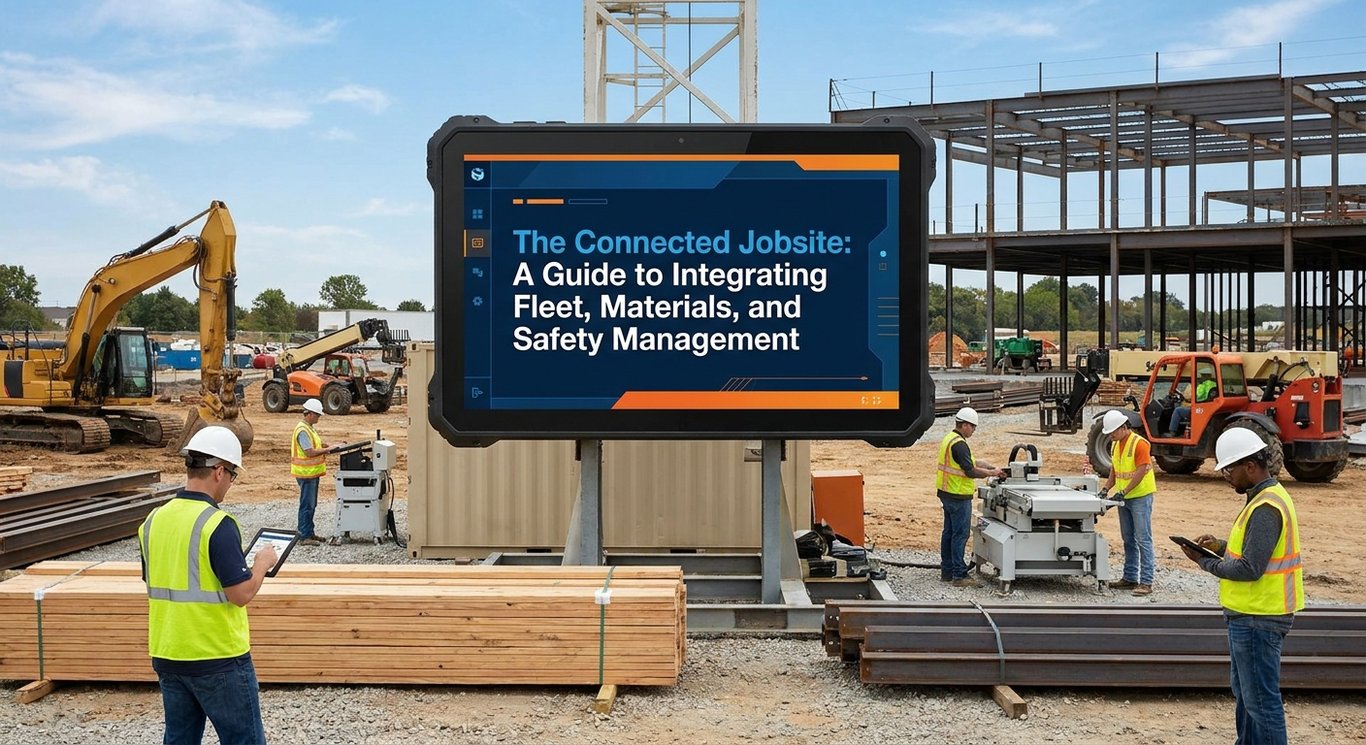
The central message of The Connected Jobsite: A Guide to Integrating Fleet, Materials, and Safety Management is straightforward: when you unify data and workflows across fleets, materials, and safety, you create a construction operation that is more productive, less risky, and more profitable. The key takeaways from this guide are equally clear. Start with well-defined goals rather than technology for its own sake. Prioritize integration and usability so that data actually gets used by the people who need it. Leverage telematics for proactive safety management rather than reactive reporting. And invest in building a culture where data is seen as a tool that supports crews and drives continuous improvement – not a surveillance system that generates disciplinary actions. When those principles are in place, the connected jobsite delivers on its full potential. 🏗️✅
If you’ve made it this far, you already have a solid foundation for moving forward. The next step is to take action. Start by assessing your current systems honestly – where are the biggest gaps in visibility? Where are fleet, materials, and safety data most disconnected from each other? Use The Connected Jobsite: A Guide to Integrating Fleet, Materials, and Safety Management as your roadmap for identifying high-impact use cases, evaluating platforms, planning pilots, and scaling successful practices across your projects. The contractors who embrace connected jobsite principles now aren’t just solving today’s problems – they’re building the operational capabilities that will define competitive advantage in construction for years to come. The data is there. The technology is ready. The only question is whether you’re ready to connect the dots. 🚀