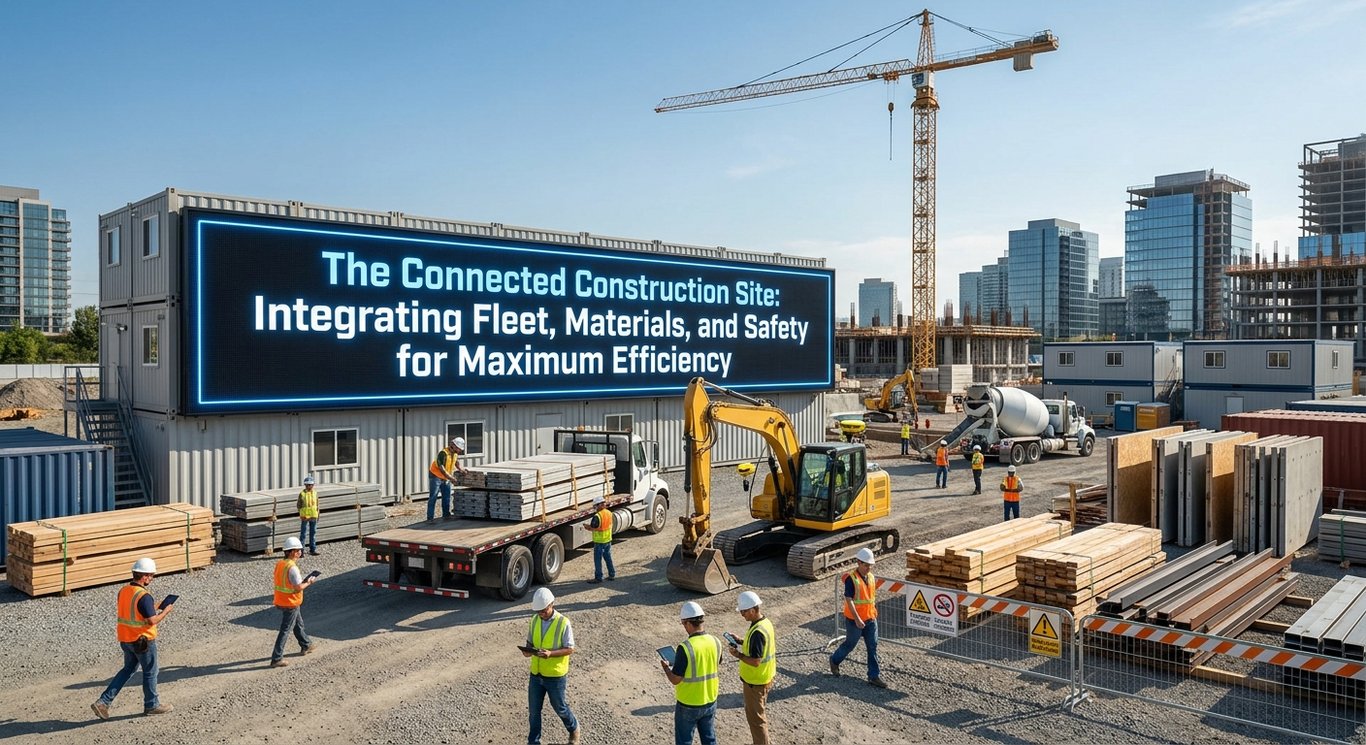
The construction industry is undergoing a major digital shift, and at the center of it all is the concept of the connected construction site. Simply put, a connected site is one where data from fleet vehicles, heavy equipment, materials, and safety systems all flows into a unified platform – giving project managers and site supervisors a real-time picture of everything happening on the ground. Technologies like IoT sensors, telematics devices, and cloud-based software platforms make this possible by continuously collecting, transmitting, and analyzing data from across the jobsite. What used to require clipboards, radio calls, and manual spreadsheets can now happen automatically, in real time, with far greater accuracy. 🏗️
The business case for integration is hard to ignore. Construction projects regularly suffer from unproductive equipment time, where expensive machines sit idle because no one knew they were available. Material delays throw schedules off track, leading to costly rework and labor waste. Safety incidents not only harm workers but also trigger regulatory scrutiny, insurance claims, and project shutdowns. These pain points eat into margins and damage reputations. By connecting fleet data, materials tracking, and safety monitoring into one operational view, contractors can address all of these challenges simultaneously – improving productivity, controlling costs, meeting compliance requirements, and reducing risk across the board.
This article is designed to be a practical guide for contractors at every level, from regional firms managing a handful of projects to large enterprises running complex, multi-site operations. We’ll walk through the key technology options available today, explain how to integrate data across fleet, materials, and safety domains, and lay out a realistic implementation roadmap. We’ll also tackle the human side of the equation – because even the best technology fails without proper change management. Whether you’re just starting to explore connected construction or looking to scale an existing program, this guide has something for you. Let’s dig in. 🚀
Understanding the Connected Construction Site Landscape
A connected construction site is defined by its ability to continuously collect and integrate data from every major operational domain – people, equipment, vehicles, and materials – and present that information in a way that drives smarter decisions. This is made possible through a combination of IoT sensors embedded in equipment and infrastructure, telematics devices installed in vehicles, wearables worn by workers, and cloud platforms that aggregate and analyze all of the incoming data streams. The result is a dynamic, real-time operational picture that replaces the fragmented, often outdated information that site managers have historically had to work with.
The main data domains on a connected site include fleet management (covering vehicles and heavy equipment), materials tracking (monitoring inventory, deliveries, and usage), safety monitoring (tracking worker locations, hazardous zone entries, and incident events), environmental monitoring (measuring dust, noise, and air quality), and workforce management (attendance, certifications, and productivity). What makes a site truly “connected” is not just collecting data in each of these areas, but integrating them so they inform one another. For example, knowing that a concrete delivery is arriving in 30 minutes is only useful if you also know that the pump truck is currently on-site and the crew is in position. That kind of cross-domain visibility is what separates a connected site from a site that simply has a few digital tools running in silos.
It’s also worth recognizing that “connected” is not a binary state – there’s a clear maturity curve. At the basic end, you might have GPS tracking on a few vehicles and a digital timesheet system. At the advanced end, you have fully integrated digital twins that model the entire site in real time, with predictive analytics flagging maintenance needs, material shortages, and safety risks before they become problems. Most contractors today fall somewhere in the middle, and that’s perfectly fine. Understanding where you are on this spectrum is the first step toward knowing where to invest next and what “good” actually looks like for your organization. 📊
Connected Fleet Management: From Visibility to Optimization
Fleet management on a connected construction site goes well beyond knowing where your trucks are. Connected fleet management encompasses a wide range of data points: GPS location, engine hours, fuel consumption, idle time, maintenance status, operator behavior, and equipment utilization rates. Telematics devices installed in vehicles and heavy equipment transmit this data continuously to a central platform, giving fleet managers and site supervisors the information they need to make real-time decisions. For construction companies managing mixed fleets of owned and rented assets – from excavators and dump trucks to concrete mixers and cranes – this level of visibility is genuinely transformative.
The benefits that contractors report from connected fleet management are significant and well-documented. Improved driver productivity is one of the most commonly cited gains, as telematics data makes it easy to identify inefficiencies in routing, idle time, and equipment usage. Speed monitoring helps prevent dangerous driving behavior on and around the site, which is especially important given the high-traffic, high-risk nature of active construction zones. Operators who know their behavior is being tracked tend to drive more carefully and use equipment more responsibly. Beyond safety, the performance data collected by telematics systems gives fleet managers deep insight into how each asset is performing, making it easier to spot problems early and schedule maintenance proactively. 🔧
One of the most powerful outcomes of connecting fleet data with broader jobsite IoT systems is the ability to run meaningful utilization analysis. When you can see not just where equipment is, but how many hours it’s working versus sitting idle, you can make much smarter decisions about asset allocation. If a particular excavator is running at 40% utilization on one site while another site is waiting on a rented machine, that’s a costly inefficiency that connected data makes visible immediately. Integrating fleet data with project cost tracking also enables more accurate job costing, because you can tie actual equipment hours and fuel usage directly to specific tasks and phases of a project.
“A connected jobsite is, in practical terms, a construction site where technology ties everything together in real time.” -Nektar
Getting started with connected fleet management doesn’t have to be overwhelming. A practical approach is to begin by deploying GPS tracking on your highest-value assets – the equipment and vehicles that represent the biggest cost or the greatest risk if they go down unexpectedly. From there, you can integrate telematics data with your existing maintenance schedules, so that service intervals are triggered by actual usage data rather than calendar dates. When evaluating platforms, look for solutions that are specifically designed for the construction industry, since they’ll typically support mixed fleets, handle the rugged data environments of active sites, and integrate with the project management and ERP systems you’re already using.
Materials Management in a Connected Construction Environment
Managing materials on a construction site has always been one of the most logistically complex challenges in the industry. Connected technologies are changing that in meaningful ways. IoT-enabled materials management uses tools like RFID tags, barcodes, and smart sensors to track materials from the moment they leave the supplier to the moment they’re installed on the project. This creates a digital chain of custody that gives project managers real-time visibility into what’s on-site, what’s in transit, and what’s been used – all integrated with the project schedule so that material needs and delivery timing are always aligned.
[cta-call:Call2]
The impact of connected materials data on project efficiency is substantial. Stockouts – where a critical material runs out mid-task and forces work to stop – are one of the most disruptive and preventable problems on a construction site. With real-time inventory visibility, site managers can see when stock levels are getting low and trigger reorders before work is interrupted. On the waste side, better tracking means materials are less likely to be misplaced, over-ordered, or left exposed to damage. For time-sensitive materials like concrete, connected monitoring is especially valuable – sensors can track temperature and environmental conditions to ensure that pours happen within specification windows, reducing the risk of costly rework. 🏚️
Some of the most exciting advanced use cases in connected materials management involve automation and spatial intelligence. License plate recognition systems, for example, can automatically log delivery vehicles as they enter the site, creating a timestamped record of every delivery without requiring manual check-in. Real-time spatial mapping tools can track the movement of both materials and equipment across the site, making it easy to see where bottlenecks are forming or where resources are being concentrated inefficiently. When this data is linked to worker attendance and fleet movement records, it creates a rich operational picture that helps site managers optimize workflows and reduce the kind of coordination failures that cause delays and cost overruns.
“Construction telematics is the integration of GPS tracking, engine diagnostics and CAN profiles into the data sent by off-highway equipment.” -Geotab
Safety, Compliance, and Worker Protection on the Connected Site
Worker safety is arguably the most important dimension of a connected construction site, and it’s also one of the areas where technology is delivering the most meaningful results. Connected safety systems use a combination of proximity wearables, geofencing, cameras, and automated event logging to monitor conditions across the site in real time. Workers wearing smart badges or wristbands can trigger alerts if they enter a restricted zone or get too close to operating heavy equipment. Geofences can automatically notify supervisors when an unauthorized person enters a hazardous area. And cameras with AI-powered analytics can detect unsafe behaviors – like workers not wearing PPE – and flag them for immediate follow-up. 🦺
Fleet telematics and in-vehicle technologies play a critical role in construction site safety as well. AI-enabled cameras mounted inside cabs can detect drowsiness, distraction, and other risky behaviors in real time, alerting both the operator and a remote supervisor. Speed monitoring ensures that vehicles stay within safe limits on and around the site. Backup alarms and proximity sensors help prevent the kind of struck-by incidents that are tragically common in construction environments. These technologies don’t just prevent accidents – they also create a documented record of safety compliance that can be invaluable during regulatory audits or insurance reviews.
Beyond in-vehicle safety, connected technologies also enhance a range of construction-specific safety practices. Pre-trip inspections, for example, can be digitized so that operators complete a structured checklist on a mobile app before starting a vehicle, with results automatically logged and flagged if a defect is reported. GPS and motion sensors can enforce secure equipment storage protocols by alerting managers if a machine is moved outside of authorized hours or zones. Loading and unloading procedures can be monitored through a combination of camera feeds and sensor data, ensuring that they’re carried out safely and in accordance with site protocols. These may sound like small improvements, but cumulatively they add up to a much safer and more disciplined operating environment.
Perhaps the most powerful benefit of integrated safety data is its ability to shift organizations from reactive to predictive risk management. When near-miss events, zone entries, machine status alerts, and environmental readings are all captured in a unified system, patterns start to emerge. You might discover that a particular intersection on the site generates a disproportionate number of near-miss alerts, or that safety incidents tend to cluster during certain shifts or weather conditions. This kind of insight allows safety managers to intervene before accidents happen, rather than simply responding after the fact. It also demonstrates a proactive safety culture to regulators and insurers – which can translate into real financial benefits through lower premiums and fewer compliance penalties. 📋
“IoT contributes to the safety of construction sites… [with] a comprehensive review of recent advances, limitations, and suggestions for future directions.” -ScienceDirect
Digital Twins, IoT Platforms, and Single-View Operations
Digital twins represent the most advanced expression of the connected construction site concept. A digital twin is a real-time virtual model of the physical site, continuously updated with data from cameras, IoT sensors, telematics devices, and asset tracking systems. It allows project managers to see not just where things are, but how they’re interacting – where people and machines are moving, which zones are congested, and how current conditions compare to the project plan. As the underlying data streams become richer and more accurate, digital twins can also support simulation and scenario planning, helping teams anticipate problems before they occur.
Integrated IoT platforms that power these capabilities typically offer a broad suite of management tools: asset management for tracking the location and status of all equipment and materials, process management for monitoring workflows and task completion, operator management for tracking certifications, behavior, and performance, and analytics dashboards that surface key metrics across all of these domains. The best platforms are designed to handle mixed fleets and diverse asset types – because real construction sites don’t have the luxury of working with a single, standardized equipment set. They also need to be robust enough to function reliably in the harsh, connectivity-challenged environments that characterize active construction sites.
The practical value of a “single pane of glass” operational view is hard to overstate. When a site manager can open one dashboard and immediately see where all equipment is located, who is operating each machine, what happened in a specific zone over the past hour, and what issues need attention right now – that’s a fundamentally different way of running a site. It eliminates the need to make dozens of phone calls to get a status update, reduces the risk of important information falling through the cracks, and enables much faster decision-making when things don’t go according to plan. In an industry where time truly is money, that kind of operational clarity is a genuine competitive advantage. 💡
Data Integration: Connecting Fleet, Materials, and Safety Streams
One of the most significant technical challenges in building a connected construction site is integration. Most contractors who have begun their digital journey find themselves with a collection of point solutions – a telematics platform for their fleet, a separate system for materials tracking, another tool for safety compliance – that don’t talk to each other. Each system generates valuable data, but because the streams are siloed, the cross-domain insights that would make the whole greater than the sum of its parts are simply not accessible. Solving this integration challenge is the key to unlocking the full value of connected construction technology.
“Predictive maintenance powered by equipment sensor data has reduced downtime incidents by 25-30% and improved asset utilization by 10-15%.” -Nature
Fortunately, there are several well-established approaches to integration that don’t require starting from scratch. APIs are the most common mechanism, allowing telematics platforms to share data with maintenance management systems, and materials tracking tools to sync with project scheduling software and BIM models. Workforce safety systems can be connected to zone geofences so that badge swipes automatically log entries and exits from restricted areas. Many modern platforms are built with open APIs precisely because the industry has recognized that no single vendor can serve every need – interoperability is now a baseline expectation rather than a premium feature. The key is to have a clear integration architecture in mind before you start adding new tools to your stack.
Data governance is another critical consideration that often gets overlooked in the excitement of deploying new technology. As data streams from multiple sources are combined, questions arise about consistency and quality: Are asset IDs standardized across systems? Who owns each dataset, and who is responsible for keeping it accurate? Which KPIs should be surfaced to site teams versus leadership, and at what level of detail? Without clear answers to these questions, integrated dashboards can quickly become cluttered and confusing, and the data they display can be unreliable. Investing time in data governance upfront pays dividends throughout the life of the connected site program. 📐
When integration is done well, the cross-domain insights it enables are genuinely eye-opening. Imagine being able to correlate material delivery delays with fleet utilization data and safety incident logs in a specific zone of the site. You might discover that deliveries to a particular area consistently arrive late because the access route is congested with equipment during certain hours – and that this congestion also correlates with a higher rate of near-miss events. That kind of multi-dimensional insight is simply not possible when data lives in separate systems. It’s the difference between managing a construction site and truly understanding it.
Choosing Technologies and Vendors for Connected Construction Sites
The technology landscape for connected construction is broad and growing rapidly, which makes vendor selection both more exciting and more complex. The main solution categories include fleet and telematics platforms (which track vehicles and equipment), construction IoT suites (which integrate sensors, cameras, and asset tracking across the site), safety wearables and analytics tools (which monitor worker behavior and environmental conditions), and digital twin and project management systems (which tie everything together into a unified operational model). Many vendors operate across more than one of these categories, and the lines between them are increasingly blurring as platforms expand their capabilities.
“The construction teams getting the most from their technology are connecting safety, equipment tracking, telematics, and reporting into a single operating view.” -Motive
When evaluating vendors, construction specialization should be near the top of your criteria list. A telematics platform built for logistics may not handle the mixed fleets, rough connectivity environments, and specialized equipment types that are common on construction sites. Beyond specialization, look for strong integration capabilities – the ability to connect with the other tools in your stack via open APIs is essential. Hardware robustness matters too, since sensors and devices need to survive the physical demands of an active construction environment. Analytics features, ease of use for site-level staff, and total cost of ownership (including hardware, software, and implementation) should all factor into your decision. 🔍
A phased approach to building your technology stack is almost always the right strategy. Start with the components that offer the clearest, fastest return on investment: GPS tracking on your highest-value plant, telematics for fleet safety monitoring, and critical materials monitoring for time-sensitive pours or deliveries. These investments tend to pay for themselves quickly and build the organizational confidence and data infrastructure needed to support more sophisticated capabilities later. From there, you can progressively add IoT sensors, safety wearables, and advanced analytics – scaling toward a fully integrated, IoT-enabled site management system as your team’s capabilities and appetite for data grow.
Implementation Roadmap and Change Management
Implementing connected construction technology is as much an organizational journey as it is a technical one. A practical roadmap starts with discovery and baseline measurement: understanding your current state, identifying the biggest pain points, and establishing the metrics you’ll use to measure success. This phase should involve conversations with site managers, fleet supervisors, safety officers, and frontline operators – the people who understand where the real friction is. From there, pilot projects on selected sites or fleets allow you to test technology choices, refine configurations, and build internal expertise before committing to a full rollout. Iterative expansion, guided by lessons learned in the pilot phase, is far more likely to succeed than a big-bang implementation. 📅
Engaging the people who will actually use the technology is one of the most important – and most frequently underestimated – aspects of implementation. Operators, supervisors, and foremen need to understand not just how to use new tools, but why those tools are being introduced and how they’ll make their working lives better. Framing connected technology as a way to reduce paperwork, get faster answers to operational questions, and work more safely tends to land much better than framing it as a monitoring or surveillance system. Hands-on demonstrations, peer champions who can answer questions from their colleagues, and clear communication about what data will and won’t be used for are all effective strategies for building buy-in at the site level.
Defining success metrics before you start is essential for demonstrating value and maintaining momentum. Key metrics for a connected construction program typically include equipment utilization rates, safety incident frequency and severity, on-time materials delivery percentages, maintenance compliance rates, and worker satisfaction scores. These should be tracked throughout the implementation process – not just at the end – so that you can identify what’s working, what needs adjustment, and where additional training or support is needed. Sharing progress updates with both leadership and frontline teams helps maintain engagement and reinforces the sense that the program is delivering real results. 📈
Every implementation encounters obstacles, and connected construction programs are no exception. Technology fatigue is real – if workers feel like they’re being asked to learn too many new tools at once, adoption suffers. Data overload is another common problem: dashboards that display too much information without clear prioritization quickly get ignored. Privacy concerns, particularly around worker monitoring, need to be addressed proactively through clear policies and transparent communication. Strong leadership support is the single most important factor in overcoming these challenges. When site managers and project leaders actively use and champion connected tools, the rest of the organization tends to follow. Simple, well-designed dashboards that surface the most important information clearly – rather than drowning users in raw data – also make a significant difference.
Measuring ROI and Continuous Optimization
The return on investment from connected construction technology comes from multiple directions simultaneously, which is part of what makes it so compelling. On the cost side, reduced fuel consumption from better fleet utilization and less idling, lower maintenance costs from predictive service scheduling, and reduced theft and asset loss from GPS tracking all contribute directly to the bottom line. On the revenue side, fewer safety incidents mean fewer project shutdowns and insurance claims, while better materials and fleet coordination means projects are more likely to finish on time – protecting margins and client relationships. These are not theoretical benefits; they are measurable outcomes that contractors are achieving today. 💰
Quantifying the benefits of telematics and IoT investment requires a disciplined approach to metrics. Productivity metrics like equipment utilization rates, driver efficiency scores, and equipment downtime hours give you a clear picture of how well your assets are being used. Safety metrics like incident frequency rates and severity scores tell you whether your safety programs are working. Comparing these metrics before and after implementation – and tracking them over time – is the most credible way to demonstrate ROI to leadership, clients, and insurers. It’s also the foundation for ongoing optimization, because you can’t improve what you don’t measure.
Continuous optimization is what separates organizations that get lasting value from connected construction technology from those that see initial gains and then plateau. This means regularly reviewing dashboards with site teams, running root-cause analyses when incidents or delays occur, and using predictive analytics to get ahead of problems before they happen. Predictive maintenance alerts, for example, can flag equipment that is showing early signs of failure before it breaks down on the job. Materials analytics can identify patterns in delivery delays and help procurement teams build more resilient supply chains. The connected site is not a one-time project – it’s an ongoing operational discipline that keeps getting smarter as more data accumulates and teams get better at acting on it. 🔄
Frequently Asked Questions About the Connected Construction Site
What is a connected construction site and how is it different from a traditional site? A connected construction site is one where data from fleet vehicles, heavy equipment, materials, safety systems, and workforce management tools is continuously collected and integrated into a unified operational view. On a traditional site, these domains operate in silos – fleet managers, safety officers, and materials coordinators each have their own systems and processes, and information sharing happens through phone calls, meetings, and manual reports. The connected site replaces this fragmented approach with real-time, integrated data flows that give every stakeholder a shared, accurate picture of what’s happening on the ground. The result is faster decision-making, fewer coordination failures, and a much stronger ability to anticipate and prevent problems before they escalate.
How do I get started with connecting my fleet and equipment? The best place to start is with GPS tracking on your highest-value assets – the vehicles and equipment that represent the greatest cost or the greatest operational risk. Once you have basic location data flowing, you can layer in telematics devices that capture engine hours, fuel usage, and operator behavior. The next step is choosing a telematics platform that’s designed for the construction industry and integrating it with your existing maintenance management workflows, so that service schedules are driven by actual usage data. From there, you can expand to broader fleet management capabilities and eventually connect your fleet data with materials tracking and safety systems for a more complete operational picture. Start simple, prove value quickly, and build from there. 🛠️
Is connected construction technology only for large contractors? Absolutely not – and this is one of the most important misconceptions to dispel. While large enterprises may have the resources to deploy comprehensive, fully integrated connected site solutions from day one, the technology is increasingly accessible to smaller and mid-sized firms as well. Cloud-based platforms have dramatically reduced upfront costs, and many vendors offer modular, subscription-based pricing that allows smaller contractors to start with one or two high-impact use cases and scale over time. A regional contractor with a fleet of 20 vehicles can get significant value from basic GPS tracking and telematics without needing to invest in a full IoT suite. The key is to focus on the use cases that address your biggest pain points and deliver the fastest return – not to try to do everything at once.
How does a connected site improve safety and compliance? Connected technology improves safety in several interconnected ways. Telematics data has been shown to reduce speeding, improve operator behavior, and decrease the frequency of safety incidents – with a significant percentage of contractors reporting measurable safety improvements after adopting these tools. Geofencing alerts supervisors when workers or vehicles enter restricted zones. AI-enabled cameras detect dangerous behaviors in real time. Proximity wearables warn workers when they’re getting too close to operating equipment. And all of these systems generate detailed logs that document safety compliance for regulatory purposes. Together, they shift safety management from a reactive, incident-response model to a proactive, data-driven one – which is where the real gains in worker protection come from. 🦺
What are the biggest challenges when implementing connected construction solutions? Integration complexity is typically the first major challenge – getting data from multiple systems to flow into a unified platform requires careful planning, the right APIs, and sometimes custom development work. Training demands can also be significant, particularly for frontline workers who may not be comfortable with new technology. Cultural resistance is real, especially if workers perceive connected tools as surveillance rather than support – which is why transparent communication and strong leadership engagement are so important. Data governance is another frequent stumbling block: without clear standards for asset IDs, data ownership, and KPI definitions, integrated dashboards can become unreliable and confusing. The good news is that all of these challenges are manageable with the right planning, the right partners, and a phased implementation approach that allows the organization to learn and adapt as it goes.
Conclusion: Turning Connected Construction Into a Competitive Advantage
The connected construction site is not a distant vision – it’s a practical reality that contractors of all sizes are building today, one data stream at a time. By integrating fleet, materials, and safety data through IoT sensors, telematics devices, and cloud software platforms, construction companies are achieving measurable improvements in productivity, cost control, and worker safety. The shift from reactive to predictive operations – where problems are anticipated and addressed before they become incidents or delays – is perhaps the most transformative benefit of all. And it’s made possible by cross-domain visibility: knowing where equipment is, how materials are flowing, and what’s happening in every safety zone, all at the same time, in real time. 🏆
If you’re ready to take the next step, start by honestly assessing your current level of connectivity. Where are your biggest pain points? Where is data siloed, manual, or simply missing? Identify one or two high-value starting points – fleet telematics and critical materials monitoring are excellent choices for most contractors – and begin designing your roadmap for “The Connected Construction Site: Integrating Fleet, Materials, and Safety for Maximum Efficiency.” Remember that even incremental steps deliver real value. Centralizing your telematics data, adding safety monitoring wearables, or connecting your materials tracking to your project schedule can each produce tangible benefits and lay the foundation for a more advanced, data-driven operation. The connected site is a journey, not a destination – and every step forward makes your projects safer, smarter, and more competitive. 🚧