Construction safety has come a long way from the days when a hard hat and a pair of steel-toed boots were considered enough protection. Today, the industry is shifting from a reactive mindset – one that responds to incidents after they happen – toward a proactive approach that identifies and eliminates risks before anyone gets hurt. Personal protective equipment (PPE) remains absolutely essential on every job site, but it simply cannot address every danger that workers face, especially those involving moving vehicles, heavy machinery, distracted driving, unauthorized equipment use, operator fatigue, or poorly maintained assets. The gap between what PPE can protect against and what actually causes harm on a construction site is wide, and that gap is exactly where a smarter safety strategy needs to step in. 🦺
Fleet telematics is one of the most powerful tools available to fill that gap. By combining GPS location data, equipment diagnostics, driver behavior monitoring, real-time alerts, maintenance tracking, and detailed reporting, telematics gives safety leaders a clear, data-driven picture of what is actually happening across their fleet and their job sites. This article explores how construction companies can use these capabilities to catch risks early, coach operators more effectively, and build a culture where safety is everyone’s daily responsibility. It is important to say upfront, though, that technology is a support tool – not a replacement for solid training, skilled supervision, thoughtful site planning, and active worker participation. The best safety programs combine all of these elements together.
Why Construction Safety Requires More Than Personal Protective Equipment
Construction sites are among the most complex and dynamic work environments on the planet. On any given day, a single project might involve delivery trucks, concrete mixers, cranes, loaders, excavators, forklifts, and dozens of workers moving through the same tight space – all while the terrain, layout, and hazard profile change from hour to hour. Add multiple subcontractors, shifting schedules, and tight deadlines into the mix, and you have a recipe for serious risk. Hard hats, high-visibility vests, and safety glasses protect workers from many hazards, but they offer almost no protection when a 40,000-pound excavator swings its arm unexpectedly or a haul truck backs up without a clear sightline. These moving-equipment and struck-by hazards require operational controls – rules, systems, and technology – that go well beyond what any piece of PPE can provide. 🚧
OSHA identifies four leading causes of construction fatalities, often called the “Fatal Four”: falls, struck-by incidents, electrocution, and caught-in or caught-between events. Together, these hazards account for the majority of construction worker deaths each year. Fleet telematics is particularly relevant to two of these categories – struck-by and caught-in or caught-between incidents – because both frequently involve mobile equipment interacting with workers in dangerous ways. When a vehicle speeds through a pedestrian zone, when a loader operates too close to an excavation edge, or when a truck driver is distracted while backing up, the consequences can be fatal. Telematics helps surface these behaviors and conditions in real time, giving supervisors the information they need to intervene before a near miss becomes a tragedy.
What Fleet Telematics Means in a Construction Environment
At its core, fleet telematics is the collection and transmission of data from vehicles and equipment using a combination of GPS receivers, onboard sensors, diagnostic port connections, cameras, and cloud-based software. Every time a piece of equipment moves, idles, accelerates, brakes, or triggers a fault code, that information is captured and sent to a central platform where managers and safety leaders can review it. In a construction context, this might include data from pickup trucks and service vans all the way up to cranes, excavators, and articulated dump trucks. The result is a continuous stream of operational intelligence that would have been impossible to gather manually just a decade ago. 📡
It is worth distinguishing between basic GPS tracking and a full telematics platform, because the difference matters enormously for safety. A simple GPS tracker tells you where an asset is – and that is useful – but a comprehensive telematics system tells you so much more. It can report engine hours, idle time, harsh braking events, rapid acceleration, speeding relative to posted limits or site-specific thresholds, seat-belt status, geofence violations, diagnostic fault codes, pre-trip inspection results, camera footage from in-cab or exterior cameras, and upcoming maintenance milestones. Each of these data points represents a potential safety signal, and together they create a detailed picture of how equipment is being operated, maintained, and managed across an entire fleet.
Fleet Telematics Versus Equipment Tracking
It is easy to use the terms “equipment tracking” and “fleet telematics” interchangeably, but they are not the same thing. Equipment tracking primarily answers one question: where is this asset right now? That is valuable for theft prevention and scheduling, but it leaves a lot of important safety information on the table. Fleet telematics goes further by also answering how the asset is being operated, when it is being used, by whom it is being driven, and what mechanical condition it is in. When you combine location data with behavior monitoring and equipment health information, you create a much stronger and more actionable safety picture – one that can help you prevent incidents rather than simply respond to them after the fact.
How Telematics Helps Prevent Struck-By and Vehicle-Related Incidents
One of the most powerful safety applications of telematics on a construction site is the ability to monitor where vehicles and equipment are in relation to workers and work zones. GPS location data, combined with geofencing tools, allows safety managers to define specific areas of a site – loading zones, blind corners, excavation edges, haul roads, pedestrian corridors – and receive alerts when vehicles enter, exit, or linger in those areas unexpectedly. For example, if a delivery truck drives into a zone that has been designated as pedestrian-only, a supervisor can be notified immediately and take action before a worker is struck. This kind of spatial awareness is simply not possible with PPE alone, and it directly addresses one of the most dangerous dynamics on any active construction site. 📍
Beyond location, telematics can reveal risky driving patterns through speed alerts, harsh-braking reports, rapid acceleration notifications, and seat-belt monitoring. If a haul truck driver is consistently braking hard at the bottom of a ramp, that pattern suggests either a behavior issue or a site design problem – and either way, it needs to be addressed. The key is to set alert thresholds that are appropriate for specific equipment types and site conditions rather than applying a one-size-fits-all standard. A speed limit that makes sense for a pickup truck on an access road may be completely inappropriate for a fully loaded articulated dump truck navigating a steep grade. Thoughtful threshold design makes alerts more meaningful and more actionable.
Trend reports are where telematics really starts to shine as a proactive safety tool. Instead of reacting to individual incidents, safety managers can look at patterns over time – identifying recurring risks by operator, route, shift, project, vehicle type, or work zone. Maybe harsh braking events spike every afternoon on a particular haul road, or one operator consistently exceeds speed limits near the site entrance. These patterns are opportunities for coaching, hazard correction, and process improvement, not just discipline. A safety culture that uses data to coach and correct – rather than simply punish – is far more likely to produce lasting behavior change and genuine risk reduction. 📊
“The Fatal Four claimed the lives of 745 construction workers annually, accounting for 70% of all construction fatalities.” -Centers for Disease Control and Prevention
Using Real-Time Alerts to Move From Reactive to Proactive Safety
Real-time alerts are one of the most immediate and practical benefits of a telematics system. Rather than discovering that a vehicle was speeding or entered a restricted area after the fact, supervisors can receive a notification while the event is still unfolding – giving them a chance to intervene before an incident occurs. These alerts can cover a wide range of risk indicators: speeding, unauthorized vehicle movement outside of scheduled hours, entry into geofenced exclusion zones, excessive idling that might signal operator distress or equipment issues, harsh maneuvering, or diagnostic fault codes that suggest a safety-critical system is failing. The difference between knowing about a risk in real time versus learning about it in a weekly report can literally be the difference between a near miss and a fatality. ⚠️
Of course, receiving an alert is only the beginning – what matters is what happens next. An effective alert-response workflow starts with clearly defining what risk each alert represents and assigning it to the right person to receive and act on it. When an alert fires, the responsible supervisor should verify the situation, contact the operator if necessary, and document both the event and the response. Just as importantly, the team should periodically review whether the alert threshold is set correctly and whether a site control – a sign, a barrier, a route change – should be put in place to prevent the same situation from recurring. Alerts that are consistently ignored or that never lead to any action quickly lose their value.
Designing Alerts Workers Can Act On
One of the most common mistakes organizations make when deploying telematics is turning on every available alert and flooding supervisors with notifications. This creates alert fatigue – a condition where people start ignoring alerts because there are simply too many of them, including a high volume of false positives. The solution is to be deliberate and selective. Prioritize high-severity events, route alerts to the supervisor who is best positioned to respond, establish clear escalation rules for situations that require immediate action versus those that can be reviewed at the end of a shift, and audit your alert settings regularly to eliminate noise. A smaller number of well-designed, highly actionable alerts will always outperform a flood of low-quality notifications. 🔔
Creating Safer Work Zones With Geofencing and Site Intelligence
Geofencing is the practice of drawing digital boundaries around specific areas of a job site and configuring the telematics system to trigger an alert – or log an event – whenever a vehicle or piece of equipment crosses those boundaries. On a construction site, geofences can serve many different safety purposes. They can mark speed-restricted areas near site entrances or worker gathering points, define pedestrian-only zones where no vehicle should travel, establish exclusion zones around active excavations or overhead power lines, identify laydown yards and fuel areas where only authorized equipment should operate, and flag project boundaries to prevent equipment from drifting into adjacent public areas. Each of these digital boundaries adds a layer of visibility that physical signage alone cannot provide. 🗺️
[cta-call:Call2]
Beyond individual safety alerts, geofence event data can also support broader site logistics and planning decisions. If the data shows that delivery trucks are consistently entering the wrong gate or cutting through a pedestrian zone to save time, that is a signal to redesign the traffic flow, adjust the delivery schedule, or add physical barriers to reinforce the intended route. This is an important point: digital controls should always work in combination with visible signs, physical barricades, designated spotters, and site-specific safety plans – not instead of them. Telematics makes existing controls smarter and more measurable, but it does not replace the fundamentals of good site design and hazard management.
Driver Behavior Monitoring, Coaching, and Accountability
Modern telematics platforms can track a wide range of operator behavior indicators that are directly relevant to construction site safety. These typically include speeding relative to posted or site-specific limits, harsh braking events, rapid acceleration, aggressive cornering, excessive idling, seat-belt compliance, and unauthorized vehicle use outside of assigned hours or locations. Some advanced systems also support phone distraction detection through in-cab cameras or AI-based monitoring tools. Together, these data points create a behavioral profile for each operator and each vehicle that safety leaders can use to identify patterns, prioritize coaching conversations, and measure improvement over time. 🚗
“Approximately 75% of struck-by fatalities involve heavy equipment (including vehicles).” -OSHA.com
Turning behavior data into a fair and effective coaching program requires more than just printing out a scorecard and handing it to an operator. The most successful programs use driver scorecards as a starting point for private, respectful conversations – not as a gotcha tool. Supervisors should acknowledge improvement, not just flag problems. Operators who show consistent safe behavior deserve recognition. Those who are struggling with specific behaviors should receive targeted remedial training, ride-alongs with a safety coach, and documented follow-up to track whether the coaching is working. The goal is behavior change, not blame, and the data should always be used in service of that goal rather than as a disciplinary shortcut.
Privacy and trust are not optional considerations – they are fundamental to making a driver behavior monitoring program work. Workers who feel surveilled without explanation or consent are likely to resist the program, resent management, and find ways to game the data. The right approach is to be transparent from day one: explain clearly what is being monitored and why, who has access to the data, how long it is retained, and how it will – and will not – be used. Commit to using data for coaching and safety improvement rather than for punitive purposes unrelated to safety. When workers understand the purpose and trust that the program is fair, they are far more likely to engage with it honestly and constructively. 🤝
Predictive Maintenance as a Construction Safety Control
Equipment failures are not just costly – they can be deadly. A brake system that fails on a loaded dump truck, a hydraulic line that bursts on an excavator, or a lighting system that stops working on a night-shift vehicle are all examples of mechanical conditions that can turn a routine operation into a catastrophic event. Telematics helps prevent these situations by continuously monitoring engine hours, diagnostic fault codes, battery condition, tire-related sensor data where available, fluid levels, and service interval milestones. When a fault code appears or a service milestone approaches, the system can automatically notify maintenance teams so they can address the issue before it becomes a failure. This kind of predictive maintenance approach is one of the most underappreciated safety benefits of a well-implemented telematics program. 🔧
Maintenance teams that rely solely on calendar-based schedules – servicing equipment every 30 days regardless of how much it has actually been used – often find themselves either over-maintaining low-activity assets or under-maintaining high-use ones. Telematics enables a smarter, condition-based approach by prioritizing inspections according to actual asset usage and health data. This works best when it is combined with rigorous pre-trip inspections, clear defect reporting procedures, proper lockout and tagout protocols for equipment taken out of service, thorough repair verification, and documented return-to-service checks. Every step in this process creates a record that can be reviewed, audited, and used to continuously improve maintenance practices across the fleet.
Using Telematics Data to Improve Daily Safety Meetings
Toolbox talks, pre-task planning sessions, and morning briefings are some of the most valuable safety touchpoints in any construction operation – but they are only as effective as the information they are based on. When supervisors walk into these meetings with generic safety reminders, workers often tune out. When they walk in with specific, recent data from their own site – “We had three harsh braking events near the east gate yesterday afternoon” or “One piece of equipment entered the pedestrian zone twice this week” – the conversation becomes immediately relevant and much harder to ignore. Telematics gives supervisors exactly this kind of site-specific, timely information to bring into daily safety discussions. 📋
The real power of data-driven safety meetings comes when the conversation goes beyond simply reporting what happened and moves into understanding why it happened and what to do about it. Encourage crews to validate the data – sometimes there is a legitimate explanation for an alert that reveals a site condition issue rather than an operator behavior problem. Ask workers to identify contributing factors: Was the sightline blocked? Was the signage unclear? Was the road surface too rough for safe braking? Then assign specific corrective actions with clear owners and deadlines. This approach transforms safety data from a management report into a shared problem-solving tool, which is exactly the kind of engagement that builds a genuine safety culture.
“93% of companies reported improvements in safe driving, with 37% reporting significant improvements thanks to their telematics systems.” -National Safety Council
Building a Safety Culture Around Learning, Not Surveillance
A proactive safety culture is one that does not wait for accidents to happen before taking action. It actively looks for weak signals – near misses, unusual patterns, minor equipment issues, worker concerns – and treats them as valuable early warnings rather than nuisances. It encourages workers to report problems without fear of punishment, corrects hazards before they cause harm, and treats safety as a shared operational responsibility rather than a compliance checkbox. This kind of culture does not emerge from technology alone – it is built through leadership behavior, consistent communication, and a genuine commitment to treating every worker as a valued contributor to the safety process. 🏗️
The risk with any monitoring technology is that it can easily slide from a safety tool into a surveillance program – and once workers perceive it that way, trust evaporates and the program’s effectiveness collapses. Leaders can prevent this by being transparent about how telematics data is used, involving workers in the design of policies and alert thresholds, applying just-culture principles that distinguish between honest mistakes and intentional misconduct, and consistently recognizing safe behavior alongside correcting unsafe behavior. The data should be used to improve systems and support people, not to build a case against them.
Frontline workers are an invaluable source of safety intelligence that telematics simply cannot capture on its own. They know which routes have poor sightlines, which intersections get dangerously congested during shift changes, which pieces of equipment have quirks that make them harder to operate safely, and which alerts are triggering for reasons that have nothing to do with operator behavior. Creating a formal channel for workers to report these observations – and demonstrating that their input leads to real changes – is one of the most effective ways to make a telematics program stronger over time. Data and human experience work best together, and a culture that values both will always outperform one that relies on either alone. 💡
Integrating Telematics With Existing Construction Safety Systems
Fleet telematics should not exist as a standalone system – it is most powerful when it is connected to the broader safety management ecosystem that construction companies already use. This means linking telematics data with job hazard analyses, site-specific safety plans, incident investigation processes, daily pre-trip inspections, near-miss reporting systems, operator training records, dispatch and scheduling software, maintenance management platforms, and contractor oversight processes. When all of these systems share information and speak a common language, safety leaders get a much more complete picture of risk across their operations – and they can identify connections between fleet behavior and other safety outcomes that would be invisible if the data were siloed. 🔗
Integrated records are particularly valuable for incident investigations and trend analysis. When a vehicle collision or equipment incident occurs, investigators can pull together telematics data, inspection records, maintenance history, training records, and near-miss reports to understand the full sequence of events and contributing factors. Over time, comparing operational behavior data with incident and near-miss outcomes helps teams identify which leading indicators are most predictive of harm on their specific types of projects. This requires consistent definitions, shared data standards, and clear ownership across safety, operations, fleet management, maintenance, and project management – but the investment in integration pays off in the quality and speed of safety decision-making.
Choosing the Right Telematics Solution for a Construction Fleet
Selecting a telematics platform for a construction fleet is not as simple as picking the one with the most features or the lowest price. Construction fleets are often highly mixed, including everything from light-duty pickups to heavy off-road equipment, and not every telematics solution handles that diversity well. Key selection criteria should include compatibility with the full range of assets in your fleet, robust support for heavy and off-road equipment, the ability to operate in low-connectivity or offline environments common on remote job sites, GPS accuracy appropriate for your site scale, available sensor options, camera functionality, geofencing tools, maintenance tracking capabilities, API integrations with other software, reporting depth, mobile access for field supervisors, and data security standards. 🖥️
“Among fleets that combine telematics with training, 78% reported fewer crashes or claims, while 89% reported improved safety.” -Work Truck Online
Usability is just as important as functionality – maybe more so. A platform that is technically impressive but difficult to navigate will not get used consistently, and inconsistent use undermines the entire safety program. The right platform should offer clear, intuitive dashboards that present the most important information at a glance, configurable alert settings that supervisors can adjust without needing IT support, role-based permissions that ensure the right people see the right data, simple mobile workflows for field use, and reports that are actionable without requiring extensive data analysis skills. If a site supervisor has to spend 30 minutes interpreting a report before they can use it in a toolbox talk, the platform is not doing its job.
Before committing to a full fleet rollout, it is strongly recommended to run a structured pilot program on a subset of vehicles or a single project site. Define clear safety objectives for the pilot – what specific risks are you trying to address, and how will you know if the system is helping? Track metrics like alert response time, behavior trend changes, maintenance work order completion rates, near-miss reporting frequency, and user satisfaction. Gather feedback from operators and supervisors regularly. Use what you learn to refine alert thresholds, adjust workflows, and fix usability issues before scaling up. A well-run pilot turns a large, risky technology investment into a series of small, manageable learning steps. 📈
Measuring Whether Telematics Improves Site Safety
One of the most important disciplines in any safety program is knowing the difference between leading indicators and lagging indicators – and tracking both. Leading indicators are the early warning signals that something might go wrong: speeding events per 100 hours of operation, seat-belt compliance rates, percentage of pre-trip inspections completed on time, average time to close a maintenance work order, geofence violation frequency, near-miss reports submitted per month, and corrective actions closed within the target timeframe. These metrics tell you whether your safety controls are working before an incident occurs, which is exactly where you want to be spending your attention. 📉
Lagging indicators, on the other hand, measure outcomes that have already happened: vehicle collisions, equipment damage incidents, worker injuries, lost-time events, unplanned downtime, and workers’ compensation costs. These are important to track, but they are by definition backward-looking – they tell you what went wrong, not what is about to go wrong. The most effective safety measurement programs use leading indicators to drive daily decisions and lagging indicators to validate whether those decisions are producing the right outcomes over time. Results should always be reviewed in context, adjusting for fleet size, total operating hours, project type, and the level of hazard exposure on each site, to avoid drawing misleading conclusions from raw numbers.
Common Implementation Challenges and Practical Solutions
Worker resistance is one of the most common obstacles to a successful telematics rollout, and it is also one of the most preventable. When workers feel that monitoring technology is being imposed on them without explanation or input, they naturally push back – and sometimes they find creative ways to defeat the system. The solution is to engage workers early and honestly. Explain the specific safety problems you are trying to solve, involve operators in designing the policies that will govern how data is used, make clear privacy commitments and stick to them, and show workers concrete examples of how telematics data has led to better equipment, safer routes, or more targeted training. When people understand that the technology is working for them rather than against them, resistance tends to drop significantly. 🙌
Poor data quality is a less visible but equally damaging challenge. If GPS coordinates are consistently off, if fault codes are not being read correctly, if vehicles are assigned to the wrong operators, or if equipment records are out of date, the safety insights generated by the system will be unreliable – and unreliable data is worse than no data, because it creates false confidence. Address this through regular sensor calibration, rigorous asset record maintenance, consistent driver identification procedures, periodic system audits, and clear processes for flagging and correcting inaccurate information. Data quality is not a one-time setup task – it requires ongoing attention and ownership.
Budget constraints are a reality for most construction companies, especially smaller contractors who may be managing a mix of owned and rented equipment across multiple projects. The good news is that a phased rollout is a perfectly legitimate – and often smarter – approach than trying to instrument the entire fleet at once. Start with the highest-risk vehicles, the busiest and most complex job sites, or the equipment most closely associated with past incidents or near misses. Use the safety improvements and cost savings generated by the initial deployment to build the business case for expanding to additional assets and projects. A focused, well-executed program on 20 vehicles will almost always deliver more value than a half-hearted rollout across 200. 💰
Step-by-Step Plan for Launching a Proactive Telematics Safety Program
Every successful telematics safety program starts with a thorough assessment of the current situation. Before selecting technology or configuring alerts, take the time to review your incident and near-miss history to identify the types of events that have caused the most harm or come closest to causing harm. Inventory your fleet and map the hazards on your most active or complex job sites. Talk to operators, supervisors, and safety personnel about the risks they encounter daily – they often know things that never make it into a formal report. Define your baseline metrics so you will have something to measure improvement against once the system is running. This assessment stage is not glamorous, but it is the foundation that everything else is built on. 🗂️
With a clear picture of your risks and priorities, you can move into the design stage. Select the specific use cases you want to address first – for example, reducing speeding near site entrances, improving pre-trip inspection completion, or monitoring equipment in pedestrian zones. Create alert thresholds that are appropriate for your specific equipment types and site conditions. Establish clear privacy rules and communicate them to all affected workers before deployment. Assign responsibilities for alert response, coaching, maintenance follow-up, and data review. Define escalation procedures for serious events. And make sure your telematics program is connected to your existing safety processes – job hazard analyses, incident investigations, training records – rather than running in parallel to them. 🛠️
The rollout and continuous improvement stage is where the real work begins – and where many programs either take hold or quietly fade away. Start with your pilot group, train all users thoroughly, and communicate expectations clearly to operators and supervisors alike. Review data weekly in the early months to catch configuration problems, identify coaching opportunities, and build the habit of using telematics information in daily safety decisions. Coach consistently and document your follow-up. Measure your leading and lagging indicators against baseline and share the results with the team. As project conditions change – new phases, new subcontractors, new site layouts – update your geofences, alert thresholds, and site safety plans accordingly. A telematics program that evolves with your operations will always outperform one that gets configured once and then left alone. 🔄
FAQ: Fleet Telematics and Construction Site Safety
What is fleet telematics in construction?
Fleet telematics in construction refers to connected technology systems that gather and communicate data from vehicles and equipment across a job site or fleet. This includes information such as GPS location, movement patterns, engine operating hours, diagnostic fault codes, maintenance milestones, and – depending on the system – driver behavior events like speeding or harsh braking, camera footage, and operator identification data. The information is transmitted in near real time to a software platform where safety managers, fleet supervisors, and maintenance teams can review it, respond to alerts, and use trends to make better operational and safety decisions. 📡
Can telematics prevent construction site accidents?
Telematics cannot eliminate every hazard on a construction site, and it would be misleading to suggest otherwise. What it can do is significantly improve a safety program’s ability to identify risky behavior, flag unsafe routes or site conditions, detect equipment faults before they cause failures, and surface rule violations early enough for supervisors to intervene. The technology works best as part of a layered safety approach that also includes engineering controls, thorough operator training, consistent PPE use, rigorous pre-task inspections, and strong supervisory presence. Think of telematics as adding a powerful set of eyes and ears to your existing safety program – not as a replacement for the fundamentals. 👁️
Does fleet tracking monitor individual construction workers?
Standard fleet telematics systems are designed to monitor vehicles and equipment rather than individual workers as they move around a job site on foot. However, when a system includes features like driver identification cards, in-cab cameras, or biometric access controls, the data generated can be associated with a specific operator – which means individual behavior becomes visible to some degree. This makes transparent privacy policies and clear communication absolutely essential. Workers should always know what data is being collected, how it is linked to them personally, who can access it, and how it will be used before any monitoring begins. ⚖️
How can construction companies use telematics without making employees feel watched?
The most effective way to prevent telematics from feeling like surveillance is to be genuinely transparent about its purpose and to back up that transparency with consistent, fair action. Explain clearly why the system is being implemented and what specific safety problems it is designed to address. Limit data access to personnel who genuinely need it for safety or maintenance purposes. Apply data policies consistently across all operators rather than selectively. Focus coaching conversations on behavior improvement and hazard prevention rather than punishment. Recognize and celebrate safe behavior just as actively as you address unsafe behavior. And give workers a clear, accessible process for questioning data they believe is inaccurate or unfair – because sometimes the data really is wrong, and people need to know they can say so. 🤝
What metrics should construction companies track with telematics?
A well-rounded telematics safety program should track both leading and lagging indicators. Practical leading indicator metrics include speeding events per operating hour, harsh braking frequency, seat-belt compliance percentage, geofence violation counts, unauthorized vehicle use incidents, pre-trip inspection completion rates, average maintenance work order response time, near-miss reports submitted, and corrective action closure rates within target timeframes. Lagging indicators to monitor alongside these include vehicle collision frequency, equipment damage incidents, worker injury rates, lost-time incident frequency, unplanned equipment downtime, and workers’ compensation costs. Reviewing both categories together gives the most complete picture of whether your safety program is actually working. 📊
Conclusion: Turning Fleet Data Into Everyday Safety Action
The central message of this guide is straightforward: hard hats and PPE remain non-negotiable on every construction site, but they are not enough on their own to address the full spectrum of risks that modern construction operations create. Proactive safety requires visibility – into vehicle and equipment behavior, into site movement patterns, into equipment condition, and into the recurring risk patterns that precede serious incidents. Fleet telematics provides that visibility in a way that was simply not possible before connected technology became affordable and accessible. When used thoughtfully, it helps construction companies detect hazards earlier, coach operators more effectively, maintain equipment before it fails, and make safety conversations more specific, evidence-based, and actionable. 🏆
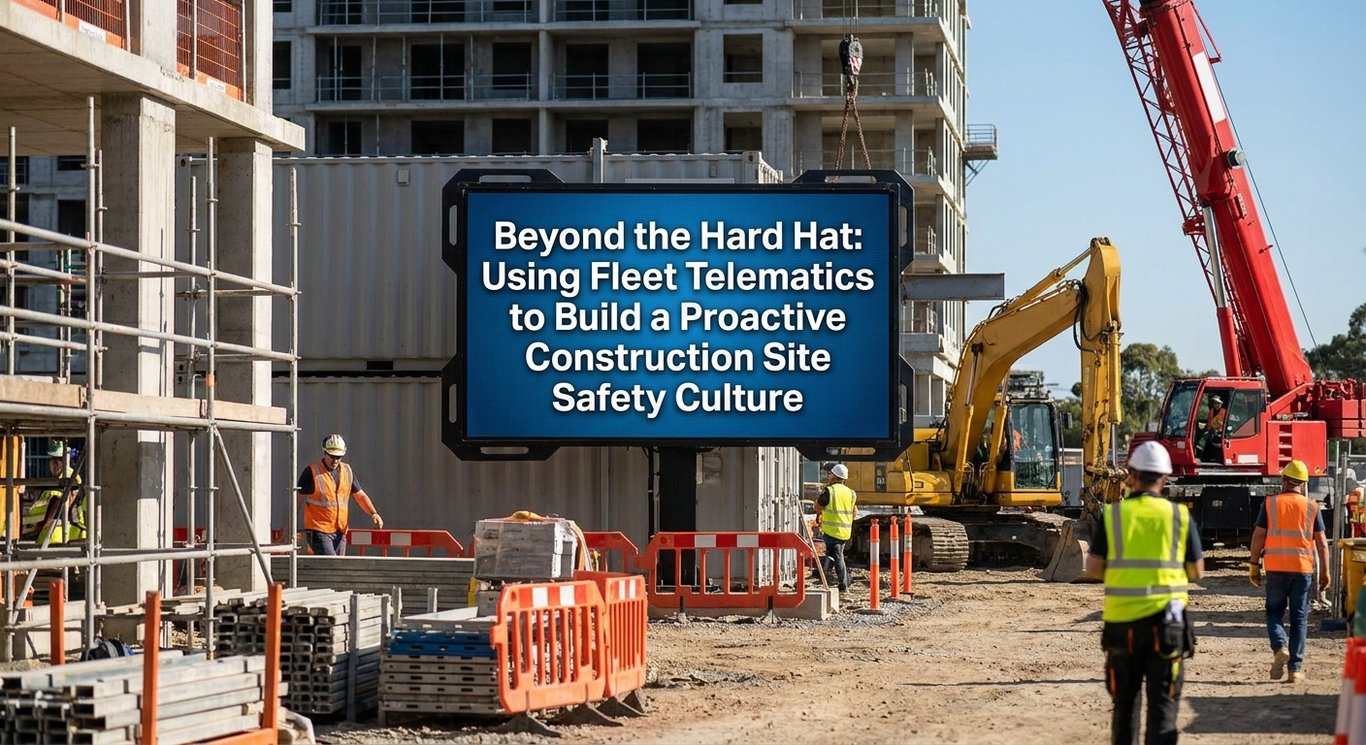
If you are ready to take the next step, start small and start focused. Identify your highest-risk vehicles, your most complex work zones, or the equipment types most associated with past incidents, and run a structured pilot program there first. Use the framework in Beyond the Hard Hat: Using Fleet Telematics to Build a Proactive Construction Site Safety Culture to define your safety goals, involve your workers in the process, establish fair and transparent data practices, and commit to turning every alert, every inspection result, and every near-miss report into a concrete opportunity for prevention. Safety culture is built one decision at a time – and with the right tools and the right mindset, every piece of data becomes a chance to make tomorrow safer than today. 💪
Ready to see what fleet telematics can do for your construction operation? Start by auditing your current fleet risks, talking to your operators about the hazards they face daily, and exploring telematics platforms that are purpose-built for the demands of construction environments. The investment you make in visibility today could be the thing that prevents the incident you never want to have to explain tomorrow.