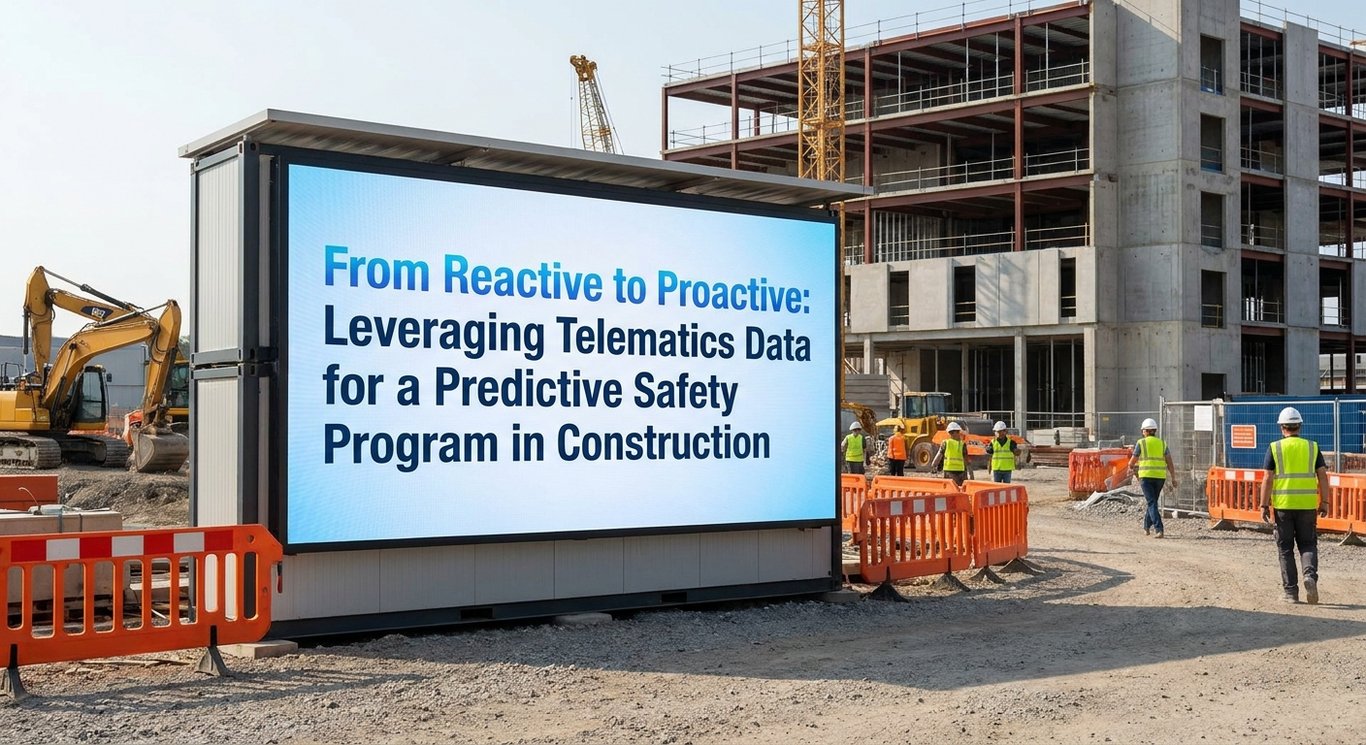
Construction sites have always been complex, high-stakes environments where a lot can go wrong in a very short time. Telematics is changing how site leaders manage that complexity by combining GPS tracking, onboard sensors, machine diagnostics, driver behavior monitoring, and cloud-connected software into one continuous stream of information. Instead of relying solely on periodic walkthroughs or paper logs, safety managers now have access to real-time visibility across their entire fleet and site layout. That shift from reactive to proactive awareness is exactly what makes telematics such a powerful tool for modern construction safety. 🚧
The safety case for telematics is compelling and very real. Construction sites see a disproportionate share of serious workplace injuries and fatalities, many of which involve predictable hazards like struck-by incidents, vehicle collisions, equipment misuse, speeding, fatigue-related events, and unauthorized machine operation. Real-time data gives safety professionals the ability to identify these risks before they escalate into incidents. When a machine enters a restricted zone, when a driver brakes too hard, or when a piece of equipment is started outside of authorized hours, telematics can flag it immediately – turning invisible risks into visible, manageable problems.
Why Construction Safety Needs a Digital Watchdog
Construction sites are genuinely difficult environments to monitor consistently. Layouts change daily as projects progress, haul routes shift, new subcontractors arrive, and temporary structures go up and come down. You have heavy equipment operating alongside pedestrian workers, mixed traffic from delivery vehicles and personal vehicles, high noise levels that mask warning signals, unpredictable weather, and limited lines of sight around structures, stockpiles, and equipment. No single safety manager – no matter how experienced – can have eyes on all of it at once. That’s not a failure of the profession; it’s simply the reality of the environment. 👷
The scale of construction risk remains serious and demands ongoing attention. The Bureau of Labor Statistics reported 1,032 fatalities among construction and extraction workers in 2024, while fatal falls, slips, and trips alone totaled 370. These numbers represent real people – experienced tradespeople, equipment operators, supervisors, and new workers – whose deaths left lasting impacts on families, crews, and communities. The construction industry has made genuine progress over the decades, but the data makes clear that significant risk remains. Understanding that scale is essential before discussing how technology can contribute to reducing it.
Traditional safety inspections, toolbox talks, and OSHA compliance programs remain the backbone of any effective construction safety effort. Telematics does not replace competent safety professionals, rigorous hazard controls, proper training, or regulatory compliance – and it shouldn’t be framed that way. What digital monitoring does is supplement those existing systems by filling in the gaps between inspections, extending visibility to remote or hard-to-reach areas of a site, and providing a continuous record of activity that human observation simply cannot match. The strongest safety programs use telematics as one layer in a multi-layered defense, not as a standalone solution.
What Is Construction Telematics and How Does It Work?
Construction telematics refers to the integrated use of connected technology to collect, transmit, and analyze data from equipment, vehicles, and operators on a jobsite. At its core, the system works like this: sensors and GPS devices installed on machines capture data in real time, transmit it over cellular or satellite networks to cloud-based platforms, and make it available through dashboards, automated alerts, and scheduled reports. Safety managers can access this information from a site office, a mobile device, or a corporate headquarters – giving them a live picture of what’s happening across the fleet at any given moment. The result is a level of operational awareness that wasn’t possible even ten years ago.
The data sources feeding into a telematics system are broad and increasingly detailed. Location and speed are the most familiar, but modern systems also capture engine status, operating hours, harsh braking events, rapid acceleration, seat-belt use, impact detection, machine movement patterns, fault codes from onboard diagnostics, and geofence activity. Each of these data points tells part of a story about how equipment is being used, whether it’s being operated safely, and whether it’s in the right place at the right time. Together, they create a rich picture of site activity that supports both real-time response and longer-term trend analysis. 📊
Not all telematics systems are created equal, and it’s worth understanding the differences. Basic asset tracking tells you where a machine is and whether it’s running. Fleet-management telematics adds utilization data, maintenance scheduling, and driver behavior monitoring. Advanced safety systems go further by combining equipment data with integrated video feeds, proximity detection sensors, and operator analytics that can identify fatigue indicators or unusual behavior patterns. Choosing the right level of system depends on your specific safety objectives, fleet size, site complexity, and budget – and understanding those differences helps you invest in the right tools for the right problems.
Using Real-Time Location Data to Prevent Struck-By Incidents
Struck-by incidents are among the most devastating and preventable hazards on construction sites, and live equipment location data is one of the most direct tools for addressing them. When safety managers can see exactly where every piece of heavy equipment is moving in real time, they can identify vehicle-pedestrian interaction zones that weren’t obvious during initial site planning. Haul routes that cross pedestrian pathways, delivery areas that overlap with active work zones, and storage areas positioned too close to equipment travel lanes all become visible – and fixable – when you have accurate location data to work with. That visibility alone can prompt traffic plan adjustments that significantly reduce exposure.
Geofencing takes location data a step further by creating virtual boundaries that trigger automatic alerts when they’re crossed. Proximity warning systems can notify both operators and nearby workers when equipment approaches a defined safety threshold. Route deviation notifications alert supervisors when machines stray from approved travel paths, and location-based emergency response becomes faster and more accurate when responders know exactly where every asset is on the site. These tools don’t eliminate the need for physical barriers, signage, and trained spotters – but they add a digital layer of protection that can catch situations that physical controls alone might miss. 🔔
Historical movement data is just as valuable as real-time tracking, though it often gets less attention. By reviewing where equipment has traveled over days or weeks, safety managers can identify recurring conflict points, pinpoint times of day when pedestrian-equipment interaction peaks, and spot patterns that individual incident reports might not reveal. That information can drive meaningful improvements: redesigned traffic plans, better pedestrian separation, improved signage placement, adjusted delivery schedules, and more targeted safety briefings for crews working in high-traffic areas. Data that looks backward helps you build a safer path forward.
Geofencing High-Risk Areas
Geofencing is one of the most practical and immediately useful features in a construction telematics system. Virtual boundaries can be drawn around excavation areas, crane lift zones, public road interfaces, fuel storage areas, electrical hazard zones, and any restricted workspace where unauthorized equipment entry creates serious risk. These boundaries exist in the system regardless of whether a physical barrier is visible on the ground, which is especially useful in fast-changing site conditions where temporary exclusion zones shift frequently. Setting up a geofence takes minutes, and it can be adjusted instantly as site conditions change throughout the project lifecycle.
“Nearly 20 percent of fatal work injuries in the U.S. occur in the construction industry.” -Geotab
The real value of geofencing comes from automated alerts that fire the moment equipment enters, exits, or operates within a prohibited zone. Those alerts can go to the equipment operator, a site supervisor, and a safety manager simultaneously – creating a rapid-response chain that doesn’t depend on anyone happening to be watching. That said, it’s important to validate GPS accuracy regularly, because signal drift, tall structures, and dense equipment clusters can affect precision. Geofencing works best when it’s paired with ground-truth checks, clear operator communication, and realistic boundary settings that account for the actual accuracy of your GPS hardware.
Monitoring Operator Behavior Without Creating a Surveillance Culture
Telematics systems can detect a wide range of operator behaviors that create safety risk on construction sites. Speeding on haul roads, harsh braking events, rapid acceleration, excessive idling, sudden turns, unauthorized equipment use outside of approved hours, and unsafe route choices all generate data signals that safety managers can review. This behavioral visibility is genuinely useful – many serious incidents involve operator behavior that was never flagged before the event, and telematics can surface those patterns early enough to intervene. The key is using that capability responsibly and constructively rather than as a surveillance tool designed to catch people doing something wrong. 👀
Behavior scores and event histories are most effective when they’re used as coaching tools rather than disciplinary weapons. A supervisor who sits down with an operator and reviews a week of harsh-braking events can have a productive conversation about haul road conditions, load weights, brake maintenance, and driving technique. That same data can be used to recognize operators who consistently demonstrate safe behavior – a powerful motivator that often gets overlooked. Targeted retraining, fair accountability, and positive reinforcement all become more precise when they’re grounded in actual behavioral data rather than general impressions or anecdotal observations.
Worker privacy is a legitimate concern that deserves serious attention in any telematics program. Employees have a right to know what data is being collected, how it’s being used, who has access to it, and how long it’s retained. Collective bargaining agreements may include specific provisions around monitoring technology, and those agreements must be respected. Transparency isn’t just a legal or ethical obligation – it’s also a practical one. Workers who understand the purpose of telematics monitoring and trust that it won’t be used unfairly are far more likely to engage with the program positively and provide the kind of honest feedback that makes the system work better for everyone. 🤝
How Telematics Supports OSHA’s Focus Four Hazard Controls
Falls are the leading cause of construction fatalities, and while telematics cannot replace physical fall protection systems, it can support several layers of fall prevention. Equipment positioning data can help ensure aerial lifts and elevated work platforms are operating within safe parameters. Geofencing can create restricted zones near unprotected edges, floor openings, and excavation perimeters. Alerts around unusual machine movement near elevated work areas can prompt immediate supervisor response. None of this substitutes for guardrails, personal fall arrest systems, and proper training – but it adds a digital monitoring layer that can catch positioning errors before they become fall hazards.
[cta-call:Call2]
Struck-by hazards are directly addressed by several core telematics capabilities. Collision warning systems, real-time vehicle tracking, reversing alerts, integrated camera systems, site-wide speed monitoring, and geofenced pedestrian zones all contribute to separating people from moving equipment – which is the fundamental goal of struck-by prevention. When an excavator backs toward a work area where pedestrians are present, a proximity alert can warn both the operator and nearby workers simultaneously. These systems don’t replace spotters, physical barriers, or high-visibility PPE, but they extend the protective perimeter in ways that human observation alone cannot match. 🚜
“Approximately 75% of struck-by fatalities involve heavy equipment such as large trucks and cranes.” -Canadian Society for Civil Engineering
Caught-in and caught-between hazards involve workers being pulled into, compressed by, or trapped between moving parts and heavy equipment. Telematics contributes to managing these risks through machine-status monitoring, which can detect when equipment is operating outside of expected parameters. Automatic shutdown alerts tied to fault codes, maintenance reminders for safety-critical systems, and exclusion-zone monitoring around active machinery all help reduce the window of exposure. When workers know that equipment status is being monitored continuously, there’s also a stronger operational incentive to follow lockout/tagout procedures and maintain proper clearances.
Electrocution hazards – particularly those involving contact with overhead power lines – can be partially addressed through telematics-supported controls. Geofenced zones around known power line locations can alert equipment operators when they’re approaching a dangerous proximity threshold. Lift-height restrictions and equipment-position monitoring can provide additional warnings for crane operators, excavator operators, and aerial lift users working near energized lines. Digital reminders can reinforce safe approach distances during pre-task planning. However, it must be stated clearly: only qualified electrical professionals and established safe-work procedures can truly control electrical hazards. Telematics is a supporting tool, not a substitute for proper electrical safety management. ⚡
Turning Telematics Data Into Predictive Safety Insights
Predictive safety is the practice of identifying patterns in data that signal increasing risk before an incident actually occurs. In a telematics context, that might look like a cluster of harsh-braking events on a specific haul road segment, a pattern of speeding that peaks during the last two hours of a shift, recurring route conflicts at a particular site intersection, or equipment fault codes that appear repeatedly before a mechanical failure. Each of these patterns is a warning sign – and the earlier you can recognize it, the more time you have to intervene with a targeted response rather than a reactive one after something goes wrong.
Modern telematics dashboards are increasingly capable of combining multiple data streams to create a richer safety picture. Near-miss records, inspection findings, location histories, maintenance logs, weather data, shift length information, and operator behavior scores can all be layered together to reveal correlations that wouldn’t be visible in any single data stream. A safety manager who can see that harsh-braking events increase on rainy days during long shifts has actionable information – they can adjust speed limits, modify haul schedules, or increase pre-shift safety briefings during those conditions. That kind of data-informed decision-making is a significant upgrade over gut instinct alone. 📈
Trend analysis transforms raw telematics data into practical field decisions. When you can see that a particular operator consistently triggers proximity alerts near a specific area of the site, that’s a signal to investigate the traffic plan, not just coach the operator. When inspection completion rates drop during peak production periods, that’s a cue to adjust scheduling or staffing. When equipment fault codes cluster around a specific age or usage threshold, that’s a maintenance planning insight. Telematics data helps safety leaders prioritize toolbox talks, refine traffic management, schedule maintenance proactively, and focus audits on the operations that carry the highest real-world risk.
Equipment Health, Preventive Maintenance, and Safety
Equipment that isn’t mechanically sound is equipment that creates unpredictable risk. Telematics systems can continuously monitor engine diagnostics, fault codes, operating hours, fluid levels, tire pressure data, brake system warnings, and inspection reminder schedules to give maintenance teams an accurate, up-to-date picture of fleet health. Instead of discovering a brake problem when a machine fails on a haul road, a maintenance team using telematics data can identify the early warning signs – abnormal brake temperatures, unusual fault codes, or inspection overdue alerts – and address them before they become a safety event. That shift from reactive to preventive maintenance is one of the most direct ways telematics improves safety outcomes. 🔧
“Within six months of implementing GPS Insight, they were able to decrease speeding incidents by 68%.” -For Construction Pros
Predictive maintenance supported by telematics data can reduce failures in some of the most safety-critical systems on construction equipment. Brakes, steering systems, hydraulics, tires, lifting mechanisms, and load-management systems all carry serious consequences when they fail unexpectedly. By tracking usage patterns and correlating them with known failure thresholds, telematics platforms can generate maintenance alerts before components reach the failure point. This doesn’t just protect workers – it also reduces unplanned downtime, extends equipment life, and lowers the cost of emergency repairs, making it a strong business case alongside the safety case.
Maintenance records generated through telematics-connected platforms also support compliance documentation in meaningful ways. Pre-use inspection records, service histories, and fault-code logs can all be stored and retrieved to demonstrate due diligence during OSHA inspections, insurance reviews, or incident investigations. Lockout/tagout procedures are strengthened when maintenance teams have accurate, real-time information about equipment status before beginning work. And when a piece of equipment generates repeated safety-related fault codes, telematics data provides the documented basis for removing it from service – a decision that protects workers and gives supervisors clear, defensible justification for taking action.
Using Telematics During Emergencies and Incident Investigations
When an emergency hits a construction site – a severe weather event, a fire, a medical crisis, a structural failure, or an evacuation order – knowing exactly where workers, vehicles, and machines are located is critical to an effective response. Live telematics location data gives supervisors and emergency responders an immediate, accurate picture of site occupancy that paper sign-in sheets and radio check-ins simply can’t match. During a site evacuation, that data can help confirm that all equipment has stopped, identify areas where workers may still be present, and guide emergency responders directly to the locations where help is needed most. ⚠️
Automatic crash notifications, impact alerts, and equipment shutdown signals add another layer of emergency response capability. When a machine experiences a significant impact event, the telematics system can immediately notify designated emergency contacts and trigger an escalation workflow – alerting supervisors, safety managers, and emergency services without requiring the operator to make a call. For situations where an operator is incapacitated, that automatic notification could be the difference between a rapid response and a delayed one. These features are most effective when escalation procedures are clearly defined, regularly tested, and understood by everyone on the site before an emergency occurs.
After an incident, telematics data becomes a valuable tool for root-cause analysis and corrective action development. Time-stamped location records, speed data, operator behavior logs, equipment status information, and geofence activity can all be reviewed to reconstruct the sequence of events leading up to an incident. This preserves evidence that might otherwise be lost, identifies contributing conditions that weren’t immediately obvious, and supports more accurate corrective actions. That said, telematics data should complement – not replace – witness interviews, physical site inspections, and professional safety investigations. Data tells you what happened; understanding why requires human judgment and context.
Building a Data-Driven Construction Safety Culture
One of the most important shifts that telematics enables is the move from lagging indicators to leading indicators in safety measurement. Lagging indicators – injury counts, lost-time incident rates, workers’ compensation costs – tell you what already went wrong. Leading indicators – completed pre-use inspections, near-miss reports, corrective-action closure rates, speeding events, proximity alerts, and behavior coaching sessions – tell you whether your safety program is actually working before someone gets hurt. Telematics generates a continuous stream of leading indicator data that safety leaders can use to assess program health and identify where to focus attention next. That’s a fundamentally more proactive way to manage safety. 💡
“Unlike lagging indicators, leading indicators offer employers the opportunity to take preventative action before a hazard can lead to an incident.” -Occupational Safety and Health Administration
Daily dashboards, pre-task planning sessions, toolbox talks, and weekly trend reviews all become more focused and more effective when they’re grounded in real data from the current site. A supervisor who reviews the previous day’s telematics summary before a morning meeting can open the toolbox talk with specific, relevant observations: “We had six speeding events on the north haul road yesterday – let’s talk about what’s driving that.” That kind of specificity cuts through the generic safety messaging that crews often tune out and replaces it with a conversation that’s clearly connected to their actual work environment. Data-driven safety communication lands differently than abstract reminders.
Worker participation is essential to making a telematics-based safety culture actually work. Operators and tradespeople who understand the system, trust its intent, and feel like their input matters are far more likely to engage with it constructively. They’re also the people best positioned to identify which alerts are genuinely useful, which ones generate too many false positives, and which interventions are realistic given actual field conditions. Inviting workers into the process of defining alert thresholds, reviewing trend data, and recommending improvements transforms telematics from something that’s done to workers into something that’s built with them – and that distinction makes all the difference for long-term program success. 🙌
Integrating Telematics With Existing Construction Technology
Telematics is most powerful when it doesn’t operate in isolation. Modern construction sites often run fleet-management software, equipment-maintenance platforms, mobile inspection apps, workforce management systems, incident-reporting tools, integrated camera systems, and access-control technology simultaneously. When telematics data flows into and out of these existing systems, the result is a connected safety ecosystem where information from one platform enriches the others. A maintenance alert generated by telematics can automatically trigger a work order in the maintenance platform. An incident report can pull in location and behavior data from the telematics system without requiring manual data entry. That kind of integration multiplies the value of every individual tool.
Making that integration work reliably requires attention to some technical fundamentals. Open APIs allow different software systems to communicate without proprietary barriers. Consistent equipment identifiers – the same asset ID used across telematics, maintenance, and inspection platforms – prevent the data fragmentation that makes cross-referencing difficult. Reliable cellular or Wi-Fi connectivity on the jobsite ensures data flows continuously rather than in unreliable bursts. Agreed-upon data standards and a single source of truth for safety reporting prevent the confusion that arises when different systems show conflicting information about the same asset or event. These aren’t glamorous considerations, but they determine whether integration actually delivers on its promise. 🔗
The practical payoff of good integration is significant. When safety, operations, maintenance, and project leadership are all working from the same underlying data, decision-making becomes faster, more consistent, and less prone to the gaps that occur when teams operate in separate information silos. Duplicate data entry – a persistent source of error and wasted time – is reduced when systems share data automatically. And when an incident occurs, the ability to pull a complete, integrated record of equipment status, operator behavior, location history, and maintenance logs from a single platform dramatically accelerates investigation and corrective action. Integration isn’t just a technical nicety; it’s a safety multiplier.
Implementation Roadmap: From Pilot Project to Jobsite Standard
The most effective telematics implementations start with a clearly defined, measurable safety problem rather than a vague goal of “improving safety.” Pick something specific: reducing speeding events on haul roads, eliminating unauthorized equipment operation after hours, reducing vehicle-pedestrian conflicts at a particular site entry point, or improving pre-use inspection completion rates. A specific objective gives you a baseline to measure against, a clear definition of success, and a focused scope that makes the pilot manageable. Trying to solve every safety problem at once with a new technology platform is a reliable path to confusion, resistance, and inconclusive results. 🎯
“82% of contractors using wearables report site safety improvements.” -For Construction Pros
Before selecting hardware or vendors, conduct a thorough audit of your current situation. Inventory the fleet – equipment types, ages, existing telematics hardware if any, and OEM data availability. Assess site conditions including connectivity coverage, GPS signal quality, and physical installation constraints. Review existing software systems to understand integration requirements and data standards. Identify privacy requirements, collective bargaining obligations, and workforce readiness. This audit prevents the common mistake of purchasing a system that doesn’t fit the actual environment and then spending months trying to make it work under conditions it wasn’t designed for.
Run a controlled pilot on a defined subset of equipment or a single project before committing to a full rollout. During the pilot, measure alert accuracy – are the alerts firing when they should, and are they generating too many false positives? Track behavior changes among operators who know they’re being monitored. Gather structured feedback from workers, supervisors, and safety managers about what’s working and what isn’t. Use that feedback to refine alert thresholds, adjust geofence boundaries, and recalibrate the system to your specific site conditions. A pilot that surfaces problems early is far more valuable than a full rollout that discovers them at scale. 🔍
The rollout plan should be as carefully designed as the technology selection. Define who owns the system – who configures it, who monitors the alerts, who conducts the coaching conversations, and who handles escalations. Create a training program that covers both the technical operation of the system and the behavioral expectations around data use. Establish data governance policies covering access levels, retention periods, and disciplinary procedures. Set key performance indicators tied to your original safety objectives, and schedule regular program reviews – quarterly at minimum – to assess whether the system is delivering on its promise and to make adjustments as site conditions and safety priorities evolve.
Measuring the Return on Safety Investment
Measuring the effectiveness of a telematics program starts with tracking the right safety metrics. Speeding events per shift, harsh-braking frequency, proximity alert counts, near-miss reports, pre-use inspection completion rates, equipment downtime hours, unauthorized-use incidents, and corrective-action closure rates all provide meaningful data points about how the program is performing. Tracking these metrics over time – and comparing them against pre-implementation baselines – gives you evidence of whether the system is actually changing behavior and reducing exposure, rather than just generating data that nobody acts on. 📋
Financial measures round out the return-on-investment picture. Reduced collision costs, lower equipment downtime, fewer emergency repair bills, improved insurance documentation, better asset utilization, and reduced project disruption following incidents all represent real financial value that can be connected to telematics-supported improvements. Insurance carriers in some markets are beginning to recognize telematics programs as evidence of proactive risk management, which can translate into premium adjustments. While these financial benefits are real, they’re most credible when they’re tied to documented safety improvements rather than presented as speculative projections.
One important caution: don’t evaluate your telematics program solely by the volume of alerts it generates. A system that fires hundreds of alerts per day that nobody acts on isn’t making your site safer – it’s creating alert fatigue and eroding trust in the technology. The strongest evaluation connects telematics data to verified hazard reduction, improved engineering controls, measurable changes in field behavior, and a documented reduction in the conditions that precede incidents. More alerts is not better. Better outcomes – fewer near misses, safer behaviors, healthier equipment, and stronger safety culture – is the actual measure of success. ✅
Challenges, Limitations, and Ethical Considerations
Telematics systems are powerful, but they come with real technical limitations that safety managers need to understand and plan for. GPS signal accuracy can be affected by tall structures, dense equipment clusters, and urban canyons, leading to location readings that are off by several meters – enough to cause problems in geofencing applications. Poor cellular connectivity in remote locations can interrupt data transmission, creating gaps in records at exactly the times when continuous monitoring matters most. Sensor failures, battery problems, and hardware damage from the harsh construction environment are ongoing maintenance realities. And alert fatigue – the tendency of users to ignore alerts when there are too many of them – is one of the most common reasons telematics programs underperform. 😤
It’s equally important to be honest about what telematics cannot do. It cannot detect every hazard on a construction site. It cannot replace a thorough job hazard analysis conducted by a competent safety professional. It cannot guarantee that operators will respond appropriately to alerts. It cannot prevent incidents on its own without effective engineering controls, administrative controls, PPE, supervision, and a genuine safety culture behind it. Treating telematics as a comprehensive safety solution – rather than as one valuable layer in a multi-layered program – is a mistake that can create a false sense of security while leaving real hazards unaddressed.
Cybersecurity is an underappreciated risk in construction telematics programs. Telematics systems collect sensitive operational data – equipment locations, operator identities, site layouts, production schedules – that could be valuable to bad actors. Unauthorized access to telematics platforms, vendor data-ownership arrangements that give third parties broad access to your data, inadequate encryption, weak system permissions, and the absence of an incident-response plan for data breaches are all genuine risks. Before selecting a telematics vendor, construction companies should ask detailed questions about data security practices, ownership rights, retention policies, and what happens to their data if the vendor relationship ends. 🔒
Fairness and privacy deserve careful, ongoing attention throughout the life of a telematics program. Workers should receive clear, written explanations of what data is collected, how it’s used, who can access it, and what triggers a disciplinary review. Data collection should be limited to what’s genuinely necessary for safety and operational purposes – not expanded opportunistically because the technology makes it easy. Role-based access controls should ensure that only authorized personnel can view sensitive operator data. Disciplinary decisions based on telematics data should always involve human review and the opportunity for the worker to provide context. Transparency, proportionality, and human oversight aren’t just ethical principles – they’re the foundation of worker trust, and without that trust, no telematics program will reach its potential.
What the Future Holds for Telematics-Enabled Construction Safety
The next generation of construction safety technology is already taking shape, and it’s significantly more capable than today’s systems. Artificial intelligence is being applied to telematics data streams to identify risk patterns that human analysts would miss. Computer vision systems integrated with site cameras can automatically detect PPE compliance, unsafe proximity, and hazardous behaviors in real time. Edge computing allows data to be processed locally on equipment rather than sent to the cloud, reducing latency in safety-critical alerts. Wearable devices are extending monitoring to individual workers, tracking location, posture, heart rate, and fatigue indicators. Digital twins – virtual replicas of construction sites updated with live data – are enabling simulation-based safety planning that was previously impossible. 🤖
Future integrated systems may combine worker location data, equipment movement histories, site plan overlays, real-time weather feeds, shift-length fatigue indicators, and operational context to produce safety warnings that are far more precise and actionable than today’s threshold-based alerts. Instead of simply flagging that a machine exceeded a speed limit, an AI-powered system might recognize that the same machine has exceeded that limit repeatedly at the same location during the final hour of long shifts, correlate that with a nearby pedestrian crossing, and automatically suggest a speed-reduction zone and a scheduling adjustment. That level of contextual intelligence represents a meaningful leap forward in what telematics can contribute to safety management.
Realizing that future, however, depends on getting some foundational things right. Trustworthy, accurate data is the prerequisite for everything else – AI systems trained on poor-quality data produce poor-quality insights. Interoperable systems that can share data across platforms and vendors are necessary for the kind of integrated analysis that delivers real value. Worker acceptance, built through transparency and demonstrated respect for privacy, determines whether the human element of safety culture aligns with the technology. Strong cybersecurity protects the sensitive data that these systems generate. And above all, the purpose of these systems must remain prevention – protecting workers – rather than surveillance for its own sake. The technology will keep advancing; the values behind it need to advance just as deliberately. 🌐
Frequently Asked Questions About Telematics and Construction Site Safety
What is telematics in construction?
Telematics in construction refers to connected technology that collects and transmits data from equipment, vehicles, and operators to a central platform for analysis and action. This includes GPS location data, engine diagnostics, operator behavior metrics, equipment usage hours, fault codes, and geofence activity. The information travels from onboard sensors and devices through cellular or satellite networks to cloud-based dashboards where safety managers, fleet coordinators, and maintenance teams can monitor asset health, track location, identify unsafe behaviors, and respond to alerts in real time. It’s essentially a continuous digital picture of what your fleet and site are doing at any given moment.
How does telematics improve construction-site safety?
Telematics improves construction-site safety through several interconnected mechanisms. Real-time alerts notify supervisors and operators when equipment enters restricted zones, exceeds speed limits, or triggers impact sensors. Behavior monitoring identifies unsafe driving patterns – harsh braking, rapid acceleration, unauthorized use – that can be addressed through coaching before they lead to incidents. Equipment location tracking helps separate pedestrians from moving machinery and supports faster emergency response. Preventive maintenance alerts reduce the risk of mechanical failures in safety-critical systems. And historical data supports near-miss documentation, trend analysis, and more targeted safety interventions across the site. 🛡️
Can telematics prevent construction accidents?
Telematics can meaningfully reduce exposure to certain hazards and support earlier intervention when risk patterns emerge, but it cannot guarantee the prevention of construction accidents. Effective accident prevention requires a comprehensive approach that includes engineering controls, administrative controls, proper personal protective equipment, rigorous training, competent supervision, and strong regulatory compliance. Telematics is a valuable layer within that system – it extends visibility, speeds up response, and supports data-driven decision-making – but it cannot compensate for inadequate hazard controls, insufficient training, or a safety culture that doesn’t genuinely prioritize worker protection. Think of it as a very capable tool in a well-stocked toolbox, not the whole toolbox itself.
Does construction telematics monitor workers?
The answer depends on the specific system and how it’s configured. Most construction telematics systems primarily monitor equipment – tracking machine location, status, and performance rather than individual workers. However, since equipment is operated by specific individuals, operator behavior data is inherently connected to the people running the machines. Some advanced systems incorporate wearable devices or access-control badges that track individual worker locations on the site. Wherever worker-level monitoring occurs, transparency is essential: employees should be informed about what data is collected, how it’s used, who can access it, and what protections are in place. Consent, clear policies, and limited-use commitments are the foundation of ethical worker monitoring. 📍
How much does construction telematics cost?
Construction telematics costs vary widely depending on several factors: the type and quantity of hardware required, the number of assets being monitored, cellular or satellite connectivity requirements, software subscription fees, installation complexity, integration with existing platforms, optional features like integrated video or wearable devices, and ongoing service and support plans. Basic asset tracking can be relatively affordable per unit, while advanced systems with AI-powered analytics, video integration, and multi-platform connectivity represent a more significant investment. The most useful way to evaluate cost is to compare total program cost against measurable safety and operational benefits – reduced incidents, lower downtime, improved utilization, and avoided emergency repair costs – rather than focusing on the hardware price tag alone. 💰
Conclusion: Making Telematics Part of the Safety Foundation
Telematics has earned its place as a genuine contributor to construction site safety – not as a magic solution, but as a powerful tool that improves visibility, helps identify risk before incidents occur, supports safer equipment operation, strengthens maintenance programs, assists emergency response, and turns the constant activity of a busy jobsite into actionable safety intelligence. The key takeaways from everything covered here are straightforward: telematics works best as part of a comprehensive safety program, its value multiplies when it’s integrated with other systems and grounded in worker participation, and its long-term success depends on transparent, ethical data practices that workers can trust. When those conditions are in place, the digital watchdog earns its keep every single day. 🏗️
If you’re a construction leader looking at where to start, the path forward is clearer than it might seem. Identify your highest-risk activities – the ones where limited visibility, equipment-pedestrian interaction, or operator behavior create the most exposure. Define a specific, measurable safety problem you want to address. Pilot telematics on a defined scope, involve your workers and supervisors in the process from day one, and build your program around real metrics that connect data to verified hazard reduction. The foundation for safer construction sites isn’t built in a single decision – it’s built one deliberate, data-informed step at a time. Start with “The Digital Watchdog: How Telematics Data is Building a New Foundation for Construction Site Safety” as your guide, and build from there. Your crews deserve a site where every available tool is working to bring them home safely. 🦺