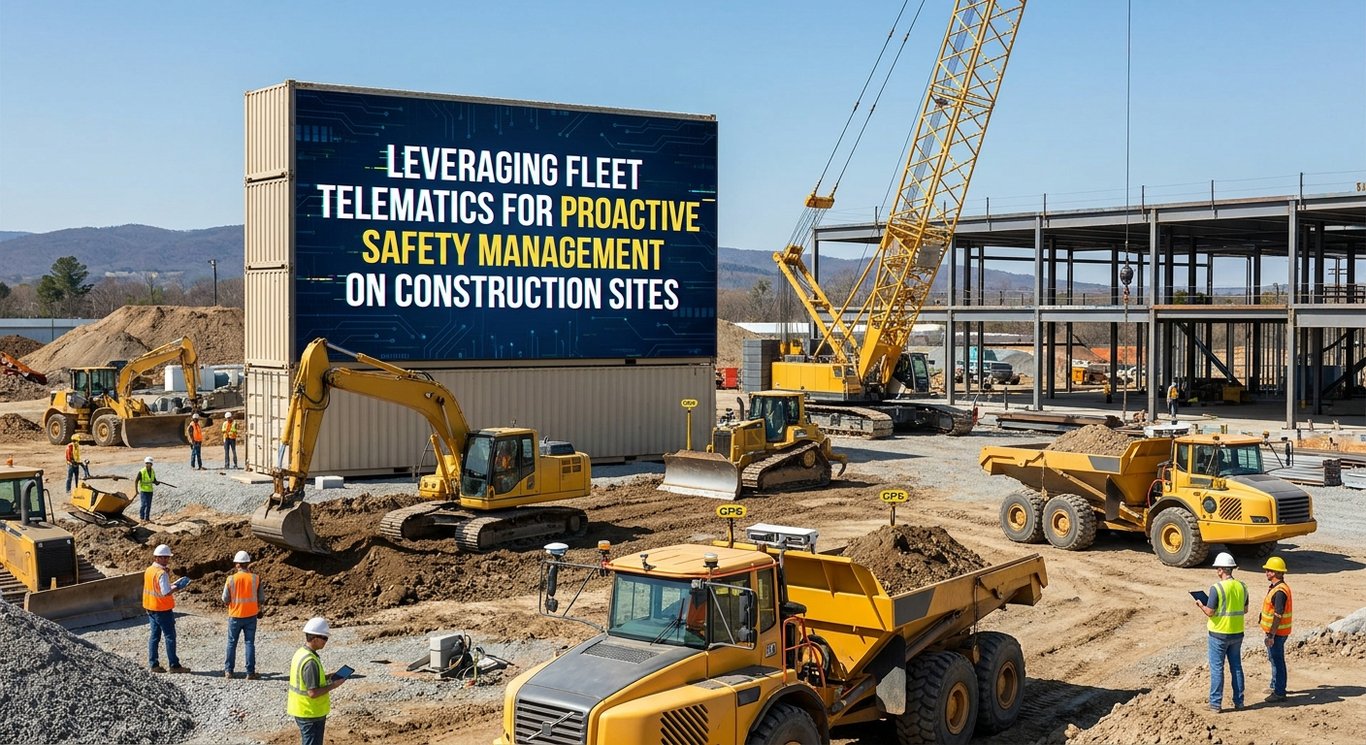
Fleet telematics has quietly become one of the most powerful tools in modern construction fleet management – and for good reason. At its core, fleet telematics combines GPS technology, onboard sensors, and vehicle engine data to deliver real-time intelligence about every asset in your fleet. Whether it’s a dump truck hauling materials across a job site or a crane lifting steel beams twenty stories up, telematics keeps fleet managers informed about what’s happening, where, and why. This constant stream of data isn’t just useful for logistics – it’s become a cornerstone of construction safety, giving teams the visibility they need to protect workers, equipment, and project timelines. 🚧
Construction sites are among the most hazardous work environments in the world. Heavy equipment operates alongside on-foot workers, vehicles navigate tight and unpredictable spaces, and many projects unfold across remote or multi-site locations where direct supervision is limited. These conditions create a perfect storm for accidents – especially when safety decisions are based on guesswork rather than data. A proactive, data-driven approach to safety isn’t a luxury anymore; it’s a necessity for any construction firm serious about protecting its people and its bottom line.
This article is designed to answer the most common questions construction leaders have about fleet telematics and safety – and to lay out practical strategies for putting that technology to work. From understanding the basics of telematics systems to integrating them into daily workflows, coaching drivers, working with insurers, and measuring real ROI, we’ll cover everything you need to know to move from reactive incident response to genuine, proactive safety management. Let’s dig in. 🔍
Understanding Fleet Telematics in the Construction Context
Fleet telematics refers to the integrated use of GPS tracking, onboard diagnostics, wireless communication, and sensor technology to monitor and manage vehicles and equipment in real time. In a construction setting, this goes well beyond tracking a few delivery trucks. Telematics systems cover a wide range of assets – on-road vehicles like pickup trucks, flatbeds, and concrete mixers; heavy off-road equipment like excavators, bulldozers, and loaders; and even smaller tagged assets like generators, compressors, and trailers. The result is a comprehensive digital picture of everything your fleet owns and operates, no matter where it’s deployed.
The data points collected by telematics systems are both broad and deep. Location and speed are the obvious ones, but modern systems also capture fuel consumption, engine health diagnostics, idle time, driver behavior events, equipment utilization rates, and hours of operation. What makes construction telematics particularly complex is the variety of assets involved. Unlike a standard delivery fleet where all vehicles are similar, construction fleets mix on-road and off-road machines with very different performance profiles, operating environments, and safety considerations. A system that can handle that diversity – and translate it into actionable insights – is genuinely valuable.
Most construction firms don’t use telematics in isolation. Instead, it functions as a critical data layer within broader fleet management software platforms that give managers visibility across multiple job sites and projects simultaneously. This bird’s-eye view is invaluable when you’re coordinating dozens of assets across several locations. Beyond productivity gains like better dispatch and reduced idle time, the safety benefits are substantial – managers can spot problems before they become incidents, track compliance in real time, and make smarter decisions faster. Telematics essentially turns scattered operational data into a unified safety and efficiency engine. ⚙️
Why Proactive Safety Management Matters on Construction Sites
The safety risks on construction sites are numerous and often unpredictable. Vehicle-worker interactions – situations where moving equipment comes dangerously close to people on foot – are among the leading causes of serious injuries and fatalities in the industry. Equipment collisions, whether between two machines or between a machine and a structure, are also disturbingly common. Add in the risks of unauthorized asset use (which can put untrained operators behind the wheel of heavy machinery), fatigue-related incidents from long shifts, and the general chaos of a busy job site, and it’s clear that safety management here demands more than a safety poster and a weekly meeting.
There’s a fundamental difference between reactive and proactive safety management, and it matters enormously in construction. Reactive safety means responding after something goes wrong – filing incident reports, investigating causes, and trying to prevent recurrence. Proactive safety means using data to identify risk before it turns into an accident. Telematics is one of the most powerful enablers of that shift. When you can see that a particular driver is consistently speeding through a congested area of the site, or that a piece of equipment is being operated outside its authorized zone, you can intervene before anyone gets hurt. That’s the real promise of telematics-driven safety management.
The business case for proactive safety is just as compelling as the human one. Executives and project managers care deeply about outcomes like reduced accident rates, lower insurance claims, less equipment downtime, and stronger regulatory compliance. A single serious incident can cost a construction company hundreds of thousands of dollars in direct costs, legal fees, project delays, and reputational damage. Clients and insurers are increasingly scrutinizing safety records before awarding contracts or setting premiums. Firms that can demonstrate a data-driven, proactive safety culture aren’t just protecting their workers – they’re protecting their competitive position in the market. 📊
Key Telematics Features That Drive Safety Performance
Real-time tracking and geofencing are among the most immediately impactful telematics features for construction safety. Geofencing allows managers to define virtual boundaries around job sites, hazardous zones, or restricted areas. When a vehicle or piece of equipment crosses those boundaries – or enters a zone it shouldn’t – the system sends an instant alert. This is enormously useful for preventing unauthorized equipment use, reducing theft, and keeping vehicles out of areas where workers are present on foot. Real-time location data also helps dispatchers route vehicles safely and efficiently, reducing the chances of congestion and conflict in tight site environments.
“Fleet telematics systems, at the very core of modern fleet management, amalgamate GPS technology, onboard sensors, and vehicle engine data to supercharge efficiency in fleet management.” -BrightOrder
Driver behavior monitoring is where telematics really starts to change safety culture at a human level. Modern systems track events like harsh braking, rapid acceleration, excessive speeding, aggressive cornering, and prolonged idling – all of which are indicators of high-risk driving habits. When these behaviors are captured and reported consistently, managers have a factual, objective basis for coaching conversations rather than relying on anecdotes or observations. Over time, identifying and addressing these patterns can dramatically reduce the likelihood of collisions and near-misses. It also creates accountability – drivers know their behavior is being recorded, which by itself tends to improve performance. 🚗💨
Maintenance alerts and vehicle health monitoring deserve more credit as safety tools than they typically get. A truck with failing brakes or an excavator with an overheating engine isn’t just an operational headache – it’s a safety hazard. Telematics systems monitor engine diagnostics and can flag issues before they become critical, enabling scheduled preventative maintenance rather than emergency repairs. This keeps equipment in safe working condition and reduces the risk of unexpected breakdowns in hazardous locations. When a machine breaks down mid-operation on a busy job site, the consequences can be severe – telematics helps prevent that scenario before it unfolds.
Beyond the core features, advanced telematics solutions are incorporating video-based monitoring, AI-driven dashcams, and event data recorders that capture exactly what happened in the moments leading up to an incident. These tools are transforming both accident investigation and prevention. Dashcam footage can exonerate drivers in disputed claims, provide training material for coaching, and identify site layout problems that contribute to near-misses. AI-powered systems can even detect distracted driving or drowsiness in real time and trigger in-cab alerts before a collision occurs. These technologies represent the cutting edge of proactive safety management – and they’re becoming increasingly accessible to construction firms of all sizes. 🎥🤖
Using Telematics Data Proactively to Reduce Incidents
Having access to telematics data is only valuable if someone is actually looking at it and acting on what they find. Effective safety managers build a habit of regularly reviewing telematics dashboards and exception reports to identify trends – not just individual incidents. For example, if the data shows repeated speeding events on a specific internal site road, that’s a signal to investigate whether the speed limit is clearly marked, whether the road design encourages faster driving, or whether a particular driver needs coaching. Trend analysis turns raw data into targeted, meaningful interventions rather than one-size-fits-all responses.
[cta-call:Call2]
One of the most powerful applications of telematics data is building structured driver and operator coaching programs. Rather than waiting for a serious incident to trigger a conversation, managers can use performance data to schedule regular, constructive feedback sessions with drivers. The key is to make these sessions feel supportive rather than punitive – the goal is behavior change, not blame. Positive reinforcement matters here too. Recognizing and rewarding drivers who consistently demonstrate safe behavior creates a culture where safety is something people take pride in, not just a compliance checkbox. Over time, this approach can transform the safety culture across an entire fleet. 🏆
Telematics data also feeds directly into preventative maintenance and security strategies. By tracking engine hours and equipment utilization, managers can schedule servicing based on actual usage rather than arbitrary calendar intervals – which means maintenance happens when it’s actually needed, not too early or too late. On the security side, geofences and real-time alerts can dramatically reduce unauthorized equipment use and theft, both of which create safety risks and significant financial losses. A piece of heavy machinery operated by someone without the proper training is a serious accident waiting to happen – telematics helps close that gap.
Perhaps the most underappreciated benefit of telematics is its role in continuous improvement. By establishing clear safety KPIs – speeding events per vehicle per week, percentage of vehicles with overdue maintenance, number of geofence violations – and tracking them consistently over time, construction firms can see whether their safety programs are actually working. When the data shows improvement, that’s worth celebrating and sharing with the team. When it shows a plateau or a new problem emerging, that’s a prompt to revisit training, policies, or site layouts. Telematics transforms safety management from a static set of rules into a dynamic, evidence-based process. 📈
“Telematics systems are key to improving fleet safety, as they monitor drivers and vehicles in real-time, helping to spot and correct unsafe behavior.” -BrightOrder
Integrating Telematics with Construction Workflows and Systems
Telematics data is most powerful when it doesn’t live in a silo. Modern telematics platforms can integrate directly with project management, scheduling, and dispatch systems, creating a seamless connection between fleet safety data and the daily operational decisions that shape how work gets done on site. When a site supervisor can see in real time which vehicles are available, where they are, and whether any have active safety alerts, they can make smarter decisions about task assignment and routing. This kind of integration means safety isn’t treated as a separate department – it’s woven into the fabric of how projects are planned and executed.
API-based integration and data consolidation across multiple sites offer particularly significant benefits for larger construction firms managing several projects simultaneously. When data from all sites flows into a single platform, safety managers can identify systemic issues that might not be visible at the individual site level. Finance teams gain better visibility into asset utilization and costs, operations teams can coordinate more effectively, and safety teams can benchmark performance across projects. Breaking down these data silos doesn’t just improve safety – it makes the entire organization smarter and more responsive. 🔗
Of course, integration only delivers value if the people using the data can actually understand and act on it. A common pitfall is overwhelming site supervisors with raw data streams that require significant technical knowledge to interpret. Practical integration means mapping data fields carefully so that information flows cleanly between systems, defining shared KPIs that are meaningful to all stakeholders, and designing simplified dashboards that surface the most important safety signals clearly and quickly. The goal is to give every person in the chain – from fleet manager to site foreman – exactly the information they need, in a format they can act on without needing a data science degree.
Change Management: Getting Drivers, Operators, and Site Teams On Board
No telematics implementation succeeds without buy-in from the people whose behavior it’s designed to influence. Drivers and equipment operators often have legitimate concerns about monitoring – questions about privacy, fears of being unfairly disciplined, and a general discomfort with the idea of being watched. These concerns shouldn’t be dismissed; they should be addressed directly and honestly. The key is to frame telematics as a safety tool that protects workers – not a surveillance system designed to catch them out. Transparent communication about what data is collected, how it’s used, and who has access to it goes a long way toward building trust. 🤝
One of the most effective strategies for driving adoption is identifying and empowering on-site tech champions – team members who are early adopters, comfortable with technology, and respected by their peers. These individuals can help colleagues navigate new tools, answer questions, and demonstrate in practical terms how telematics makes their jobs safer and easier. A recommendation from a trusted coworker carries far more weight than a top-down mandate from management. Investing in these internal advocates is one of the smartest change management moves a construction firm can make.
Training is non-negotiable. Managers need to understand how to interpret telematics dashboards, set meaningful alerts, and conduct data-driven coaching conversations. Drivers and operators need to understand what the in-cab devices and mobile apps are showing them and why it matters. Training shouldn’t be a one-time event – it should be an ongoing process that evolves as the technology and the organization’s use of it mature. Hands-on, role-specific training that connects telematics data to real scenarios from the job site tends to be far more effective than generic software tutorials. 📱
Finally, feedback loops are essential for sustaining engagement over time. Sharing telematics dashboards during toolbox talks, celebrating improvements in safety scores, and genuinely incorporating worker input into policy decisions all signal that management values the data as a shared resource – not just a management tool. When drivers see that their feedback leads to real changes – a revised site route, a clearer speed limit sign, a more realistic delivery schedule – they become active participants in the safety program rather than reluctant subjects of it. That shift in mindset is where real cultural change happens.
“Premier fleet telematics systems offer driver safety measurement and monitoring tools. These enable analysis of events including harsh braking, speeding, excess cornering, and rapid acceleration.” -Powerfleet
Working with Insurers and Regulators Using Telematics Evidence
When accidents do happen – and in construction, despite everyone’s best efforts, they sometimes will – telematics data and dashcam footage can be invaluable in establishing an objective account of events. Video evidence and event data recorder logs can show exactly what a vehicle was doing in the seconds before a collision: its speed, direction, braking inputs, and the actions of the driver. This kind of objective evidence supports fair claims handling, can exonerate drivers who weren’t at fault, and helps insurers and legal teams resolve disputes more efficiently. In a world where liability claims can be enormous, that clarity is worth a great deal. ⚖️
Insurers are increasingly recognizing the value of telematics as a risk management tool, and many now offer programs that reward construction firms for adopting fleet safety technology. These programs may bundle fleet safety monitoring, vehicle health tracking, and asset management capabilities into a single offering, and participating can translate into lower premiums and improved risk profiles. The logic is straightforward: a fleet that is actively monitored, well-maintained, and operated by coached drivers is a significantly lower risk than one that isn’t. Building a relationship with your insurer around telematics data is a smart long-term strategy.
Beyond insurance, telematics supports regulatory and contractual compliance in important ways. Many construction contracts and regulatory frameworks require detailed records of driver hours, equipment maintenance, and increasingly, emissions data. Telematics systems can automate the capture of much of this information, reducing the administrative burden on site managers and ensuring that records are accurate, complete, and readily available for audits. As environmental regulations tighten and clients demand greater accountability, the ability to produce clean, automated compliance records becomes a meaningful competitive advantage. 📋
Measuring ROI: Safety, Productivity, and Cost Benefits
To make a compelling business case for fleet telematics, it helps to understand exactly where the costs are coming from in the first place. The main cost drivers that telematics directly influences include accident-related expenses (vehicle repairs, medical costs, legal fees, and insurance claims), fuel consumption, scheduled and unscheduled maintenance costs, equipment theft and unauthorized use, and project delays caused by breakdowns or safety incidents. Each of these represents a real, measurable financial drain – and telematics has documented impact on all of them. Understanding your baseline costs in each category is the first step toward quantifying the potential return.
When safety-focused telematics features are implemented effectively, the ROI shows up across multiple dimensions simultaneously. Fewer accidents mean lower claims and less downtime. Better driver behavior means less fuel burned and fewer wear-and-tear events on vehicles. Proactive maintenance means fewer unexpected breakdowns and longer asset life. Geofencing and anti-theft alerts reduce equipment losses. And when projects run more smoothly because the fleet is operating safely and efficiently, the downstream benefits to client relationships and contract renewals are real, if harder to quantify. The cumulative effect across a fleet of any meaningful size can be substantial. 💰
Setting up a rigorous business case requires a bit of upfront work, but it’s well worth doing. Start by baselining your current incident rates, fuel costs, maintenance expenditures, and theft losses. Then use industry benchmarks – many telematics providers publish data on typical improvements – to estimate what a well-implemented telematics program could deliver. Track actual results against those estimates over time, adjusting your assumptions as real data comes in. This approach not only demonstrates ROI to leadership and finance teams but also helps you identify which features and practices are delivering the most value so you can double down on what’s working.
Practical Steps to Implement Fleet Telematics for Site Safety
The most successful telematics implementations don’t try to do everything at once. A phased approach – starting with a single site or a specific asset class, testing the technology and processes, refining based on what you learn, and then scaling across the broader fleet – dramatically reduces implementation risk. It also gives your team time to build competence and confidence with the system before they’re responsible for managing data from dozens of vehicles across multiple locations. Think of the first phase as a proof of concept that builds internal credibility and surfaces the practical challenges before they become organization-wide problems. 🛠️
“GPS fleet management solutions automate inspection forms for vehicles and alert managers when an asset may be in need of repair.” -Teletrac Navman
Before you configure a single device, get clear on your safety objectives. What specific outcomes are you trying to achieve? Reducing speeding events by a certain percentage? Cutting preventable collisions in half? Eliminating unauthorized equipment use? Concrete, measurable goals should drive how you configure the system, which alerts you set up, and what you include in your reporting dashboards. A telematics system that’s configured around vague intentions will produce vague results. One that’s aligned with specific safety targets will give you clear signals about whether you’re making progress – and where you need to push harder.
Choosing the right telematics solution is a critical decision that deserves careful evaluation. Key criteria include the safety features offered (real-time tracking, geofencing, driver behavior monitoring, maintenance alerts, video telematics), ease of use for both managers and drivers, scalability to grow with your fleet, integration capabilities with your existing systems, and the quality of customer support and training resources. Don’t be dazzled by feature lists – focus on whether the system will actually be used by your team in the way it needs to be. A powerful platform that no one uses effectively is worse than a simpler one that gets daily attention. 🔎
Finally, ongoing governance is what separates a telematics program that delivers sustained value from one that fades into the background after the initial excitement wears off. Assign clear ownership of safety-related telematics metrics – someone needs to be accountable for reviewing the data, acting on alerts, and reporting findings to leadership. Establish a regular review cadence: weekly for operational alerts, monthly for trend analysis, quarterly for strategic program evaluation. Make sure findings flow into concrete decisions about training, equipment, policies, and site design. Telematics data is only as valuable as the decisions it informs.
Frequently Asked Questions About Leveraging Fleet Telematics for Proactive Safety Management on Construction Sites
How does fleet telematics directly improve safety on construction sites?
Fleet telematics improves safety on construction sites through several interconnected mechanisms. Real-time monitoring of vehicle and equipment movement gives managers immediate visibility into where assets are and how they’re being operated. Geofencing keeps vehicles and equipment out of hazardous zones and triggers alerts when boundaries are crossed. Driver behavior monitoring flags risky events like harsh braking and speeding the moment they occur. And maintenance alerts catch mechanical issues – brake wear, overheating engines, hydraulic problems – before they cause a failure in the field. Together, these features create a safety net that catches risks that would otherwise go unnoticed until something goes wrong. 🛡️
Beyond individual alerts, the continuous collection of telematics data enables a genuinely proactive approach to safety management. When managers can see patterns – a driver who consistently speeds on a particular stretch of road, or a vehicle that’s repeatedly entering a restricted zone – they can intervene with targeted coaching, route changes, or policy updates before an incident occurs. This is fundamentally different from investigating accidents after the fact. Telematics shifts the safety conversation from “what went wrong?” to “what can we do to prevent this?” – and that shift saves lives and money.
What types of construction assets benefit most from telematics?
Both on-road and off-road assets benefit significantly from telematics, though in somewhat different ways. On-road vehicles like trucks, service vans, and concrete mixers benefit from driver behavior monitoring, speed tracking, and route optimization – the same kinds of features that deliver value in any commercial fleet. Off-road heavy equipment like excavators, loaders, cranes, and compactors benefit from utilization monitoring, engine health diagnostics, geofencing, and hours-based maintenance scheduling. For these larger, more expensive machines, knowing how they’re being used and whether they’re in good operating condition is critical for both safety and asset longevity. 🏗️
Smaller assets and tools are often overlooked in telematics conversations, but they represent a real opportunity. Generators, compressors, portable lighting rigs, and other smaller equipment can be tagged with GPS trackers or asset monitoring devices to capture location and usage data. This helps prevent misuse, reduces losses from theft or misplacement, and ensures that equipment isn’t being deployed in unsafe ways by untrained personnel. In a busy construction environment where dozens of assets are moving around constantly, this level of visibility can make a meaningful difference.
Is telematics mainly for large fleets, or can smaller construction companies use it too?
Telematics absolutely scales to fleets of all sizes, and smaller construction companies shouldn’t assume the technology is out of reach. A small contractor with ten vehicles can start with the core features – GPS tracking, driver behavior monitoring, and maintenance alerts – on a subset of their fleet and expand as they see results and build internal capability. The key is to start focused, with clear safety objectives, rather than trying to implement every feature at once. Many smaller firms find that even a modest telematics deployment delivers rapid, visible benefits that justify further investment. 📡
The good news is that the telematics market has matured significantly, and many providers now offer flexible, modular solutions with subscription-based pricing that doesn’t require heavy upfront capital expenditure. Smaller contractors can access safety-critical features without committing to enterprise-level platforms they don’t need. As the business grows and the fleet expands, the system can grow with it. The barrier to entry is lower than many small construction firms realize – and the safety and operational benefits are just as real regardless of fleet size.
How do we address driver and operator concerns about being monitored?
The most effective approach to addressing monitoring concerns is honest, proactive communication – before the technology is deployed, not after. Explain clearly what data is being collected, how it will be used, who will have access to it, and what the consequences of various behaviors will be. Emphasize that the primary purpose of telematics is to protect workers – to provide objective data that can exonerate a driver in a disputed incident, to catch mechanical problems before they cause a breakdown, and to identify systemic site issues that put everyone at risk. When workers understand that the system is designed to help them, not just to watch them, the conversation changes. 🤝
Involving workers in the process from the beginning also helps enormously. Give drivers and operators a voice in setting safety KPIs. Review telematics feedback together in team settings rather than only in one-on-one disciplinary conversations. Use data to recognize and reward safe behavior publicly – not just to flag problems. When people see that telematics data is used fairly and transparently, and that it genuinely leads to improvements in their working environment, skepticism tends to give way to acceptance and even enthusiasm.
What should we look for when choosing a telematics solution for construction safety?
When evaluating telematics solutions for construction safety, prioritize the features that have the most direct impact on risk reduction. Real-time GPS tracking and geofencing are non-negotiable for site safety control. Driver behavior monitoring – including harsh braking, speeding, and cornering detection – is essential for coaching programs. Maintenance alerts and vehicle health diagnostics keep equipment safe and operational. Video-based telematics and dashcams add a powerful layer of incident documentation and prevention. And easy-to-use reporting dashboards ensure that the people who need to act on the data actually can. 🖥️
Beyond features, pay close attention to scalability, integration capabilities, and the quality of vendor support and training. A system that works beautifully for five vehicles but struggles to scale to fifty is a problem. One that can’t connect to your project management or dispatch software creates data silos that undermine its value. And a vendor that disappears after the sale leaves your team without the guidance needed to use the system effectively. The best telematics solution for your construction fleet is one that your team will actually use – consistently, correctly, and with confidence – over the long term.
Conclusion: Moving from Reactive to Proactive Safety With Fleet Telematics
Fleet telematics represents a genuine step change in how construction firms can approach safety management. The combination of real-time visibility into vehicle and equipment movement, data-driven driver coaching, proactive maintenance scheduling, and geofencing-based access control creates a safety infrastructure that’s far more powerful than anything achievable through manual oversight alone. When these tools are implemented thoughtfully and used consistently, the results are measurable: fewer incidents, less downtime, better compliance, and a workforce that feels supported rather than surveilled. The technology is here, it’s proven, and it’s increasingly affordable for firms of all sizes. 🏆
But it’s important to be clear-eyed about what telematics can and can’t do on its own. Installing devices on vehicles doesn’t automatically make a construction site safer. The technology is an enabler – it’s the decisions made with the data that create real change. That means setting clear safety objectives from the start, integrating telematics into daily workflows rather than treating it as a bolt-on tool, providing genuine leadership commitment to using the data fairly and consistently, and actively engaging drivers, operators, and site teams in the safety mission. When all of those elements come together, telematics becomes a true catalyst for a safer, more productive construction operation.
If you’re a construction leader reading this and thinking about where to start, the best move is to take an honest look at your current safety performance. Where are incidents happening most frequently? Where does lack of visibility or delayed information contribute to near-misses or accidents? Which assets or drivers represent the highest risk? The answers to those questions will point you toward the highest-impact starting point for a telematics pilot. Whether you begin with a single site, a specific asset class, or a focus on driver behavior monitoring, starting somewhere – and starting soon – is what matters. Reach out to a telematics provider, request a demo, and begin leveraging fleet telematics for proactive safety management on construction sites before the next incident happens on your watch. 🚀
The long-term payoff for making this investment is substantial and multidimensional. Fewer accidents and insurance claims protect your people and your finances. More productive crews and better-maintained equipment keep projects on schedule and on budget. Stronger regulatory compliance reduces legal exposure and opens doors to contracts that require demonstrated safety standards. And a reputation for rigorous, data-driven safety management is an increasingly powerful competitive differentiator in an industry where clients are paying closer attention to how their contractors operate. Investing in telematics-powered safety today isn’t just the right thing to do – it’s the smart business decision for the long haul. 💡