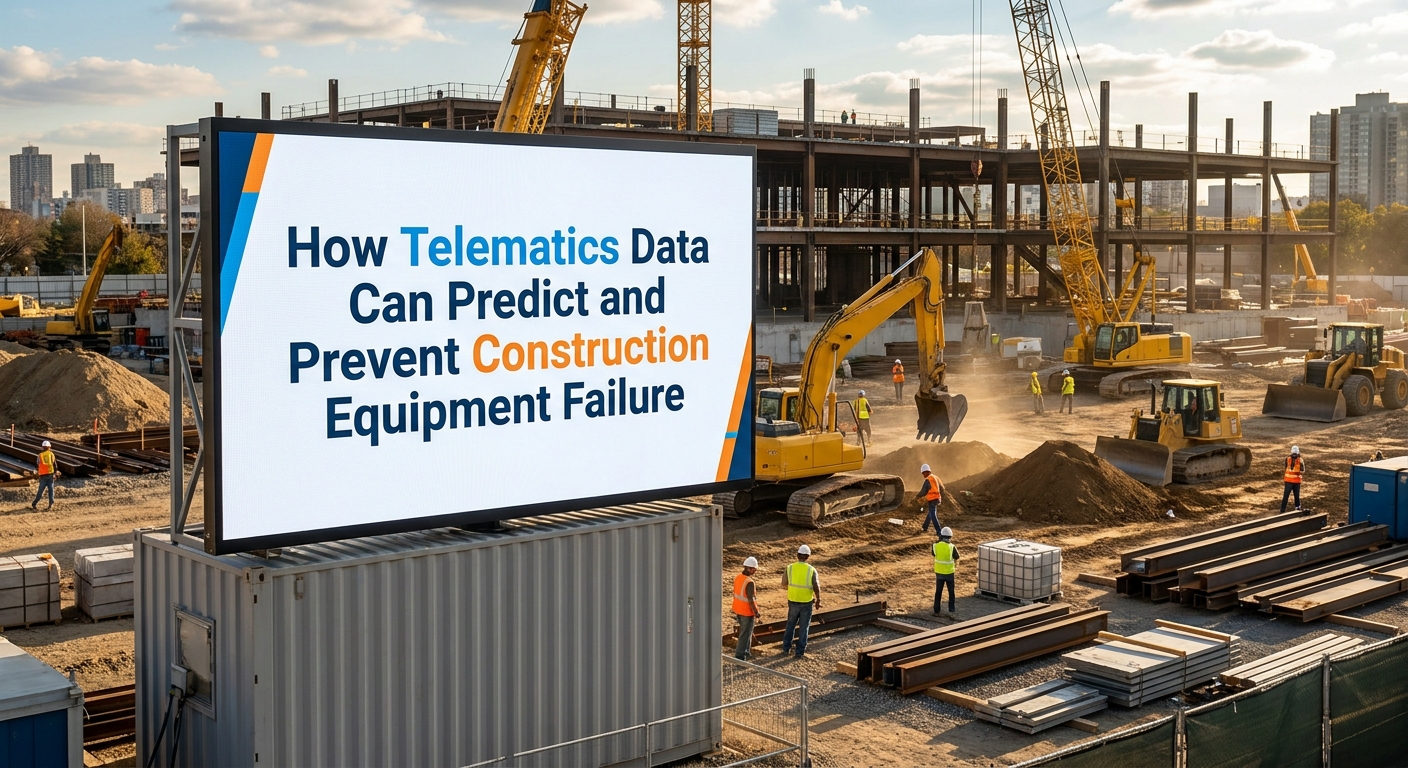
1. What Telematics Data Is and Why It Matters for Construction Equipment Failure
Telematics in construction is a technology system that combines GPS tracking, onboard sensors, diagnostic fault codes, engine hour meters, temperature gauges, pressure readings, and utilization data into one continuous stream of machine intelligence. Every time a piece of heavy equipment runs, telematics hardware is quietly collecting information – where the machine is, how long it has been operating, how hot the engine is running, whether any fault codes have been triggered, and how efficiently it is burning fuel. This data is transmitted in real time to a central platform where fleet managers and maintenance teams can access it from a computer or mobile device. The result is continuous, remote visibility into the health and condition of every machine on the jobsite, no matter how many assets a fleet has or how spread out they are across different projects.
This level of visibility matters enormously when it comes to preventing equipment failure. Traditionally, construction maintenance has been reactive – a machine breaks down, work stops, and the repair crew scrambles. Telematics changes that equation by giving teams the information they need to shift toward condition-based and predictive maintenance strategies. Instead of waiting for something to go wrong, fleet managers can spot warning signs early, schedule repairs during planned downtime, and keep machines running longer with fewer unexpected failures. The bottom line is better asset availability, lower repair costs, and far less disruption to project timelines. 🚧
2. How Telematics Predicts Failure Before Breakdowns Happen
The real power of telematics for failure prevention lies in pattern recognition. A single data reading from an engine temperature sensor might not tell you much on its own, but when that temperature reading is tracked over days and weeks, trends begin to emerge. If a machine’s coolant temperature is creeping up by a few degrees each week, that trend is a signal – even if the reading is still within the acceptable range. Telematics platforms can apply threshold rules and trend analysis to flag these gradual changes before they cross into dangerous territory. This kind of early detection is what separates teams that prevent failures from teams that are always reacting to them.
Analytics and artificial intelligence are taking this capability even further. By combining telematics with AI, construction firms can now process massive volumes of machine data and convert it into actionable failure predictions, automated alerts, and specific maintenance recommendations. AI models can be trained on historical failure data to recognize the exact patterns that tend to precede a hydraulic pump failure, a transmission breakdown, or an overheating event. Instead of a fleet manager manually reviewing hundreds of data points, the system surfaces the machines that need attention and explains why – making the whole process faster and more reliable. 🤖
There is also an important distinction between monitoring a single event and tracking gradual change over time. A sudden spike in hydraulic pressure might trigger an immediate alarm, but many equipment failures do not happen suddenly – they develop slowly. A transmission that is slowly losing pressure, a battery that is holding less charge each week, or a filter that is becoming increasingly restricted will all show up as gradual trends in telematics data long before they cause a breakdown. Effective failure prediction depends on detecting these slow-moving changes, not just reacting to the dramatic ones. That is why long-term trend monitoring is such a critical part of any telematics-based maintenance strategy.
3. Common Machine Data Signals That Indicate Impending Equipment Failure
Certain data points are consistently the most valuable for predicting construction equipment failure. Engine coolant temperature and hydraulic oil temperature are two of the most important, since overheating is a leading cause of component damage across almost every machine type. Transmission pressure, fuel consumption rates, battery voltage, vibration levels, and active diagnostic fault codes all provide critical windows into machine health. When any of these readings start behaving abnormally – climbing higher than usual, dropping below baseline, or fluctuating in ways they did not before – that is the system telling you something is changing inside the machine. ⚠️
The tricky part is that abnormal readings often show up as very small changes spread out over days or weeks, not as dramatic spikes that are easy to spot. A hydraulic system that is slowly developing a leak might show a pressure drop of just a few PSI per day. An engine that is starting to struggle with heat dissipation might run two or three degrees hotter than normal for a week before it becomes a real problem. These subtle shifts are easy to miss if you are relying on manual inspections or periodic service intervals. Telematics platforms that continuously log data make it possible to catch these early-stage changes before they turn into costly failures.
“This paper presents the development and validation efforts of a data-driven prognostics system that utilizes timely collected telematics data to monitor the equipment health condition and predict its failure hazard.” -University of British Columbia
To make this work effectively, fleet managers need to establish baselines for each machine type in their fleet. A baseline is a clear picture of what normal looks like for that specific machine under typical operating conditions. Once a baseline is established, the telematics platform can automatically flag any readings that deviate significantly from that normal range. Different machine types will have different baselines – a compact track loader operating in a hot climate will have different temperature norms than a large excavator working in cooler conditions. Customizing those baselines by machine type, age, and operating environment makes the alert system far more accurate and useful. 📊
4. Which Components Are Most Likely to Fail and How Telematics Helps Catch Them Early
Some components in construction equipment fail far more often than others, and knowing which ones to watch closely is half the battle. Cooling systems are a major source of failures – clogged radiators, failing water pumps, and degraded coolant all lead to overheating events that can destroy engines quickly. Hydraulic systems are another high-risk area, with seals, hoses, pumps, and cylinders all subject to wear and pressure-related failures. Batteries and electrical systems are increasingly critical as machines add more electronic controls. Transmission systems, air filters, fuel filters, and various sensors are also common failure points that can cascade into larger problems if left unaddressed.
[cta-call:Call2]
The good news is that each of these failure types produces a telematics signal that can expose the problem early. Rising coolant temperature trends point to cooling system issues before an overheat event occurs. Gradual hydraulic pressure drops signal seal wear or pump degradation before a line blows. Declining battery voltage trends warn of electrical system problems before a machine refuses to start. Repeated transmission-related fault codes indicate internal wear that needs attention before the transmission fails completely. By connecting each failure type to its corresponding telematics signal, maintenance teams can build a targeted monitoring plan that addresses the specific vulnerabilities of each machine in the fleet. 🔧
5. The Role of Preventive, Predictive, and Condition-Based Maintenance
It helps to understand the differences between the three main maintenance approaches before diving into how telematics supports each one. Preventive maintenance is the traditional approach – service is performed on a fixed schedule based on time or engine hours, regardless of the machine’s actual condition. Predictive maintenance goes a step further by using data to anticipate when a failure is likely to occur and scheduling service just before that point. Condition-based maintenance is closely related but focuses specifically on the real-time health of the machine, triggering service when monitored parameters indicate that a component is deteriorating. All three approaches have a place in a modern fleet maintenance program, and telematics supports all of them.
“Pressure drops 10-15% over 2-3 weeks predict component failure.” -Heavy Vehicle Inspection
The key difference between fixed-interval servicing and condition-based or predictive maintenance is efficiency. Fixed-interval maintenance often results in either over-servicing machines that are in good condition or under-servicing machines that are working harder than expected. A dozer running 12-hour shifts in harsh conditions may need an oil change long before the scheduled interval, while a compact excavator used lightly on a small project may be perfectly fine going beyond the standard interval. Telematics gives managers the actual usage and condition data they need to make smarter decisions about when each machine truly needs service, rather than defaulting to a one-size-fits-all schedule.
Industry authorities consistently emphasize that proactive maintenance is one of the most effective ways to lower the total cost of owning and operating heavy equipment. When teams evaluate equipment health using real data and act on that information before failures occur, they avoid the expensive chain reaction that follows an unplanned breakdown – emergency labor, expedited parts shipping, machine recovery, and project delays. Condition monitoring, when done well, is not just a maintenance strategy – it is a business strategy that directly improves the profitability and reliability of construction operations. 💡
6. How Telematics Data Reduces Unplanned Downtime and Emergency Repairs
One of the most immediate and measurable benefits of telematics-based maintenance is the reduction of unplanned downtime. When a telematics system detects an early warning sign – a rising temperature trend, a pressure drop, or a recurring fault code – it gives the maintenance team time to respond before the machine fails in the field. That means repairs can be scheduled during planned downtime windows, such as overnight, on weekends, or during natural breaks in the project schedule. Instead of a machine going down mid-shift and bringing work to a halt, the problem is addressed at a time that minimizes disruption. That is a fundamentally different and better way to run a fleet. 📅
The operational benefits extend well beyond just avoiding a single breakdown. Fewer unplanned failures mean fewer emergency roadside service calls, which are expensive and logistically complicated on remote jobsites. Overtime labor costs drop because technicians are not scrambling to respond to breakdowns at inconvenient hours. Towing and machine recovery costs – which can run into thousands of dollars for large equipment – are largely eliminated. Project schedules stay on track because critical machines are available when they are needed. Over the course of a construction season, these savings add up to a significant improvement in fleet operating costs and project profitability.
“By combining telematics (the remote monitoring of equipment via sensors and GPS) with artificial intelligence, construction firms can predict problems before they happen.” -Neuroject
7. How to Set Up a Telematics-Based Failure Prevention Program
Getting a telematics-based failure prevention program off the ground starts with the basics: making sure the right hardware is installed on every machine in the fleet. Some newer equipment comes with factory-installed telematics systems, while older machines may need aftermarket devices added. Once the hardware is in place, the next step is collecting baseline data – ideally several weeks of normal operating data for each machine type. During this period, the focus should be on identifying which machines carry the highest risk based on age, usage intensity, maintenance history, and known problem areas. High-risk machines should be prioritized for closer monitoring from the start. 🏗️
After baselines are established, the next step is configuring the alert system. This means setting specific thresholds for each key parameter – temperature limits, pressure ranges, voltage levels, fault code categories – and deciding what happens when a threshold is crossed. Alerts should be tiered by severity, with low-priority notifications going to maintenance planners and high-priority alerts escalating immediately to supervisors or senior technicians. Clear escalation rules ensure that critical warnings do not get lost in a flood of lower-priority notifications. The goal is to make sure the right person gets the right information at the right time, every time.
The final piece of the setup puzzle is connecting telematics alerts to the maintenance workflow. The most effective programs automate work order creation so that when a machine triggers a maintenance alert, a service ticket is generated automatically in the fleet management or maintenance management system. This eliminates the gap between detecting a problem and actually scheduling a repair. Technicians can see the alert details, the machine’s location, and the recommended service action all in one place. When telematics data flows directly into maintenance planning, the whole process becomes faster, more organized, and less dependent on manual follow-up. ✅
8. Telematics Use Cases Across Different Construction Machines and Jobsite Conditions
Telematics can be applied across virtually every type of construction equipment, and the use cases are compelling for each machine class. Excavators benefit from hydraulic pressure and temperature monitoring that can catch seal wear and pump degradation early. Dozers and motor graders generate valuable data through transmission temperature and drive system diagnostics. Wheel loaders and haul trucks can be monitored for tire pressure, brake system health, and engine load patterns. Tower cranes and mobile cranes benefit from structural stress monitoring and electrical system oversight. Even compact equipment like skid steers and mini excavators, as well as generators and light towers, can be connected to telematics systems that track runtime, fuel consumption, and fault codes. 🏗️
“Industry benchmarks consistently show that construction fleets implementing telematics-driven maintenance programs can reduce overall maintenance costs by 18% to 31%.” -Nektar
What managers monitor should vary depending on the machine type, its duty cycle, the environment it operates in, and how operators are using it. A haul truck running loaded cycles up steep grades in a hot climate puts extreme stress on its drivetrain and cooling system, so those systems deserve the most attention. A crane operating in a coastal environment may face accelerated corrosion and electrical system issues. Compact equipment used by multiple operators may show more operator-behavior-related wear patterns. Understanding the specific risk profile of each asset class allows fleet managers to customize their monitoring strategy and make sure the alerts they receive are relevant, accurate, and actionable for that particular machine.
9. How Telematics Improves Safety, Reliability, and Asset Life Cycle Value
Preventing equipment failure is not just about saving money – it is also about protecting people. A machine that overheats and catches fire, a hydraulic line that fails suddenly and sprays hot fluid, an electrical fault that causes a short circuit, or a tire blowout on a loaded haul truck are all serious safety hazards. Telematics helps prevent these events by catching the warning signs before they escalate into dangerous situations. When fleet managers can monitor hydraulic system health, cooling system performance, electrical system voltage, and tire pressure in real time, they have a powerful tool for keeping operators safe and reducing the likelihood of equipment-related incidents on the jobsite. 🦺
Beyond safety, condition-based maintenance directly extends the useful life of construction equipment. Machines that are serviced based on their actual condition – rather than being run to failure or over-serviced unnecessarily – tend to reach their full lifecycle potential with fewer major component replacements. This also protects resale value, since well-maintained equipment with complete service records commands significantly higher prices on the secondary market. Every hour of additional productive life that a machine delivers because of smart, data-driven maintenance represents real financial value for the fleet owner. In an industry where equipment represents one of the largest capital investments a company makes, that matters a great deal.
10. Costs, ROI, and the Business Case for Predictive Maintenance Using Telematics
The cost savings from telematics-based predictive maintenance show up in several places at once. Fewer unexpected failures mean lower emergency repair costs, which are typically two to three times more expensive than planned repairs due to overtime labor, expedited parts, and machine recovery expenses. Better parts planning means maintenance teams can order components in advance at standard prices rather than paying a premium for rush delivery. Reduced downtime means machines are generating revenue more of the time. And catching small problems before they cascade into major failures means that a $200 sensor replacement does not turn into a $20,000 engine rebuild. 💰
Fleet efficiency also improves when maintenance is driven by actual condition and usage data rather than fixed schedules. Machines that are in good condition stay in the field longer. Machines that are showing signs of deterioration get pulled for service at the right time – not too early, not too late. This smarter timing of maintenance activities reduces the total number of service events while also reducing the severity of repairs, since problems are caught at an earlier stage. The result is a fleet that is more productive, more reliable, and less expensive to operate over the course of a project or a construction season.
Fleet managers and executives who want to measure the ROI of telematics-based predictive maintenance typically track a handful of key metrics. Downtime reduction – measured as a percentage decrease in unplanned out-of-service hours – is one of the most direct indicators of success. Maintenance cost per machine hour is another important metric that should trend downward as predictive maintenance matures. Overall equipment availability, which measures the percentage of time machines are ready to work, should improve. And total asset lifespan, measured in engine hours or years of productive service, should extend as machines receive better, more timely care. Tracking these metrics over time builds the business case for continued investment in telematics technology. 📈
11. Challenges, Limitations, and Best Practices When Using Telematics Data
Telematics is a powerful tool, but it is not without its challenges. Data quality is one of the most common problems – if sensors are damaged, improperly calibrated, or not installed correctly, the data they produce will be unreliable. Missing sensor coverage on older machines means that some assets may have significant blind spots in their monitoring. False alerts are another real issue: if thresholds are set too aggressively, maintenance teams can quickly become overwhelmed with notifications that do not represent genuine problems, leading to alert fatigue where real warnings get ignored. Inconsistent baseline settings across different machine types can also produce misleading results that undermine trust in the system. ⚙️
Human expertise remains essential even in the most advanced telematics programs. Data can tell you that something is changing, but it takes an experienced technician or maintenance manager to interpret what that change actually means in the context of a specific machine, its operating environment, and its history. Over-reliance on automated alerts without human verification can lead to unnecessary repairs or, worse, missed problems that the system did not flag correctly. The best telematics programs treat data as a powerful input to human decision-making, not a replacement for it. Technicians who understand both the data and the machines are the ones who get the most value out of these systems.
Following a few key best practices will dramatically improve the effectiveness of any telematics-based maintenance program. Start by choosing the right KPIs for each machine type rather than trying to monitor everything at once – focus on the signals that matter most for that equipment’s known failure modes. Invest in training so that maintenance staff understand how to read and act on telematics data. Review alert thresholds regularly and adjust them as you gather more data and learn more about each machine’s normal behavior. And make sure telematics data flows directly into your maintenance management workflow so that alerts translate into action quickly and consistently. The technology is only as good as the processes built around it. 🎯
12. FAQ: Common Questions About How Telematics Data Can Predict and Prevent Construction Equipment Failure
Many fleet managers and construction professionals are still in the early stages of understanding how telematics connects to equipment failure prevention, so it helps to address the most common questions directly. Telematics in construction equipment refers to the combination of GPS tracking, onboard sensors, and diagnostic systems that collect and transmit real-time data about a machine’s location, health, and performance. Telematics predicts machine failure by continuously monitoring key parameters – like temperature, pressure, voltage, and fault codes – and using trend analysis or AI to identify patterns that historically precede a breakdown. The data points fleet managers should watch most closely include engine and hydraulic temperatures, transmission pressure, battery voltage, fuel consumption trends, vibration levels, and active fault codes, since these are the most reliable early indicators of developing problems.
Yes, telematics can genuinely and significantly reduce both downtime and maintenance costs – but the results depend on how well the program is implemented and how consistently the data is acted upon. To start using telematics for predictive maintenance, a fleet needs to install compatible hardware on its machines, connect that hardware to a telematics platform, establish baselines for normal operating parameters, configure meaningful alert thresholds, and integrate the alert system with the maintenance workflow. It does not need to happen all at once – many successful programs start with the highest-risk machines and expand from there. The key is to start collecting data, learn from it, and build the program incrementally over time. 🚀
Conclusion: What Construction Teams Should Do Next With Telematics Data
Telematics data has fundamentally changed what is possible in construction equipment maintenance. The key takeaways from everything covered here are straightforward: telematics gives fleet managers continuous visibility into machine health, helps identify early warning signs of failure before they become breakdowns, supports smarter and more cost-effective maintenance decisions, and makes construction operations safer and more reliable. The shift from reactive to predictive maintenance is not just a technology upgrade – it is a strategic advantage that directly impacts project profitability, equipment longevity, and team safety. The tools to make this shift are available right now, and the construction companies using them are already seeing the results. 💪
If your fleet is not yet using telematics data for predictive maintenance, now is the time to start. Begin by auditing your current fleet data – what information are your machines already generating, and how much of it is being used for maintenance decisions? Identify your highest-risk assets based on age, usage intensity, and maintenance history, and make those machines the starting point for closer monitoring. From there, build a telematics-driven predictive maintenance plan that connects machine data to real maintenance actions, with clear alert thresholds, escalation rules, and workflow integrations. Every day that high-risk machines run without proper monitoring is a day that an expensive, avoidable breakdown could be developing. Take the data you have, put it to work, and start preventing failures before they happen. 🏆