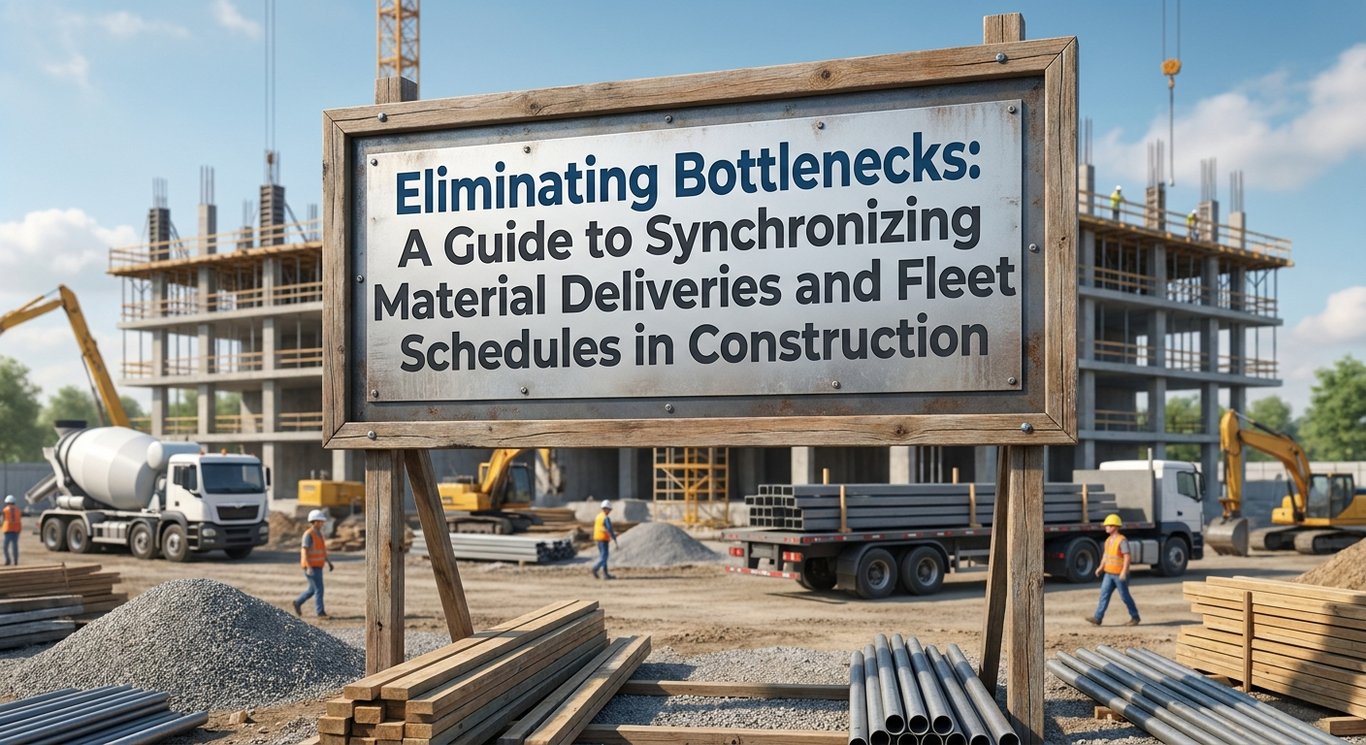
Eliminating Bottlenecks: A Guide to Synchronizing Material Deliveries and Fleet Schedules in Construction
Construction projects are complex machines with dozens of moving parts, and when material logistics and fleet operations fall out of sync, the whole machine starts grinding. Bottlenecks happen when deliveries arrive too early, too late, or all at once – leaving crews standing around with nothing to do or scrambling to work around a congested site. Synchronization, in a construction context, means deliberately aligning when materials arrive, when trucks move, and when crews are ready to work so that everything flows together like a well-rehearsed performance. Without that alignment, the risks are very real: project delays stack up, idle crews burn through labor budgets, equipment sits unused, and cost overruns become almost inevitable. 🚧
The good news is that synchronization is achievable with the right strategies in place. This guide walks through the key approaches that construction teams can use to eliminate logistics bottlenecks and keep projects moving on time. The topics covered include phased material planning that matches deliveries to project milestones, integrated fleet routing that accounts for site realities, the use of digital tools to track and coordinate everything in real time, communication best practices with suppliers and drivers, and a framework for continuously monitoring and improving performance. Each of these strategies builds on the others, creating a system that’s far more resilient than any single fix on its own.
Understanding Bottlenecks in Construction Logistics
A bottleneck in construction logistics is any point in the supply chain or site operation where the flow of materials, vehicles, or labor slows down because demand exceeds capacity. 🚛 Think of it like a traffic jam on a highway – when too many trucks try to enter a job site at the same time, they back up onto the street, blocking access and wasting time. Or picture a framing crew that shows up on Monday morning ready to work, only to find that the lumber they need hasn’t been delivered yet. The crew gets paid to wait, the schedule slips, and the ripple effect moves through every task that was supposed to follow. These aren’t rare edge cases – they’re everyday realities on poorly coordinated job sites.
The root causes of these bottlenecks are usually predictable and preventable. Uncoordinated schedules between the project manager, logistics team, and suppliers are one of the biggest culprits, especially when everyone is working from different versions of the plan. Inaccurate material forecasts lead to either shortages or excess inventory that clogs up the site. Site congestion builds when too many vehicles arrive during the same window without a clear plan for where they go and how they unload. Last-mile issues – like narrow access roads, low bridges, or weight-restricted streets – can delay or even prevent deliveries entirely. And when a site has only one or two unloading areas, even a single slow truck can create a queue that backs up an entire afternoon’s worth of deliveries. Understanding these causes is the first step to solving them.
The measurable impact of these bottlenecks is hard to ignore. Extended project durations push overhead costs higher and trigger penalty clauses in contracts. Labor and equipment that sit idle still cost money – sometimes thousands of dollars per day. Safety risks increase when drivers rush to make up lost time or when congested sites create confusion about where vehicles and workers are supposed to be. And when projects run late and over budget, client dissatisfaction follows, making it harder to win future work. Bottlenecks aren’t just operational inconveniences – they’re financial and reputational threats.
Linking Project Phases, Material Needs, and Fleet Schedules
Every construction project moves through distinct phases – foundation work, structural framing, building enclosure, and interior finishes – and each phase has its own unique set of material and fleet requirements. During the foundation phase, you need concrete, rebar, and formwork, along with concrete mixer trucks and pump trucks. During framing, the focus shifts to lumber, steel, and engineered wood products, requiring flatbed trucks and forklifts for off-loading. These needs don’t just differ in what’s required – they also differ in volume, timing, and the type of equipment needed to handle them. Treating all phases the same way is a recipe for mismatches that create bottlenecks at every transition. 📋
Building a master schedule that maps project tasks to material arrival windows and required vehicle types is one of the most powerful tools a construction team can use. This schedule should specify not just what materials are needed and when, but also what kind of truck will deliver them, how long unloading will take, and what site equipment needs to be available to receive them. By mapping out these details in advance for each phase, project managers can spot potential conflicts before they happen – like two heavy deliveries scheduled for the same time slot through the same site gate. The master schedule becomes the single source of truth that suppliers, fleet operators, and site supervisors all work from, reducing the miscommunication that leads to congestion and shortages.
To make this concrete, consider a foundation pour: the project schedule should align concrete mixer truck arrivals with the availability of the pump truck and the readiness of the formwork crew, so that concrete is placed continuously without gaps or overflow. Similarly, during framing, lumber deliveries should be staggered across the day so that the forklift operator can unload each truck fully before the next one arrives, rather than having three trucks sitting in queue while one forklift scrambles to keep up. These kinds of real-world synchronizations are what turn a good plan into a smooth operation.
Planning Material Deliveries to Prevent Site Congestion
One of the most effective ways to prevent site congestion is to align material arrivals tightly with project phases and task sequences so that materials show up just in time – not days early, and definitely not after crews have been waiting. Just-in-time delivery reduces the amount of material stored on site at any given moment, which lowers the risk of damage from weather or forklift accidents, reduces double-handling, and keeps the site organized and navigable. 📦 When materials arrive too early, they pile up in laydown areas, block access routes, and create confusion about what’s been inspected and what hasn’t. When they arrive too late, crews go idle and the schedule bleeds time. The goal is a delivery rhythm that matches the pace of the work.
Achieving that rhythm requires some deliberate planning. Establishing clear delivery windows – specific time slots assigned to each supplier and material type – is a foundational practice that prevents multiple trucks from arriving at the same time. Consolidating orders where possible (combining smaller deliveries from the same supplier into one trip) reduces the total number of vehicle movements on and around the site. Defining dedicated delivery routes through the site and designated laydown areas for each material type ensures that drivers know exactly where to go without needing to ask, which speeds up turnaround time significantly. These techniques might sound basic, but they make an enormous difference in day-to-day site flow. 🗺️
“Prevent traffic bottlenecks: Stagger vehicle arrivals to avoid site congestion and delays at shift start times.” -Ideal Charter
When materials arrive, a quick inspection process should be built into the delivery window to check quantities and quality before the truck leaves. Catching a short shipment or a batch of damaged materials at the point of delivery is far less disruptive than discovering the problem hours later when a crew is ready to install. Early detection of these issues prevents secondary bottlenecks – like a framing crew that has to stop work because the lumber count was wrong – and reduces the costly rework that comes from using substandard materials.
Designing Fleet Routes and Schedules Around Site Realities
Fleet planning for a construction project can’t happen in isolation from what’s actually happening on and around the site. Subcontractor vehicles, material delivery trucks, crew shuttles, and equipment transporters all need to share the same access points, and if their arrivals aren’t coordinated, the result is a bottleneck at the gate that wastes everyone’s time. Local traffic patterns matter too – a delivery scheduled for 8:00 AM on a busy urban street might routinely arrive 45 minutes late because of rush-hour congestion, throwing off the entire day’s schedule. Effective fleet planning means taking all of these realities into account and designing routes and time slots that work in the real world, not just on paper. 🗂️
[cta-call:Call2]
Staggering vehicle arrivals is one of the simplest and most effective ways to prevent queuing at site entrances. Rather than scheduling all deliveries for the start of the shift, spreading them across the morning and afternoon ensures that unloading areas are never overwhelmed. Heavy vehicles should be routed on roads that can handle their weight and dimensions, both to avoid damage to infrastructure and to prevent breakdowns that block routes. For peak periods – like the start of a major pour or the delivery of a large prefabricated component – pre-booking logistics capacity in advance ensures that the right trucks and equipment are available when needed, rather than scrambling at the last minute. Planning ahead for these high-demand moments is what separates reactive logistics from proactive logistics.
Beyond the planning stage, driver feedback is a surprisingly valuable source of intelligence about what’s actually happening on the ground. Drivers who regularly service a site will notice patterns that don’t show up in scheduling software – a gate that’s consistently blocked by a parked subcontractor van, a turning radius that’s too tight for a loaded flatbed, or a time of day when a nearby school creates unexpected traffic. Building a simple feedback loop where drivers can report these issues – through a quick daily check-in or a shared messaging channel – helps the logistics team fix problems before they become chronic bottlenecks.
Using Digital Tools to Synchronize Deliveries and Fleet Movements
Modern construction projects generate a lot of moving pieces, and trying to track all of them with spreadsheets and phone calls quickly becomes unmanageable. Project management and advanced scheduling software brings material needs, delivery timelines, and resource assignments into a single environment where the whole team can see the current state of the plan and flag conflicts before they cause problems. 💻 Tools like Procore, Autodesk Build, or Primavera P6 allow project managers to link material procurement milestones directly to the construction schedule, so that when a task gets pushed back, the associated delivery window automatically updates. This kind of integrated visibility reduces the manual coordination burden and makes it much easier to keep logistics aligned with the evolving project plan.
“The first step in your strategy should be to align material arrivals with each construction phase.” -ARS Contracting
Transportation management systems (TMS) and GPS/telematics platforms add another layer of real-time visibility by tracking where trucks are, when they’re expected to arrive, and how they’re performing on their routes. Instead of calling a driver to find out where they are, a dispatcher can see their location on a live map and send updated instructions if conditions change. Real-time tracking also improves last-mile performance by flagging delays early enough to adjust receiving arrangements on site – like holding off on staging an unloading crew until the truck is confirmed to be nearby. These tools turn logistics from a reactive scramble into a proactive, data-driven operation. 📡
The real power comes from integrating these systems – connecting ERP platforms that manage procurement, warehouse management systems (WMS) that track inventory, and TMS platforms that manage transportation – into a unified control tower that gives logistics managers a near-real-time view of the entire supply chain. When a delivery is running late, the control tower can automatically flag the impact on downstream tasks, suggest alternative scheduling options, and notify the relevant site supervisors. This level of integration isn’t just for large contractors – even mid-sized firms can achieve meaningful integration by connecting a few key tools with simple APIs or shared dashboards.
Building Strong Communication Channels with Suppliers and Drivers
Even the best scheduling software can’t compensate for poor communication between the project team and its suppliers. Regular check-ins with key suppliers – weekly at a minimum, daily during critical phases – keep everyone aligned on upcoming delivery windows, quantities, and any changes to the schedule. Sharing the master schedule with suppliers, rather than just sending individual purchase orders, helps them understand the broader context of their deliveries and plan their own logistics accordingly. Designating a single point of contact on both the project team side and the supplier side eliminates the confusion that comes from multiple people giving conflicting instructions, and makes it much easier to resolve issues quickly when they arise. 📞
Communication with fleet operators and drivers is equally important, especially for day-of-delivery coordination when conditions on the ground can change rapidly. Drivers need to know the site access rules, the location of their designated unloading area, the contact number for the site supervisor, and what to do if they encounter a problem. Fleet operators need to be looped in on any schedule changes that affect their dispatch plan. Maintaining an open, two-way channel – whether through a dedicated messaging app, a logistics group chat, or a structured check-in call – means that issues get escalated and resolved in real time rather than discovered hours later when the damage is already done. 🤝
Clear protocols for handling disruptions are the final piece of the communication puzzle. When a delivery is delayed, a site access point is temporarily closed, or a safety incident affects traffic flow, every relevant party needs to know immediately so they can adjust. A simple notification protocol – who gets called first, what information needs to be shared, and what decisions can be made at each level – ensures that trucks can be rerouted or rescheduled before queues form and cascading delays set in. These protocols should be documented and shared with all parties before the project starts, not improvised in the heat of the moment.
“Define precise delivery time windows is vital. This allows construction teams to plan their activities around expected arrivals, thus maximizing productivity on-site.” -Cigo Tracker
Managing Last‑Mile and On‑Site Delivery Constraints
The last mile of a construction delivery is often the hardest part. Narrow roads in older neighborhoods, height and weight restrictions on bridges and overpasses, urban congestion during peak hours, limited staging areas near the site, and restricted delivery hours imposed by local authorities all create obstacles that can turn a simple delivery into a logistical puzzle. 🏙️ These constraints are especially challenging in dense urban environments where construction sites are squeezed between existing buildings, pedestrian traffic is heavy, and neighbors are quick to complain about noise and disruption. Ignoring these realities during the planning stage is one of the most common reasons that delivery schedules fall apart in practice.
The good news is that most last-mile constraints can be managed with the right strategies. Last-mile delivery planning – which means mapping out the specific route each truck will take from the highway to the site entrance, including any restrictions it will encounter – should be done before the project starts, not improvised by drivers on delivery day. Off-site consolidation hubs, where materials from multiple suppliers are received, sorted, and combined into site-ready loads, can dramatically reduce the number of individual truck movements to and from the site. Time-window deliveries during off-peak hours or overnight can bypass urban congestion entirely, though they require coordination with site security and may involve additional costs. Clearly marked access routes on site maps shared with all drivers remove the guesswork that causes trucks to wander and block traffic. 🗺️
On-site traffic flow design is just as important as the route planning that happens off-site. Separating delivery paths from worker pedestrian routes reduces both congestion and safety risks. Coordinating crane and hoist availability with scheduled deliveries ensures that materials can be lifted and placed immediately upon arrival, rather than sitting in the way while the crane is busy elsewhere. A well-designed on-site traffic plan, updated as the project progresses and the site layout changes, is one of the most cost-effective tools for keeping deliveries moving smoothly.
On‑Site Organization, Storage, and Inventory Control
A disorganized job site is a bottleneck waiting to happen. When trucks arrive and drivers can’t find their designated unloading area, or when crews spend 20 minutes searching for materials that were delivered yesterday, time and money disappear fast. Organized laydown areas with color-coded zones for different material types – concrete supplies here, lumber there, MEP materials in a third zone – make it immediately clear where everything belongs and where everything is. Clear signage that matches the site logistics plan ensures that drivers can navigate to the right spot without needing an escort, which speeds up turnaround time and reduces the bottleneck at the site entrance. 🟡🟢🔵
Inventory management doesn’t have to be high-tech to be effective, but it does need to be consistent. Barcodes, RFID tags, or even a well-maintained spreadsheet can provide accurate stock level data that prevents two of the most common logistics failures: stockouts that leave crews without materials, and over-ordering that fills the site with excess inventory that gets damaged or lost. Regular inventory counts – daily during high-activity phases – keep the data accurate and give the procurement team early warning when a reorder is needed. When inventory data is integrated with the project schedule, it becomes possible to trigger deliveries automatically when stock levels drop below a defined threshold, removing another manual coordination step. 📊
“Use statistical and AI based forecasting tools.” -YouTube
The connection between site organization and delivery efficiency is direct and measurable. When trucks can pull in, unload in a designated area that’s clear and accessible, and pull out without waiting for someone to move materials out of the way, turnaround times drop significantly. Multiply that improvement across dozens of deliveries per week and the cumulative time savings are substantial. A tidy, well-planned site isn’t just aesthetically pleasing – it’s a logistics asset that directly reduces the bottlenecks that cost projects time and money.
Risk Management and Contingency Planning for Delivery Delays
No matter how well a project is planned, disruptions will happen. Suppliers go out of business or face their own supply chain problems. Traffic accidents close key routes. Extreme weather delays both material production and transportation. Regulatory inspections hold up shipments at borders or weigh stations. Each of these risks can simultaneously disrupt material flow and throw fleet utilization into chaos – trucks that were supposed to deliver materials are now sitting idle, and crews that were supposed to be working are waiting. The projects that handle these disruptions best aren’t the ones with the best luck – they’re the ones with the best contingency plans. ⚠️
Building contingency into the logistics plan means identifying the most likely risks for each phase of the project and preparing specific responses in advance. Alternative suppliers for critical materials should be identified and pre-qualified before they’re needed, not during a crisis. Backup haulers who can step in if a primary carrier has a breakdown or capacity issue should be on a pre-approved list. Buffer times built into the schedule – especially before critical-path milestones – provide a cushion that absorbs minor delays without triggering a cascade of downstream problems. Critical-path analysis helps identify which deliveries have zero float and therefore need the most careful monitoring and the most robust backup plans. Pre-approved alternate routes for key deliveries mean that when a road is closed, drivers aren’t calling the dispatcher to ask what to do. 🔄
Contingency plans only work if the team knows what they are and has practiced using them. Documenting the plans in a format that’s accessible to everyone – not buried in a project management system that only the PM knows how to navigate – is essential. Running through “what if” scenarios during pre-construction planning meetings helps the team internalize the options and make faster decisions when real disruptions occur. When a problem hits, the goal is to shift schedules, resequence tasks, or reassign trucks within minutes, not hours.
Measuring, Monitoring, and Continuously Improving Logistics Performance
You can’t improve what you don’t measure, and construction logistics is no exception. Key performance indicators (KPIs) give the logistics team objective data to work with instead of relying on gut feelings about how things are going. The most useful KPIs for delivery and fleet synchronization include on-time delivery rate (what percentage of deliveries arrive within their scheduled window), average unloading time (how long it takes from truck arrival to departure), truck turnaround time (the total time a truck spends on site), idle crew hours (time crews spend waiting for materials or equipment), and schedule variance (how far actual progress deviates from the planned schedule). Tracking these metrics consistently creates a baseline that makes improvements visible and keeps the team accountable. 📈
“Construction managers should analyze historical delivery performance to estimate appropriate buffer periods for different material types.” -ARS Contracting
When KPIs reveal a problem, the next step is figuring out why it’s happening – and that requires digging into the data rather than jumping to conclusions. Monitoring work-in-progress (WIP) levels, cycle times, and capacity utilization can reveal where in the system the constraint actually lives. Value stream mapping – a technique borrowed from lean manufacturing – traces the flow of materials from supplier to point of use and highlights every step where time is being lost, whether to waiting, transport, processing, or rework. These analytical tools turn raw data into actionable insights that point directly at the root cause of a bottleneck rather than just its symptoms. 🔍
Regular coordination meetings and periodic schedule reviews are the human side of continuous improvement. Data tells you what’s happening, but it’s the conversations between project managers, site supervisors, logistics coordinators, and fleet operators that generate the ideas for fixing it. Daily stand-ups during high-activity phases keep everyone aligned on the day’s delivery plan and surface issues before they escalate. Weekly schedule reviews allow the team to update routing and delivery windows based on what they’ve learned, and to carry those lessons forward into future phases and future projects. Over time, this discipline of monitoring, reviewing, and refining turns good logistics management into an organizational capability.
Technology Adoption Roadmap for Construction Logistics Teams
Not every construction company is starting from the same place when it comes to technology, and that’s perfectly okay. A realistic roadmap for technology adoption starts where the team actually is. For companies still relying primarily on phone calls and spreadsheets, the first step is implementing a shared digital master schedule that all stakeholders can access and update in real time – even a well-structured Google Sheet is a significant improvement over disconnected email threads. From there, adding a simple delivery tracking app and basic telematics on fleet vehicles provides visibility that was previously impossible. As the team grows more comfortable with these tools and starts seeing results, the next step is moving to purpose-built construction project management software with integrated procurement and logistics modules. 🚀
Technology adoption fails more often because of people problems than technology problems. If the site superintendent doesn’t trust the new scheduling tool, they’ll keep their own parallel system, and the shared schedule becomes unreliable. Involving site teams and drivers in the tool selection process – asking them what problems they need solved and what features would actually help them – creates buy-in that makes adoption much more likely to stick. Pilot projects on a single phase or a single site allow the team to learn and adjust before rolling out to the whole organization. Setting realistic adoption milestones – “by the end of month two, all deliveries will be logged in the system” – gives everyone a clear target to work toward without overwhelming them with change all at once. 👷
Once these tools are in place and generating consistent data, they become a strategic asset that goes well beyond day-to-day coordination. Historical data on delivery performance, fleet utilization, and site productivity supports better forecasting for future projects, more accurate bids, and smarter decisions about fleet size and composition. Scenario planning tools can model the impact of different supplier choices or routing strategies before committing to them. And the relationships built with suppliers and fleet operators through consistent, data-driven communication become a competitive advantage in their own right.
Case‑Style Scenarios: Common Bottlenecks and How to Fix Them
Picture this: it’s 7:00 AM on a Monday morning, and three material delivery trucks, two subcontractor vans, and a crew shuttle all arrive at the site gate at the same time. The result is a queue that stretches back onto the main road, blocking traffic and frustrating everyone involved. The site supervisor spends the first hour of the day managing the chaos instead of running the work. This scenario plays out on construction sites all over the world, and it’s almost entirely preventable. The fix starts with mapping out every vehicle movement that’s expected during the first two hours of the shift and assigning each one a specific arrival window with at least a 15-minute buffer between them. Crew shuttles get a dedicated drop-off zone separate from the delivery entrance, so they don’t compete for the same access point. Suppliers are given written delivery windows as part of their purchase orders and briefed on the site access rules before their first delivery. Within a week of implementing these changes, the morning chaos disappears and the site supervisor gets their morning back. 🙌
Now consider a different problem: a structural steel crew keeps running out of work because the steel fabricator consistently delivers two to three days late, and there’s no backup plan. The crew sits idle, the schedule slips, and the project manager gets increasingly frustrated calls from the client. The root cause turns out to be a combination of inaccurate quantity forecasts (the fabricator is always surprised by last-minute scope changes) and a single-supplier dependency that leaves the project with no options when the primary supplier falls behind. The solution involves three changes: first, sharing a detailed four-week look-ahead schedule with the fabricator so they have enough lead time to plan their production; second, pre-qualifying a second steel supplier who can handle rush orders; and third, building a two-day buffer of pre-delivered steel into the site inventory so that minor delivery delays don’t immediately translate into idle crews. After implementing these changes, on-time delivery rates improve dramatically and the crew stays productive through the rest of the project. 💪
The lessons from these scenarios can be distilled into a practical checklist that any project team can apply. A daily delivery review each morning confirms the day’s scheduled deliveries, checks for any supplier alerts or traffic issues, and assigns a site contact for each delivery window. An access readiness check before each delivery window confirms that the unloading area is clear, the necessary equipment is available, and the receiving crew is in place. These two simple habits, done consistently, prevent the majority of the bottlenecks that plague construction logistics.
Frequently Asked Questions about Synchronizing Material Deliveries and Fleet Schedules
Q1: How do I start synchronizing deliveries and fleet schedules on an active project without causing more disruption? The best approach is to start with a clear picture of what’s currently happening before trying to change anything. Spend a day or two mapping the current flow of deliveries and vehicles – when they arrive, how long they take to unload, where the queues form, and when crews go idle. That mapping exercise will almost always reveal one or two bottlenecks that are causing the majority of the problems. Focus your first improvement effort on just those bottlenecks, in a limited scope – maybe one phase or one type of delivery – before rolling out changes more broadly. Small, visible wins build confidence and buy-in for bigger changes later.
Q2: What tools are most important for small and mid‑sized contractors to improve logistics coordination? For smaller teams, the essentials are simpler than you might think. A shared master schedule – even in a tool as basic as Google Sheets or Microsoft Excel – that all key stakeholders can access and update is the single most impactful starting point. Adding a simple delivery tracking app (many are free or low-cost) gives you visibility into what’s been ordered, what’s confirmed, and what’s arrived. Basic telematics on your own fleet vehicles – available through affordable plug-in devices – provides location tracking and arrival time data that dramatically reduces the “where’s my truck?” phone calls. These three tools, used consistently, deliver most of the coordination benefits of much more expensive systems.
Q3: How often should we review and adjust delivery and fleet schedules? The right frequency depends on the pace and complexity of the project. For large, fast-moving projects with multiple simultaneous trades and daily deliveries, a quick daily review – 15 minutes each morning – is essential to catch problems before they cascade. For smaller or slower-paced projects, a weekly review is usually sufficient to keep the schedule aligned with reality. During high-risk phases – like a major concrete pour, a critical material delivery, or a period of adverse weather – daily monitoring is always worth the time, regardless of project size. The key is to make these reviews a consistent habit rather than something that only happens when there’s already a problem.
Q4: How can we reduce last‑mile delivery problems in dense urban areas? Urban last-mile challenges require a combination of planning and flexibility. Consolidation centers – off-site facilities where materials from multiple suppliers are received and combined into site-ready loads – can dramatically reduce the number of individual truck trips to the site, which is especially valuable in areas with restricted delivery windows or limited staging space. Off-peak deliveries during early morning or evening hours bypass rush-hour congestion and often face fewer access restrictions. Close coordination with local distributors who know the area well, and proactive communication with local authorities about planned deliveries, can also open up options that aren’t available to teams who show up without warning. 🌆
Q5: What’s the best way to get suppliers and drivers to follow our time windows and site rules? Compliance with delivery windows and site rules is much higher when suppliers and drivers understand the reasoning behind them and feel like partners in the process rather than just vendors following orders. Pre-delivery briefings – a short meeting or a clear written guide shared before the first delivery – set expectations clearly and give suppliers and drivers the information they need to comply. Service level agreements (SLAs) that specify delivery window requirements and the consequences of non-compliance create accountability. Positive reinforcement works too – acknowledging suppliers who consistently perform well costs nothing and builds the kind of relationship where they’ll go the extra mile when you need a favor. And maintaining consistent two-way communication, where suppliers can flag problems before they become your problem, is the most effective way to prevent compliance issues from developing in the first place. 🤝
Conclusion: Turning Synchronization into a Competitive Advantage
At its core, eliminating bottlenecks in construction logistics is about one thing: making sure the right materials arrive at the right place at the right time, with the right vehicles and equipment ready to handle them. When material deliveries and fleet schedules are synchronized, the benefits compound quickly – delays shrink, labor and equipment costs drop, safety improves because sites are less chaotic, and project predictability increases to a level that clients notice and appreciate. The strategies covered in this guide – planning deliveries by project phase, designing smart delivery windows, building organized sites with clear laydown zones, leveraging digital tools for real-time visibility, and maintaining strong communication with suppliers and drivers – don’t work in isolation. They work together as a system, each one reinforcing the others to create a logistics operation that’s genuinely resilient. 🏆
The key takeaways from this guide are worth holding onto as you move forward. Real-time visibility into where materials are and where trucks are is no longer a luxury – it’s a baseline expectation for any project that wants to stay on schedule. Strong, consistent communication with suppliers and drivers is the connective tissue that holds the logistics system together when things go sideways, as they inevitably will. Disciplined monitoring of KPIs like on-time delivery rate and truck turnaround time turns logistics management from guesswork into a data-driven practice that improves with every project. And proactive contingency planning – knowing in advance what you’ll do when a supplier fails or a road closes – is what separates teams that absorb disruptions from teams that get derailed by them. If you’re ready to take action, start by auditing your current logistics processes on your next project: identify one or two critical bottlenecks, pick two or three strategies from this guide that address them directly, and implement them with discipline. Treat the lessons from “Eliminating Bottlenecks: A Guide to Synchronizing Material Deliveries and Fleet Schedules in Construction” not as a one-time checklist but as an ongoing management discipline – because in construction, the teams that master logistics synchronization don’t just run better projects, they win more of them. 🚀