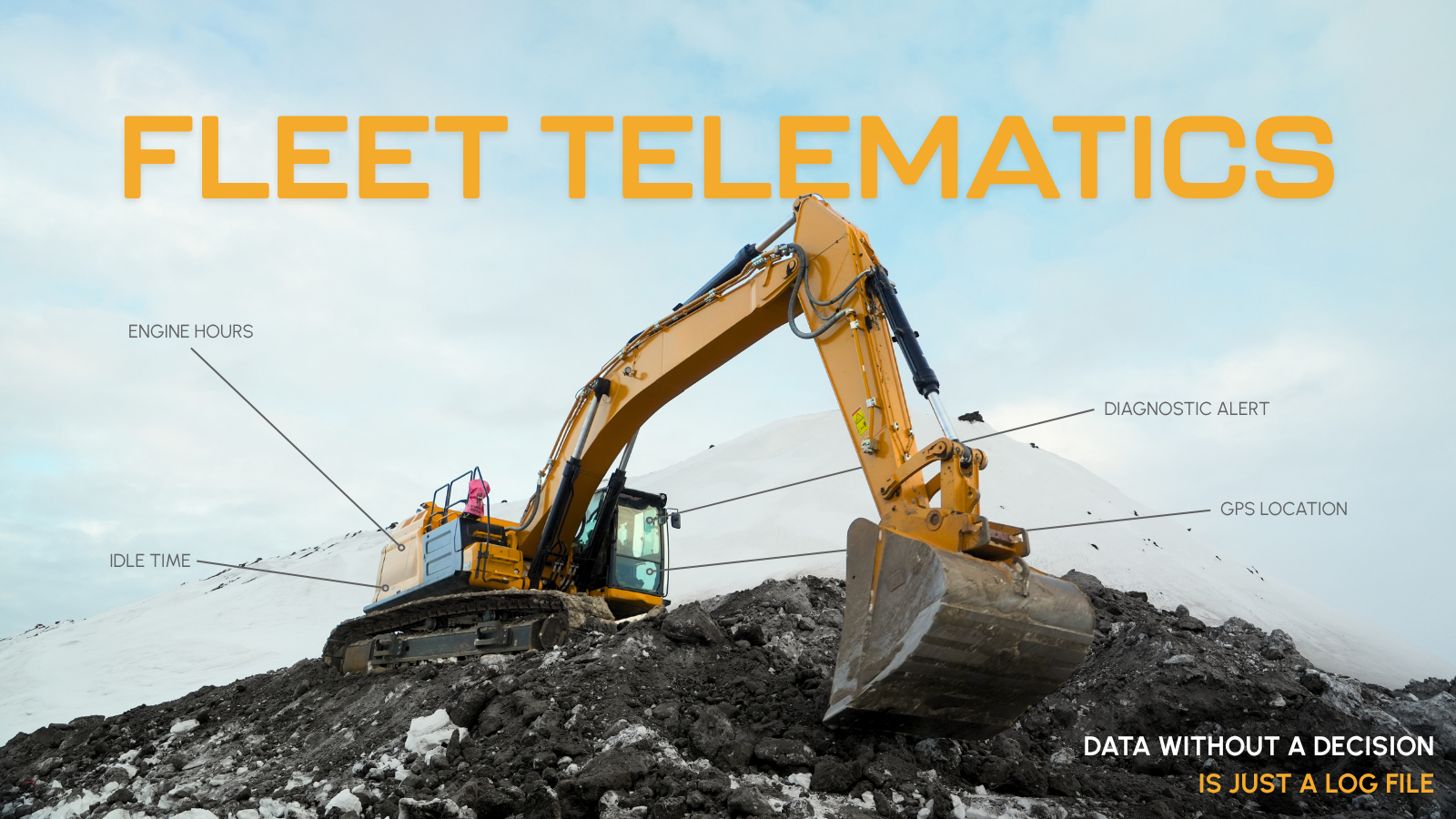
Most construction companies aren’t struggling to get telematics data anymore. They’re struggling to do anything with it. You’ve got GPS pings, engine hour logs, idle time reports, and diagnostic alerts flowing in from dozens of assets, and yet fleet managers still make allocation decisions by gut feel, and maintenance still happens reactively. The gap isn’t data collection. It’s the layer between data and decision.
Where telematics programs actually stall
- Dashboards nobody opens. Most platforms hand you a utilization report, not a recommendation. If a fleet manager has to log in, filter, and interpret before acting, the data competes with fifty other priorities, and it usually loses.
- No connection to job costing. Telematics tells you an excavator ran for 6.5 hours. It doesn’t tell you whether that time was billed to the right project code. Without a tie into your project management or ERP system, utilization data and cost data live in separate silos, which means fuel and labor overages go unnoticed until the project is already over budget.
- Maintenance alerts without ownership. A diagnostic alert fires. Who owns the follow-up: the fleet manager, the site super, the mechanic? In fleets without a clear workflow attached to the alert, “predictive maintenance” quietly becomes “another notification we ignored.”
- Utilization data with no benchmark. Knowing an asset ran 40% of available hours means nothing without a target. Is 40% good for a generator on a phased project? Bad for a compactor on an active pour schedule? Raw utilization numbers without segment-specific benchmarks lead to under- or over-fleeting decisions either way.
What separates fleets that get ROI from telematics
The fleets seeing real returns aren’t collecting more data. They’re closing the loop faster. That means utilization and idle data automatically tied to job cost codes, maintenance alerts routed to a specific owner with an SLA, and utilization benchmarks segmented by asset type and project phase, not fleet-wide averages.
The real question to ask your telematics vendor
Not “what data do you track?” (almost every platform tracks the same fields at this point). Ask instead: “What decision does this data make for me automatically, and what still requires a human to notice it?” If the answer is mostly the latter, you don’t have a telematics platform. You have a very expensive log file.