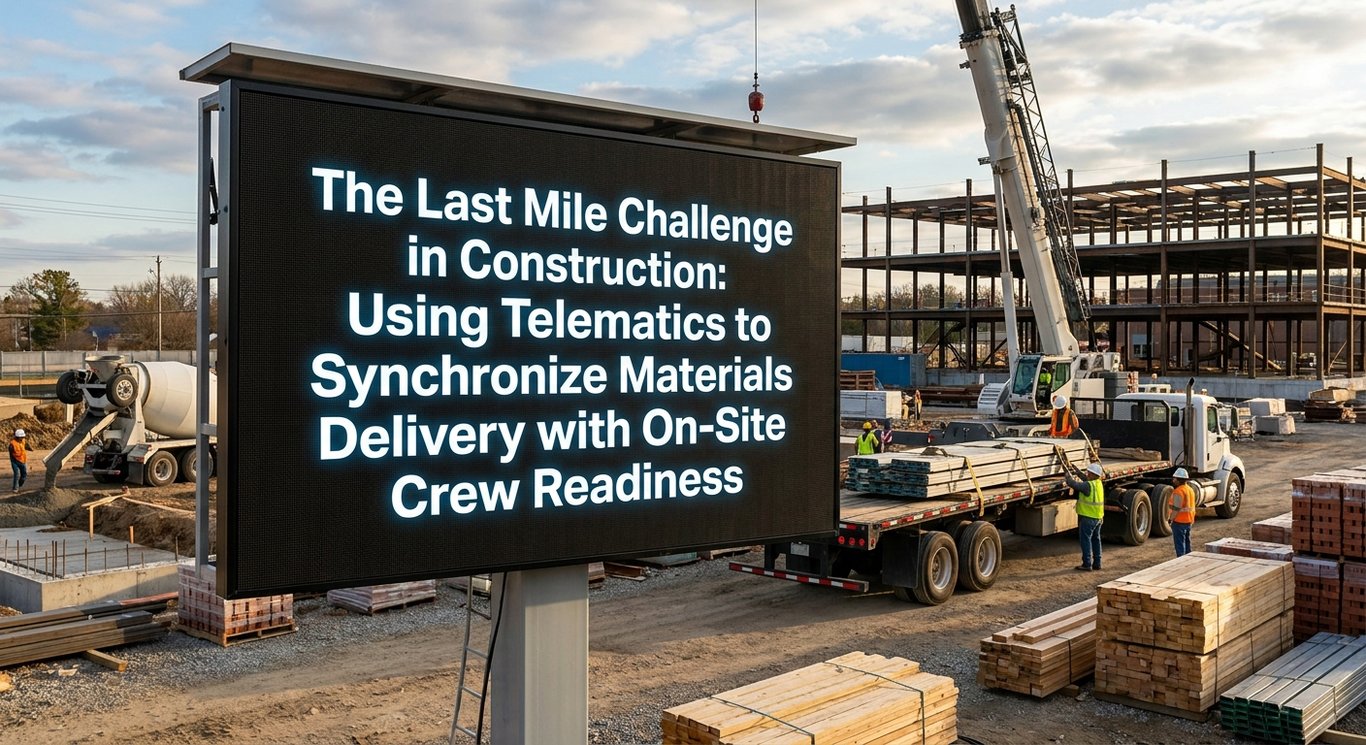
The Last Mile Challenge in Construction: Using Telematics to Synchronize Materials Delivery with On-Site Crew Readiness
In construction logistics, the “last mile” refers to that final, critical leg of a delivery journey – from a plant, depot, or distribution hub all the way to the active jobsite. It sounds simple enough, but anyone who has worked in construction knows this stretch can be an absolute nightmare. 😤 When materials arrive too late, crews stand around burning through labor budgets. When they arrive too early, trucks idle while sites scramble to get ready. Getting this timing right is not just about convenience – it directly impacts productivity, worker safety, and whether a project stays profitable. Telematics, in a construction context, brings together GPS tracking, onboard sensors, and cloud-based data platforms to give dispatchers, fleet managers, and site supervisors a shared, real-time picture of where every truck is and what it’s doing. That shared visibility is the foundation for finally getting deliveries and crew readiness in sync.
The pain points here are very real and very costly. Picture a line of ready-mix trucks queuing outside a site because the crew isn’t ready to pour yet. Or imagine a framing crew sitting idle for two hours because a steel delivery got caught in unexpected traffic with no one notified until the last minute. These situations lead to wasted man-hours, extended equipment rentals, rework risks, and in some cases, contract penalties for missed milestones. Leading fleet and construction software providers have recognized this gap and are now building integrated telematics, routing, and proof-of-delivery tools specifically designed to close it. The industry is moving fast, and firms that don’t keep up risk falling behind on both cost efficiency and client satisfaction.
This article is going to walk you through everything you need to know about tackling the last mile challenge with telematics. We’ll cover how telematics actually works in construction fleets, what data you need to collect, how to connect delivery ETAs with site readiness, and the practical steps to implement these systems. We’ll also dig into change management – because technology is only as good as the people using it – and we’ll quantify the measurable benefits you can expect. Along the way, we’ll answer the most common questions construction professionals ask about this topic. By the end, you’ll have a clear, expert-backed roadmap for turning last mile chaos into a genuine competitive advantage. 🏗️
Understanding the Last Mile Challenge in Construction Logistics
The last mile in construction logistics is not just a metaphor – it’s a specific operational zone where things tend to go sideways. It covers the final stretch from a plant or depot to the jobsite, where time-sensitive materials like ready-mix concrete, aggregates, prefabricated steel components, or specialty building products must arrive within tight windows that align with crew schedules, equipment availability, and site access conditions. Unlike retail or e-commerce deliveries, construction last-mile logistics carries enormous stakes. A missed concrete pour window doesn’t just mean a rescheduled delivery – it can mean structural rework, regulatory complications, and thousands of dollars in lost productivity.
The typical last mile issues in construction are frustratingly familiar to anyone in the industry. Arrival times are uncertain, real-time truck status is often unknown until a driver calls in, and site access restrictions – narrow gates, weight limits, shared access roads – add another layer of unpredictability. Project managers frequently have little to no visibility into where a delivery actually is until it either shows up or doesn’t. The downstream effects are serious: crews sit idle waiting for materials, work sequences get scrambled, and costs pile up in ways that are hard to recover from mid-project.
Solving the last mile challenge requires attacking it from two directions at once. On one side, you need logistics optimization – better routing, smarter scheduling, and more accurate forecasting. On the other side, you need operational coordination – site readiness planning, crew allocation, and clear communication protocols. Telematics is the data backbone that makes both sides work together. It creates a continuous flow of real-time information between the truck on the road and the team on the ground, turning what used to be a series of phone calls and guesses into a coordinated, data-driven operation. 📡
What Is Telematics and How Is It Used in Construction Fleet Management?
Construction telematics is the integration of GPS tracking, engine diagnostics, IoT sensors, and data analytics into vehicles and equipment, all feeding real-time information into cloud-based fleet management platforms. In practical terms, this means every truck in your fleet – whether it’s a ready-mix mixer, a flatbed hauling steel, or a dump truck moving aggregates – becomes a live data source. Managers can see exactly where each vehicle is, how it’s performing mechanically, and what stage of the delivery process it’s in, all from a single dashboard. It’s a significant leap from the clipboards and radio check-ins that many construction operations still rely on.
The key capabilities telematics brings to construction fleet management are wide-ranging and genuinely useful. You can track truck and equipment locations down to street level, monitor engine health and fuel consumption to catch problems before they cause breakdowns, log driver behavior like speeding or harsh braking, and capture detailed status events for each delivery – ticketed, en route, on site, unloading, and returning to the plant. This kind of granular, real-time data transforms fleet management from a reactive exercise into a proactive one, where you’re making informed decisions rather than constantly putting out fires.
The connection between telematics and last mile performance is direct and powerful. When a dispatcher knows a truck is running 20 minutes behind schedule, they can notify the site supervisor immediately. When a site supervisor sees that three trucks are 10 minutes out, they can have the crew staged and the access route cleared. Telematics provides accurate ETAs, sends alerts when delays occur, and gives full visibility into each phase of a trip – information that can be shared instantly with the people who need it most. That’s how you start turning last mile chaos into coordinated, efficient delivery operations. 🚛
“Real-time location tracking and route monitoring are the foundation of better material logistics. When you can see exactly where every delivery truck is at any moment, you can coordinate arrivals to prevent bottlenecks at the gate and ensure that the right crew and equipment are ready to receive and place materials as soon as they arrive.” -Nektar
Common Pain Points: When Deliveries and On-Site Crews Are Out of Sync
One of the most common and costly scenarios in construction logistics is when crews are ready and waiting but materials are nowhere to be seen. A truck gets stuck in unexpected traffic, a driver takes a wrong turn, or dispatch fails to communicate a route change – and suddenly a six-person crew is standing around at $50+ per hour per worker, doing nothing. Extended equipment rentals tick on, schedule buffers evaporate, and project managers start fielding uncomfortable calls from clients. These situations happen more often than they should, largely because the communication chain between dispatch, driver, and site manager is broken or non-existent in real time.
The opposite scenario is equally damaging, and arguably more frustrating. Materials arrive on time – great! – but the site isn’t ready. Maybe the groundworks aren’t complete, the receiving area is blocked by another subcontractor, or the crew hasn’t started their shift yet. Now the truck is sitting there, engine running, driver on the clock, and nobody can do anything about it. For perishable materials like ready-mix concrete, this isn’t just a cost problem – it’s a quality and safety risk. Concrete has a limited workability window, and if that window closes while the truck waits for site access, you’re looking at potential structural compromises and a very expensive day for everyone involved.
At the root of both these scenarios is a data gap. Dispatchers don’t have real-time visibility into site conditions. Site managers don’t have accurate truck ETAs. Telematics systems, transportation management platforms, and site planning tools operate in silos, never sharing information with each other. The result is a coordination vacuum that gets filled with phone calls, assumptions, and reactive firefighting. Bridging these data gaps is not a luxury – it’s a fundamental requirement for running a competitive, profitable construction operation in today’s environment. 📊
Key Telematics Data Needed to Synchronize Delivery and Crew Readiness
To actually synchronize deliveries with crew readiness, you need the right data flowing to the right people at the right time. The most critical data types are GPS location, current route and speed, estimated time of arrival, job status codes (ticketed, en route, on site, unloading, returning), and proof-of-delivery records. Together, these data points give dispatchers and site supervisors a live, accurate picture of exactly where every delivery stands at any given moment. Instead of calling a driver to ask “where are you?”, a supervisor can glance at a dashboard and see the truck is 8 minutes out – and start getting the crew ready accordingly.
[cta-call:Call2]
Beyond the basics, additional context data dramatically improves the quality of last mile decision-making. Driver behavior data – harsh braking, speeding, idling – helps identify risk factors that could cause delays or incidents. Vehicle health monitoring flags mechanical issues before they cause a breakdown mid-delivery. Geofencing around key sites creates automatic alerts when trucks enter or leave defined zones, eliminating the need for manual check-ins. And when telematics data is combined with order information from ERP or transportation management systems, you get a much richer picture that supports better forecasting and proactive risk management throughout the last mile.
There’s one more data category that often gets overlooked but is absolutely essential: site readiness data. This includes site access calendars, time windows for deliveries, crew schedules, equipment availability, and any safety constraints that affect when and how materials can be received. Telematics data on its own tells you where the truck is – but integrating that with site planning data tells you whether the site will actually be ready when the truck gets there. That integration is what transforms telematics from a tracking tool into a true synchronization engine for construction delivery operations. 🔗
“Transportation management systems and GPS/telematics platforms add real-time visibility by tracking where trucks are, when they’re expected to arrive, and how they’re performing on their routes. Real-time tracking improves last-mile performance by flagging delays early enough to adjust receiving arrangements on site-like holding off on staging an unloading crew until the truck is confirmed to be nearby.” -Nektar
Real-Time Visibility Platforms: Connecting Fleet, Dispatch, and Jobsite Teams
Real-time visibility platforms are the operational hub that makes last mile synchronization possible at scale. These platforms connect trucks, trailers, telematics providers, carriers, and subcontractors into a single, unified project view – so that everyone from the dispatcher to the site foreman is working from the same information. Without this centralization, you end up with fragmented visibility where each team has a piece of the puzzle but nobody has the full picture. Unified platforms eliminate that fragmentation and create the shared situational awareness that coordinated construction delivery demands.
The functionality these platforms offer is genuinely impressive when it’s working well. Live maps show the real-time positions of every vehicle in the fleet. Status dashboards display the current state of each load – whether it’s been dispatched, is en route, is on site, or has completed delivery. Geofence alerts fire automatically when trucks approach or leave sites, triggering notifications to the right people without anyone having to manually check in. Mobile apps give drivers and site supervisors a direct communication channel, so a driver can flag an issue and a supervisor can respond in real time without going through a dispatcher as a middleman.
Perhaps most importantly, these platforms enable rapid, informed decision-making when things don’t go according to plan – which in construction, is fairly often. 😅 If a truck is running significantly late, a site supervisor can see that immediately and decide whether to reassign the crew to a different task, call in an additional load from another plant, or adjust the delivery window. If a site becomes unavailable due to an inspection or safety issue, dispatch can redirect trucks before they waste time traveling to a site that can’t receive them. That kind of agile, data-driven coordination is what separates high-performing construction operations from those that are constantly reacting to problems they could have anticipated.
Linking ETAs, Site Calendars, and Crew Schedules with AI and Forecasting
The next frontier in last mile synchronization is AI-driven delivery forecasting – and it’s already here for construction firms willing to embrace it. These solutions ingest telematics data alongside weather forecasts, real-time traffic conditions, historical delivery patterns, and site readiness information to predict not just when a truck will arrive, but how likely that arrival is to be on time, how long unloading will take, and where the highest risk of disruption lies. That kind of predictive intelligence allows construction managers to shift from reactive problem-solving to proactive planning – a fundamentally different and far more efficient way to operate.
These AI systems don’t just generate predictions – they act on them by exchanging data with TMS, ERP, telematics platforms, and electronic proof-of-delivery workflows. When a risk score spikes because a truck is caught in unexpected congestion, the system can automatically trigger a notification to the site supervisor, propose a route adjustment to the driver, and update the site calendar to reflect the revised ETA. This kind of automated, closed-loop workflow reduces the cognitive burden on dispatchers and site managers while ensuring that the right people always have the most current information to make good decisions.
The practical day-to-day uses of these capabilities are genuinely game-changing for construction logistics. Imagine a site calendar that automatically updates based on live truck ETAs, so crew leaders always know exactly when to expect materials without having to chase down information. Or push notifications that alert a crew when their delivery is a specific distance away – say, 15 minutes out – so they can wrap up prep work and be ready to receive and unload efficiently. Or a system that automatically reprioritizes truck routes when a site reports it’s not ready, redirecting that load to another project that is ready and rescheduling the original delivery for the next available window. That’s the power of connecting AI forecasting with telematics and site planning data. 🤖
“AI agents automate the synchronization of deliveries with your construction sequence to prevent work stoppages that idle crews and equipment. They provide real-time visibility into delivery status so you can proactively adjust site layouts, crew schedules, or equipment positioning to accommodate incoming materials.” -Datagrid
Operational Workflows: From Dispatch to On-Site Unloading
Understanding how telematics-enabled workflows actually function in practice helps make the technology feel tangible rather than abstract. A typical workflow starts with order creation in an ERP or TMS system, where materials are requested, quantities are specified, and delivery windows are set. From there, route planning software optimizes the path from plant to site, and a truck is assigned based on availability, location, and load type. Once the truck departs, telematics tracking begins – the platform captures the vehicle’s position, speed, and status in real time, updating the ETA continuously as conditions change during transit. When the truck arrives and completes unloading, a mobile proof-of-delivery is captured, closing the loop and feeding data back into the system for invoicing and performance analysis.
On-site teams play an equally important role in making this workflow effective. Site supervisors monitor dispatch dashboards to stay ahead of incoming deliveries, using that information to prepare access routes, position unloading equipment, and stage crews in the right locations. When a delivery is 20 minutes out, the crew leader knows to wrap up whatever they’re doing and get into position. Safety protocols for unloading – traffic management, spotters, load securing – can be activated at the right time rather than scrambled together at the last minute. This level of preparation doesn’t just improve efficiency; it meaningfully reduces the risk of incidents during the high-risk unloading phase of the delivery process. 🦺
The most critical coordination moments in this workflow are the ones where synchronization either holds or breaks down. Confirming time slots before dispatch, dynamically reallocating crews when a truck reports a significant delay, and capturing immediate feedback on delivery issues – these are the touch points where good data and clear communication protocols make the biggest difference. When a delivery problem is logged in the system in real time, it doesn’t just help resolve the immediate situation – it also feeds into future planning, helping dispatchers and site managers build better schedules and avoid repeating the same mistakes. Continuous improvement is built into the workflow when the data infrastructure is set up correctly.
Benefits of Using Telematics to Align Materials Delivery and Crew Readiness
The direct operational benefits of telematics-driven last mile synchronization are substantial and measurable. On-time delivery performance improves because dispatchers have the visibility to proactively manage delays rather than discover them after the fact. Crews spend less time idle because they have accurate ETAs and can plan their activities around real delivery schedules. Trucks spend less time waiting at sites because site teams are prepared for arrivals. Fleet and equipment resources are utilized more efficiently because routing and scheduling are optimized based on actual conditions rather than best guesses. These improvements compound across a large project portfolio, generating significant cost savings.
The indirect benefits are equally compelling, even if they’re harder to put a dollar figure on. When deliveries are reliable and well-coordinated, clients notice – and that builds the kind of trust that leads to repeat business and referrals. For perishable materials like ready-mix concrete, better timing directly reduces quality risk, protecting both the structural integrity of the project and the firm’s professional reputation. Safety improves because unloading operations are better prepared and less rushed. And the auditable records generated by telematics and proof-of-delivery systems provide a defensible paper trail for contract disputes, insurance claims, and regulatory compliance requirements. 📋
Industry experts consistently point to fleet management software and telematics integration as key drivers of operational cost reduction, equipment utilization improvement, and worker safety enhancement in construction. The firms that are investing in these capabilities are not just solving a logistics problem – they’re building a structural advantage over competitors who are still managing last mile coordination through phone calls and spreadsheets. In a tight-margin industry where every hour of idle labor and every wasted truck trip erodes profitability, that advantage is not trivial. It’s the difference between winning and losing bids, and between delivering projects on time and on budget versus constantly explaining overruns to unhappy clients.
“A predictive ETA is a continuously updated arrival time built from live GPS, traffic conditions, driver-hours availability, route restrictions and weight class-and it is what allows the site to plan asphalt orders, pour windows, crane lifts and gate slots against reality rather than memory.” -CO3
Implementation Steps and Best Practices for Construction Firms
Getting telematics-driven last mile synchronization up and running doesn’t have to be an overwhelming undertaking – but it does require a structured, phased approach. Start by honestly assessing your current last mile performance: How often are deliveries late? How much crew idle time is attributable to material delays? How long do trucks typically wait at sites? This baseline data will define your starting point and help you measure progress. From there, select telematics and fleet management platforms that are specifically designed for construction delivery use cases – not generic logistics software that wasn’t built with jobsite complexity in mind. Then plan the integration with your existing ERP, TMS, and site planning tools, because the value of telematics multiplies when it’s connected to the rest of your operational data ecosystem.
Best practices for implementation are worth spelling out clearly, because the details matter a lot here. Define standard status codes that everyone in the organization uses consistently – “en route,” “on site,” “unloading,” “returning” – so that dashboards and reports mean the same thing to dispatchers in the office and supervisors on the ground. Configure geofences around your key delivery sites to automate alerts and reduce manual monitoring burden. Establish clear roles and responsibilities for who monitors dashboards, who acts on alerts, and who escalates issues when they arise. And set specific, measurable KPIs from day one – on-time delivery rate, truck waiting hours, crew idle time due to material delays – so you can track whether the system is actually delivering results. 📈
Change management is where many technology implementations succeed or fail, and telematics is no exception. Drivers need to understand how to use mobile apps for status updates and proof-of-delivery, and they need to trust that the data collected isn’t just being used to monitor them punitively. Crew leaders need training on how to read and act on dispatch dashboards. Data quality needs to be actively managed – garbage in, garbage out, as they say. Starting with a pilot project on a selected route or materials segment, rather than rolling out company-wide all at once, dramatically reduces risk and gives you a chance to work out the kinks before scaling. Build on early wins, gather feedback from the field, and iterate continuously. 🔄
Challenges, Risks, and How to Overcome Adoption Barriers
Let’s be honest about the barriers, because they’re real and ignoring them doesn’t make them go away. The upfront technology costs of telematics hardware, software licenses, and integration work can feel steep, especially for smaller firms. Many construction fleets are fragmented, with trucks from multiple OEMs running different telematics systems that don’t talk to each other easily. Field teams – drivers, crew leaders, foremen – often resist new technology, particularly when they feel it’s being imposed on them without adequate training or explanation. And there’s a legitimate concern about data overload: if a system generates too many alerts and notifications, people start ignoring all of them, which defeats the purpose entirely.
Fortunately, there are proven strategies for managing these risks. Choosing unified platforms that support mixed fleets and multiple telematics providers is essential – you shouldn’t have to replace every piece of hardware to get a coherent operational picture. Starting with high-impact, high-visibility use cases – ready-mix concrete delivery is a classic example because the time sensitivity is extreme and the benefits of better coordination are immediately obvious – helps build momentum and demonstrate ROI before expanding to more complex scenarios. And keeping the initial focus on simple, actionable metrics rather than sophisticated analytics prevents the data overload problem. Give people a small number of clear signals to act on, and let the complexity grow as capability and confidence build. 💪
Governance and continuous improvement are what sustain these gains over time. Regular reviews of last mile KPIs – monthly at minimum, weekly during high-intensity project phases – keep the focus sharp and surface emerging issues before they become serious problems. Structured feedback loops between dispatch teams and site teams are invaluable: the people on the ground often know exactly what’s not working, and giving them a formal channel to share that knowledge drives iterative improvement. Routes, status codes, geofence boundaries, and notification rules should all be treated as living configurations that get refined based on real-world performance data, not set-and-forget decisions made during initial implementation.
Future Trends: AI, IoT, and Integrated Construction Supply Chains
The future of last mile synchronization in construction is moving fast, and the direction is clear: more intelligence, more integration, and more automation. Advanced AI agents are emerging that can forecast delivery outcomes across entire project portfolios, not just individual loads. These systems combine telematics data with weather forecasts, traffic models, contract milestone data, and historical performance patterns to anticipate disruptions hours or even days in advance – and then orchestrate interventions automatically, adjusting routes, rescheduling crews, and flagging risks to the right people before they materialize. That’s a fundamentally different capability than today’s reactive alert systems, and it’s coming faster than many in the industry expect.
Deeper integration with Building Information Modeling (BIM) platforms and IoT-enabled jobsite sensors is another trend that will reshape last mile coordination. Imagine a smart jobsite where sensors monitor the status of groundworks, formwork, and equipment positioning in real time, and that data feeds directly into delivery scheduling systems. When the site is ready for a pour, the system knows – not because a supervisor made a phone call, but because the sensors confirmed it. Connected equipment management platforms can similarly signal when a crane or forklift is available to support unloading, enabling even tighter synchronization between material arrivals and the resources needed to handle them. 🔮
Taken together, these developments will move last mile coordination from reactive to predictive and ultimately to prescriptive – where systems don’t just tell you what’s happening or what might happen, but actively recommend and in some cases execute the best response. Construction firms that invest in building the data infrastructure and organizational capability for this future now will be positioned to operate at a level of efficiency and reliability that firms still relying on manual coordination simply won’t be able to match. The last mile challenge won’t disappear, but it will become a manageable, optimizable process rather than a daily source of chaos and cost.
FAQ: Common Questions About The Last Mile Challenge in Construction and Telematics
How does telematics improve ETA accuracy for construction material deliveries?
Telematics improves ETA accuracy by tracking vehicle locations and routes in real time, combining GPS data with live traffic conditions and historical delivery patterns to generate continuously updated arrival estimates. These ETAs are automatically shared with dispatchers and site managers through fleet management dashboards, so everyone is working from the same current information rather than an estimate made when the truck left the plant an hour ago. The result is far less uncertainty in delivery planning, which directly enables better crew scheduling and site preparation. 🎯
Can telematics help reduce truck waiting time at construction sites?
Yes, absolutely – and this is one of the most immediately measurable benefits of implementing telematics in construction delivery. By giving site teams accurate, live ETAs and real-time status updates, telematics allows sites to prepare for arrivals precisely, adjust time slots when delays occur, and redirect trucks when access constraints arise unexpectedly. Instead of a truck arriving to find a blocked gate and waiting 45 minutes while the site scrambles, the site knows the truck is coming and is ready. That reduction in waiting time translates directly into better asset utilization and lower operational costs across the fleet.
What systems should telematics integrate with to synchronize crews and deliveries?
Effective last mile synchronization requires telematics to be integrated with several other operational systems. Transportation management systems handle routing, scheduling, and load assignment. ERP and order management platforms carry the order data that defines what needs to be delivered, when, and where. Mobile proof-of-delivery solutions capture completion data at the jobsite. And site planning tools – including crew scheduling platforms and site access calendars – provide the operational context that determines whether a delivery can actually be received when it arrives. Connecting all of these into a closed-loop workflow is what enables true synchronization rather than just better tracking. 🔧
Is telematics only useful for large construction companies?
Not at all – this is a common misconception worth addressing directly. Small and mid-sized construction firms and building materials distributors face exactly the same last mile coordination challenges as large enterprises, and they often feel the financial impact of poor synchronization even more acutely because they have fewer resources to absorb the losses. Many telematics providers now offer scalable, modular solutions that allow smaller firms to start with basic GPS tracking and status monitoring, then add more sophisticated capabilities like AI-driven forecasting and ERP integration as their needs and budgets grow. The barrier to entry is much lower than it used to be. 😊
What are the key metrics to track when optimizing the last mile with telematics?
The most important metrics for last mile optimization with telematics include on-time delivery rate, which measures how often materials arrive within the agreed delivery window; truck waiting hours at sites, which captures how much time is lost to site unreadiness; and crew idle time attributable to material delays, which quantifies the labor cost of poor synchronization. Beyond these core metrics, tracking the number of re-routed or rescheduled loads helps identify systemic planning issues, safety incident rates during loading and unloading highlight operational risk, and overall delivery cost per ton or cubic meter provides the financial bottom line on whether your last mile operation is improving. 📊
Conclusion: Turning The Last Mile Challenge into a Strategic Advantage
The last mile challenge in construction is, at its core, a synchronization problem. Materials need to arrive when crews are ready, sites are accessible, and equipment is in position – and that alignment doesn’t happen by accident. It requires real-time visibility, accurate data, and coordinated workflows connecting the people and systems on both sides of the delivery equation. Telematics provides exactly that foundation: live truck locations, accurate ETAs, automated status updates, and the integration layer that connects fleet operations, dispatch, and jobsite teams into a unified operational picture. Firms that get this right see measurable improvements in on-time delivery, crew utilization, truck efficiency, safety, and client satisfaction. The benefits are real, they’re significant, and they’re achievable with today’s technology.
The key is to treat last mile synchronization as a strategic initiative, not just a technology project. Invest in integrated telematics and fleet management solutions that are built for the complexity of construction delivery. Align those tools with your site planning processes and crew scheduling practices so that the data flows where it needs to go. Start with clear KPIs so you can measure progress and demonstrate ROI. Foster a culture of data-driven coordination where dispatchers, drivers, and site supervisors all see themselves as part of the same team working toward the same outcome. If you haven’t already, take an honest look at your current last mile performance, identify your biggest pain points, and pilot telematics-enabled workflows on your most critical routes or projects. Then build from there, scaling what works and continuously refining your approach. The last mile doesn’t have to be your biggest headache – with the right tools and the right mindset, it can be one of your strongest competitive advantages. 🏆